Wordless Wednesday (well, almost)

Wordless Wednesday – 1947 floods and the 2012 flooding at Haddenham and Earith, Cambridgeshire. Both causing widespread disruption.

1947

My Great Grandmother receiving tinned goods from The Red Cross during the 1947 floods.

1947 - Red Cross suppliers


2012

The Great Ouse at Earith. The neighbouring village from where my Great Grandparents lived, cut off by flooding in December 2012. There’s a river in there somewhere.

Flooding in Earit, Cambridgeshire in 2012

My Top 5 Genealogy ‘to-dos’ for 2013

My top 5 genealogy things I hope to achieve in 2013 – a mixture of visits, writing and demolishing those research brick walls.

I don’t really go for New Year’s Resolutions, as I like to challenge myself on a daily basis, but I thought that I would put down 5 areas of my family tree research where I hope to make progress in 2013.

1. The Missing Bowers

If you use RootsChat.com, you may have spotted me trying to unravel the Bowers family of Burwell, Cambridgeshire. There’s quite a lot of them there during the 19th century, and amongst them i am sure, *should be* my Great Great Great Great Grandfather, Henry Bowers – yet there’s no sign of him in an appropriate part of the baptism registers, and unhelpfully he was born in about 1812 (so, well before that helpful 1st July 1837 date) and there’s no parents noted on his 1832 marriage entry in nearby Wicken. Henry’s children’s Burwell connections are frequent, yet he himself has yet to appear.

I feel that I’m beginning to make progress though, by researching all the Bowers in Burwell by cross-referencing the registers to census returns. Annoyingly, my favourite census – the 1851 for Burwell – is missing, and so this leaves a hole in the data.

I am determined to crack this one. Somehow.

2. My Time-traveling Great Great Great Great Great Grandmother

Elizabeth Yarrow‘s birth, death and burial dates and place of death is open to discussion as none of the key sources corroborate. A death in London, a burial in Stretham, a date of burial in Stretham differing from the date of burial (randomly) noted in the register for neighbouring hamlet Little Thetford, date of death and age different between burial registers and gravestone.

It’s all a mess… and with her 1837 death year, there’s also no suitable certificate to help iron it all out (the one i did excitedly find was for a small child). My 5x Great Grandmother’s life and death might be impossible to unravel unless I get my hands on some newspapers and some railway records.

3. Writing that book

So, for quite a while now I’ve been toying with writing up research into a book, but then the genealogist’s work is never ever finished – so at what point do I start and end the book? What do i include and omit? Having several friends who are published authors themselves helps, but I hope to be able to work out how, and start, to turn my years of research into something that can be shared in print and in eBook.

If you’re a published genealogy author – drop me a message – i’d love to hear about your experiences.

4. Visiting places familiar to my ancestors

I’m quite good at this, mainly because few strayed from Cambridgeshire. Top of my list is to find the building (or site) of my Great Grandmother’s birthplace – The Stables, Abercorn Place, Kilburn. I’ve meandered the streets via Google Streetview, and I’ve been in the neighbouring streets (including the famous Abbey Road) where the family lived and worked… but this place remains unvisited.

5. Killing off my wicked Great x4 Grandmother

My Great x4 Grandmother, Mary Clarke ended up in court and eventually prison for neglecting, abusing and playing the role of wicked step-mother to her husband’s children during the mid-1800s. She’d already bore my Great x3 Grandmother and a brother outside of marriage and before becoming the wife of William Bailey of Botesdale, Suffolk. This was to be to their advantage, as they went on to escape the miserable family life that followed. No wonder my Great x3 Grandmother Caroline Clarke changed her name and hid her parentage. Meanwhile, after a couple of stints in the workhouse, and one in prison, Mary vanishes after 1881… but I’ve yet to kill her off.

Mary, i’m coming to get you!

What genealogy brick walls are you hoping to demolish in 2013? Is there something special you hope to achieve in the coming year?  Let me know in the comments below.

Alternatively, join in the conversation over on LinkedIn.

Encouraging children to take an interest in their genealogy

What motivates children to take an interest in genealogy?

I remember being about 11 or 12 and sitting in the front rooms of both sets of maternal Great Grandparents and being completely bored by tails of the war years. Whilst one Gt Grandfather saw action in Egypt and other places, whilst the other was with the Home Guard, yet to my child ears, they were so utterly boring.

As a child, I didn’t want to know about ‘The War’. It meant nothing to me, and I couldn’t comprehend the date, why people would want to fight each other, and certainly not the scale of what actually took place. My mother was the same – she too had spent many hours listening to the very same stories as a child, and had not been interested either.

Now, as an adult, with those Great Grandparents all deceased, I’m left with a gap. An unrecorded gap in oral history, in personal history, and with only a few pay-to-view scanned documents sitting in sites like Ancestry or FindMyPast.

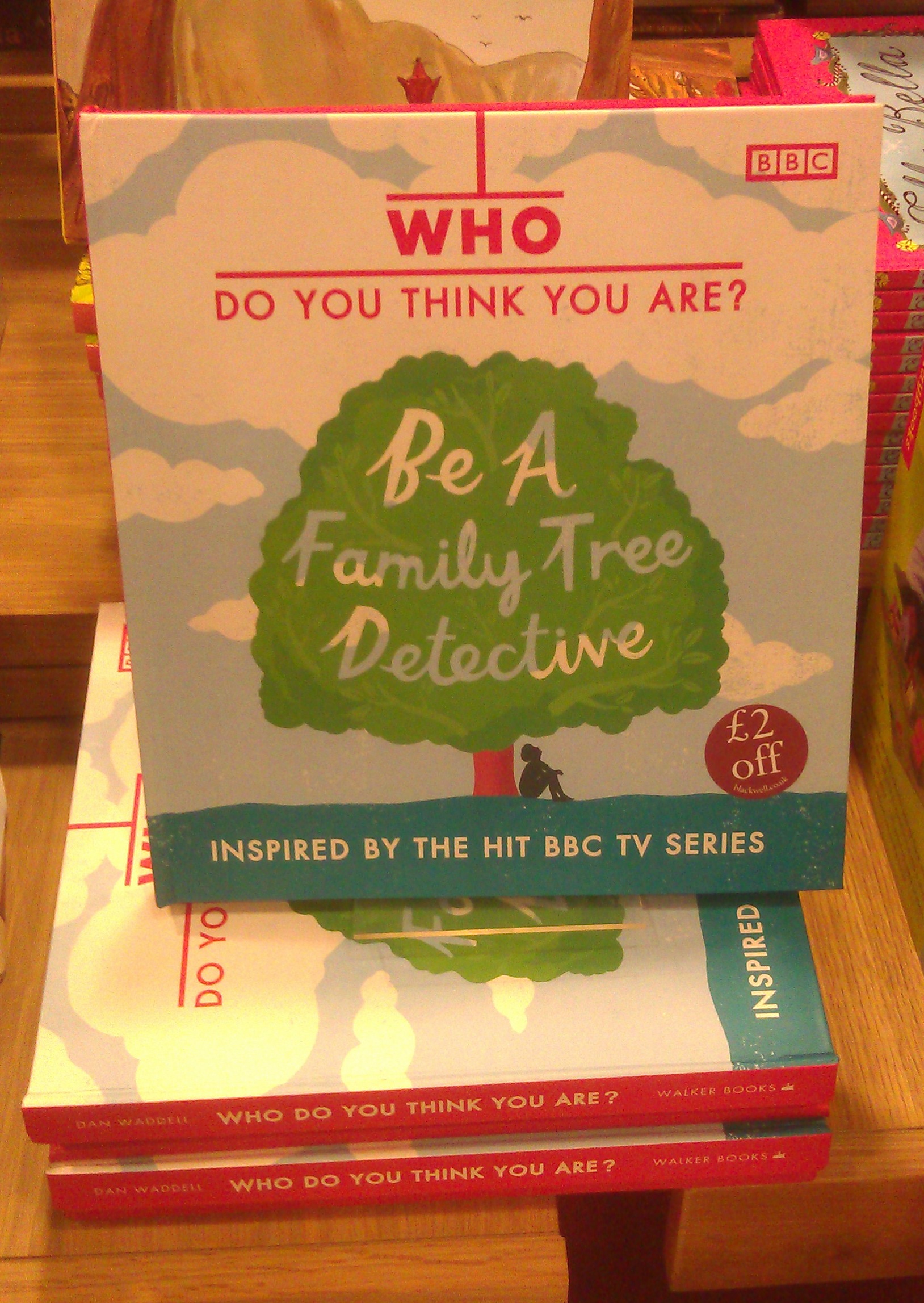
I was in Cambridge earlier today, picking up a few last minute Christmas presents when I spotted the following book from the Who Do You Think You Are? brand. I generally don’t buy genealogy books, as I rely on online information, but this one was different – it was aimed at children.

Be A Family Tree Detective book
Be A Family Tree Detective

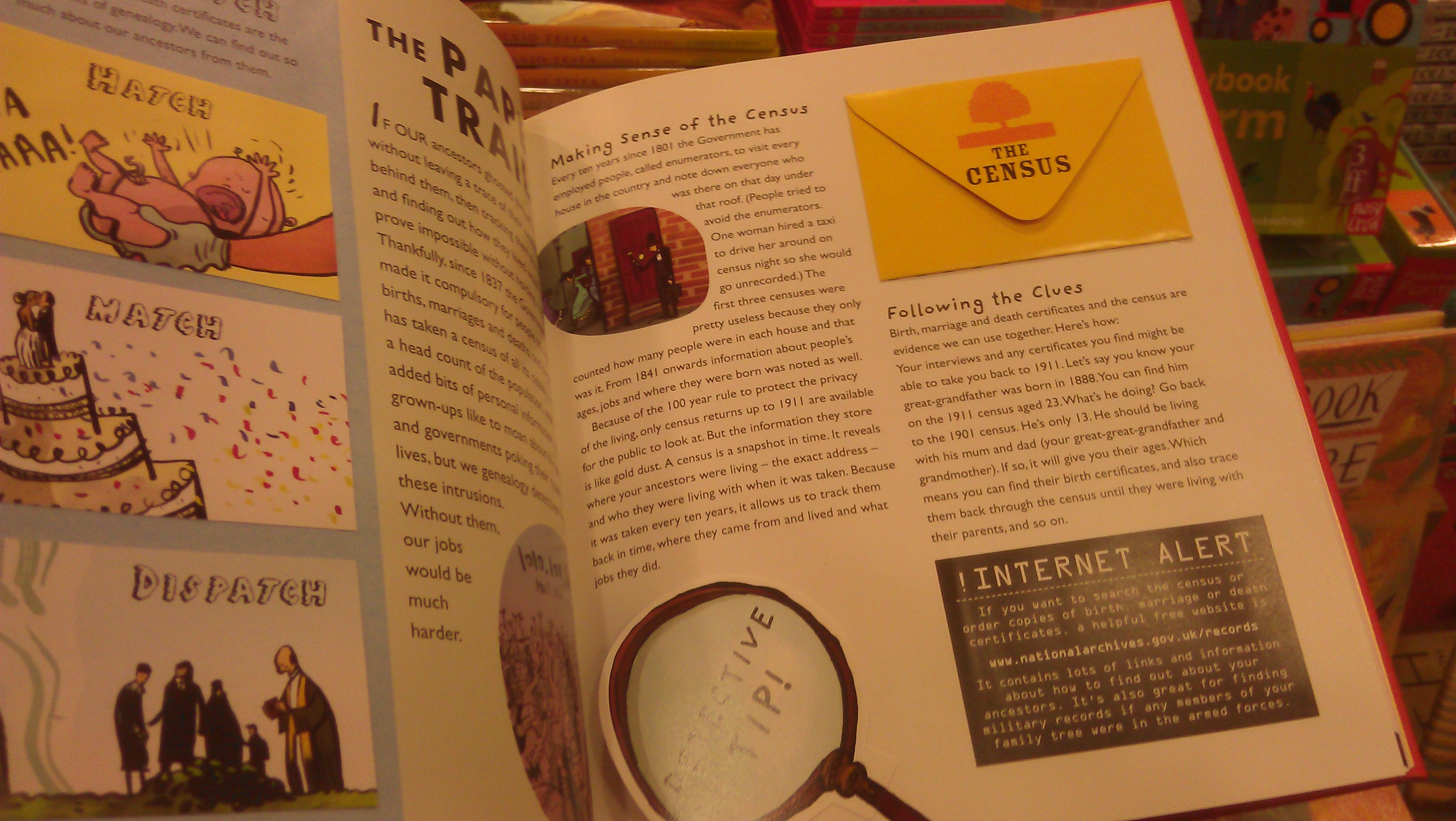
I picked it up and flicked through, to find that it was full of colourful pictures, flaps to reveal information, and more along the lines of a pop-up book (without the pop-up bit).

inside the Be A Family Detective book
Inside the book – open the envelope to look at Census, lift the magnifying glass to reveal a tip. 

I wondered what it was that inspired me to start (although admittedly i was 16/17yrs old) – knowing that it wasn’t anything like this. Had it have been, i would most likely have been hooked and written down the stories (or at least listened and perhaps remembered some of them) at a much younger age.

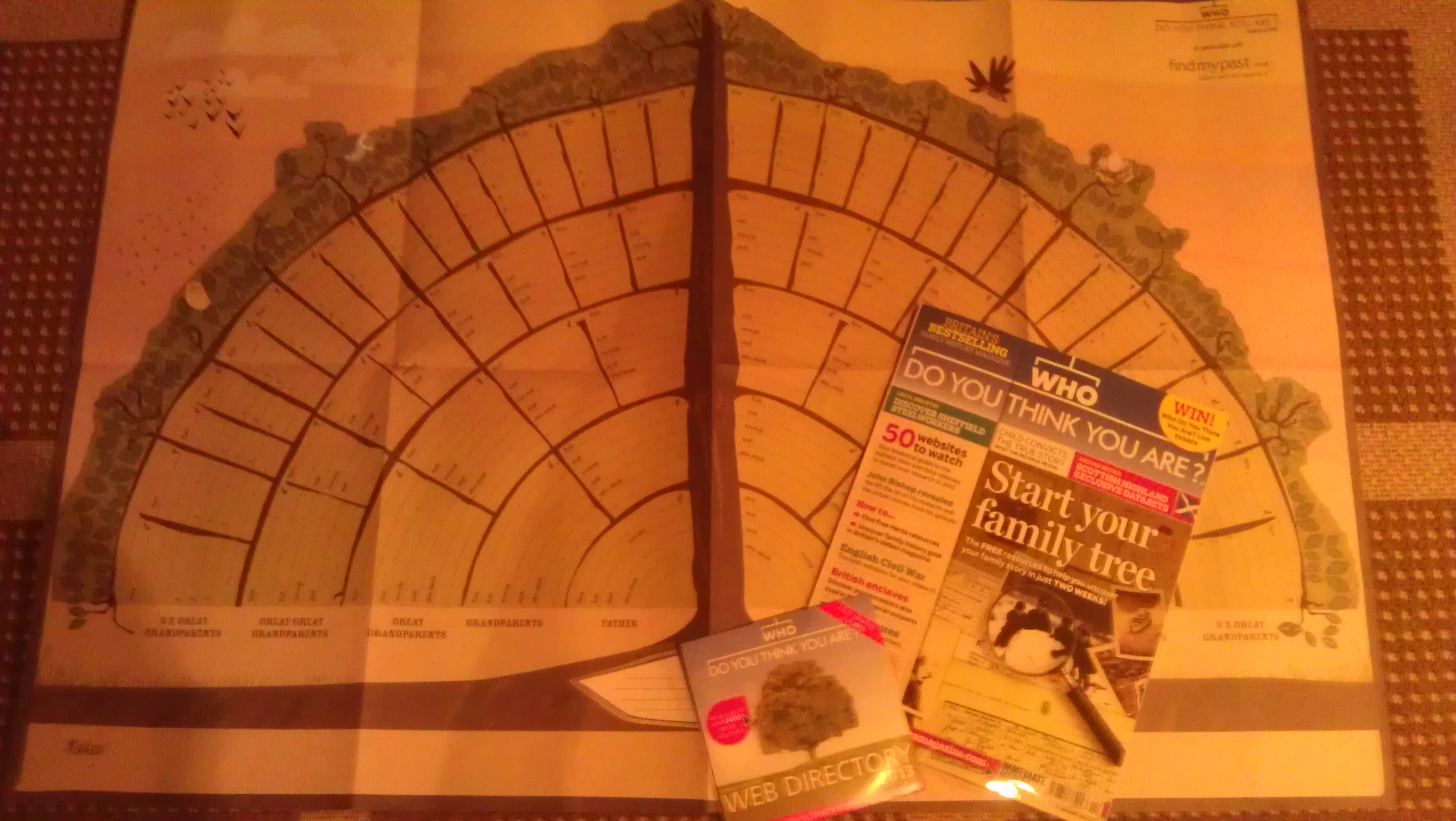
I also got home to find that Who Do You Think You Are? magazine had also landed on my doormat – the January edition – and inside was a great tree chart from FindMyPast – encouraging people to fill in their ancestors. What a great way to help inspire kids to think about the past lives of their family?

The free FindMyPast tree chart with the January 2013 edition of Who Do You Think You Are? magazine.

What was it that motivated you, and at what age?

The digital afterlife and the genealogist

What happens to our digital selves after our physical selves have died?

I was driving home when I heard Aleks Krotoski presenting this week’s Digital Human (BBC Radio 4, UK only), which covered the topic of death and how we continue to live on digitally after our physical death.

Digital Human on iPlayer (UK only)

This got me thinking about myself and how might my digital self and my digital assets exist and be of use to others, as a web-friendly genealogist.

Firstly, stop here for a moment and back up your genealogy research. Copy it and save it somewhere where another can find it. Also, think about how you’re filing your research – is it as simple as it can possibly be? What happens to your life’s work of research when you’re not around to explain it? Is it trapped behind a password? Is it stuffed in a filing system that would need Bletchley Park and Stephen Fry to unravel?

I’ve not thought about what happens to my website or this blog after my lifetime, but both are an extension of my research, which also sits in filing cabinets, folders and in my Reunion10 software on my Mac.

Genealogy website LostCousins has for many years, had a ‘My beneficiary’ option in your user account – where you can enter the email address of someone who can take over your research when you are no longer able to.

LostCousins 'My Beneficiary' field
LostCousins ‘My Beneficiary’ field

Should your websites, blogs and profiles be deleted like many people/families have Facebook profiles of the dead deleted? Is that the right thing to do? Some of the interviewees on Digital Human felt that making a Facebook profile a memorial was a heartwarming way to keep someone’s memory alive. Others may be upset about the continuation of seeing the profile, photos etc of a dead relative.

As a genealogist, I would want my research, my website and my social media accounts to stay online – as sites like Facebook are a daily account of my life, interests, interactions with friends.

What do you think?

Remembrance 2012

Remembrance Sunday 2012 – Remembering the bravery of those who have served in, and gave their lives to war.

Remembrance Sunday has arrived again, and like so many others here in the UK, i have bought a poppy and will be observing the two minute silence at 11am.

There are seldom few days where I don’t spare my ancestors a thought, especially those who served and gave their life in the ugliness of war with a bravery far beyond anything I can comprehend.

The Martin Family (c. 1916)
ABOVE: Herbert (my Great Grandfather) would have been 32/33 in this photo, which was taken in 1916. Within 12 months, he had been killed in a train accident in France, leaving 31yr old Daisy with her 4 young sons.

Death Card for Herbert Martin (1884-1917)

Support The Royal British Legion’s Poppy Appeal

Who Do You Think You Are? Live 2013

The dates for the seventh Who Do You Think You Are? Live genealogy show in London Olympia have been announced for 2013.

Once again, Olympia London plays host to the 7th Who Do You Think You Are? Live genealogy and history show.

I’m excited about the 2013 WDYTYA? Live show which runs from 22nd to 24th February. The event website – which will be properly updated soon – is now counting down to the 3 day genealogy feast. Tickets go on sale on the 7th of November, and in a nod to these tough financial times – the ticket prices are remaining the same price as in 2012!

Who Do You Think You Are? Live website screenshot

I first attended in 2011 – a late starter on this front – but having also visited in 2012, I recommend going along. On my first visit, I found myself wandering around, tweeting, and browsing the plateau of stands from societies and those large commercial organisation stands. This can be quite tiring, and whilst there are lots of great stands, not everything will be relevant to you and your research.

Attend Workshops

In 2012 I booked myself onto a couple of workshops, and found this to be a much better approach to the day – giving me great advice from experts, and also some structure to my day.

Else Churchill introduces the panel
Else Churchill introduces the panel of experts at the ‘Breaking the barriers of Social Networking – Strategies and tricks’ workshop

I attended the workshops ‘Google Search Strategies for the Family Historian’ by the brilliant genealogist, author and Genealogy Gems podcaster – Lisa Louise Cooke, and “Breaking the barriers of Social Networking – Strategies and Tricks” with the fantastic Else Churchill (of the Society of Genealogists) keeping an expert panel in order.

Tweet-up

If you’re like me, and can’t peel yourself away from social media for any more than five minutes, then I recommend using twitter whilst at the event. In the past, the event has had its own hashtag (a # symbol followed immediately by a word or initialism relating to that specific event).

These hashtags are great for keeping up to date with conversation and inside information about the event whilst at the event! It’s like tuning into the grapevine.

If you are a twitter user, you can get free apps for your smartphone and tablet device that will let you keep track and contribute to the real-time event conversation.

I found this particularly useful and fun, as it enabled me to have conversations with other genealogists at the event. It is even common for people to tweet quotes and advice in real-time from the very workshop they are sitting in!

Look out for the event hashtag in 2013!

You can even take this further by using this conversation to meet up with other tweeting genealogists on the day. This is something that I will be trying to do more at 2013’s event.

Follow me on twitter at @FamilyTreeUK and let’s tweet up!

My three top tips for visiting Who Do You Think You Are? Live

  • Leave yourself plenty of time if you’re traveling via London Underground – Earls Court station gets very busy and isn’t the easiest to navigate.
  • Be prepared for lots of walking and standing….. and talking!
  • Book tickets for the ‘big’ workshops and talks online as early as you can – many of these were sold out weeks in advance.

How To: Have your ancestor’s headstone cleaned and stood back up (Part One)

Article detailing the first two steps in exploring how to get my great great grandparents’ headstone cleaned and re-stood in a UK churchyard.

If whilst doing the graveyard shift of your family history research, you find one of your ancestor’s headstones in a less-than-favourable condition, what can you do about it?

This article might help you if you’re in the UK and thinking of having a gravestone cleaned up, repaired, or re-stood up.

My Great Great Grandparents’ headstone toppled over at some point in 2011 or early 2012. It had always seemed sturdy, so this came as a surprise. I wonder whether it might have been helped on its way down? I’ll never know.

John and Elizabeth Dewey gravestone laying down in 2012
John and Elizabeth’s gravestone in 2012 – may have fallen over as long ago as 2011.

When the headstone fell backwards, it landed partly on the kerb stones of the grave behind it, but fortunately it appears that neither grave sustained any damage.

During the 00s, the church had a tidy up of their churchyard, and this included removing the kerb stones from the grave in order to help them mow the grass (don’t think they asked!). This would have probably have contributed to the gravestone’s instability, as it was never designed to stand on its own. Also, the grave stands in Cambridgeshire, and therefore with the heavy clay soil, it is prone to movement.

John Freeman Dewey and Eliabeth (née Boulter) grave in 1990s
The grave of John and Elizabeth, complete with some kerbstones, in about 1996.

Step One: The Church

My first step was to email the church to find out how to go about having it re-stood and possibly cleaned. I received a friendly and helpful email back from the Canon to say that the church is not involved in that process but that I should contact a stonemason directly as they would then do the necessaries.

Understandably the Cannon asked that, if I did go through with some work and the stone needed to be removed (perhaps for cleaning), that it would be best to keep her and/or the churchwarden in the know, so that its removal doesn’t suddenly trigger a search for a missing headstone.

So, next step is the stonemason for an idea on costs and feasibility of cleaning it.

It’s worth bearing in mind that some lichen in the UK are protected by law, so I’m hoping that this will not be an issue here – and that I can bring this headstone back up to how it would have looked in 1943 after John Dewey’s burial.

My reasoning for contacting the church first was down to a couple of conversations i’ve heard over the years about being charged by the church for setting a stone in place. No fee has been mentioned – perhaps an indication that the Cannon would be pleased to see a tidier graveyard.

Step Two: Contacting the Stonemasons

After Googling for stonemasons in the appropriate county, I emailed 3 of them to ask for rough ideas of prices for both the re-standing and cleaning parts, and included a link to the photo of the grave laying down.

Essentially I have a few questions about the whole process:

  • Cost for re-standing
  • Cost for cleaning
  • Insurance – what happens if the stone breaks whilst in their care?
  • Marker – does a grave get a marker to a) mark the position of the grave and b) alert any visitors to the grave as to where/why the stone isn’t there?

Admittedly I haven’t asked the last two questions yet, but as I don’t have a massive budget, I want to know that I have the first two options covered first.

… to be continued….

How a Care Giver can play a key role in your genealogy research

How a carer could add extra information to your genealogy research.

I had a lovely email the other day from a lady who had found information about one of my late distant Yarrow cousins via Google. She used to be her care giver.

Having realised that she was looking at my Yarrow tree, she decided to drop me an email to tell me about her work caring for one of my relatives in her later years.

A carer with an elderly woman
Carers may hold the key to some of your un-answered genealogy questions.

This took me by surprise, as I’ve not received this kind of correspondence before, but as she mentioned a few specific details about the relative that she would not have found elsewhere, it got me thinking as to just how much information might your relatives be telling, or have told, their carers?

Think about how many nameless faces turn up in antiques and house-clearance stores – those long-lost loved ones who will rarely find their way back into the families they belong to. Yet, a carer may well have heard many stories about the people in these photos, and be able to give you some small clues as to the identities. Alternatively, they may have remembered being told about the childhood lives of your relatives.

Tracking down a carer for your elderly relative may be very difficult, but if they worked as part of a carer company, then you may be able to ask the company to pass on your contact details in a hope that they might respond. With any luck, they may be able to give you some time for a phone interview.

Act fast…

The advice here, would be to act quickly for two reasons:

  1. Stories can fade or become muddled as time goes on, even those stories that have been told every time the busy carer visited.
  2. The caring profession is generally poorly paid (in the UK at least, with some people receiving no pay at all) and therefore carers move around quickly – and internationally – so if you leave it too long, then you may never be able to trace your relative’s carer.

A word of caution though, carers have no obligation to contact you, and they work extremely hard with a lot of clients – and therefore they genuinely may not have any useful information for you. Some carers work in very difficult circumstances, so recalling details may be impossible or painful for them, or simply outside of their confidentiality comfort zone.

William Bailey ‘Died by the visitation of God’

William Bailey died whilst cutting oats in a field in Wicken in 1861. The inquest’s verdict was ‘died by visitation of God’.

William Bailey - killed 'by God'

Newspaper report from page 5 of the Cambridge Chronicle, dated 31st August 1861, details the sudden death of labourer William Bailey of Wicken. After an inquest took place, the cause of death was noted as ‘Died by the visitation of God’.

Needless to say, the culprit was subsequently not brought to justice.

Discovering half-brothers and sisters

Have you discovered a half-brother or sister? Or do you suspect that you might have a half-sibling somewhere?

I’ve just received an email from a producer from a TV company who is looking for people who have recently discovered or suspect that one of their parents had other children. Maybe you have a story to tell?

Have you discovered half-brothers and sisters you didn’t know existed?

Have you discovered half-siblings whilst researching your family history? Maybe your mum or dad had, or has, another partner and children you never knew about? Perhaps you’ve recently found out you have a half-brother or sister and you’re trying to find them?

We are looking for people to help with research for a sensitive TV documentary for a leading broadcaster. We would be interested to speak to you about what it is like to discover half brothers and sisters, and what this means to you.

If you can help, or would just like to know more, please email research@whatlarks.tv. Please be assured that all conversations are strictly confidential.

Thank you.