
The death of a child

William Martin died aged 10 in 1890 when he was entrusted with a horse and cart. The Factory Act (1891) could have protected him and many others from a working childhood.

Long before health and safety was invented, before ‘risk assessments’ unified a workforce with a sigh, and compulsory education was implemented, children were commonplace in factories, mines and other workplaces.

William was the fourth of the twelve children of my Great Great Grandparents, James Martin and his wife Sarah Elizabeth (née Giddings), and one of two of their children to die that year.

An inquest was held at Pyemoor, on the body of William Martin, a boy of ten years of age. He was entrusted, the previous day, with a horse and manure cart. He was lifted on the horse and afterwards found face downwards on the ground with an internal injury and died before the doctor arrived. The jury returned a verdict of “Accidental Death”, expressing their disapproval of children so young being entrusted with a horse and cart, the boy’s master being one of the jury – 31st July 1890.

Like most of those families living in fenland during the 19th century, children working in agriculture meant that the family could afford to keep food on their table and avoid the workhouse.

Whether William, at 10yrs of age, was employed or whether he was just there, is unclear (‘master’ may have been employer or his father), but his accidental death would never have been an easy situation to deal with.

The Factory Act (1878-1901)

The Factory Act (1878) meant that children under the age of 10 could not be employed in any trade, and that compulsory education ran up until the age of 10.
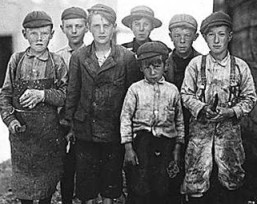
Group of child workers from the 19th century.
A group of unknown Victorian child workers.

This act was key at keeping the youngest of children away from dangerous environments such as mills, mines, glassworks, and other industries with heavy machinery – or at least it meant that those who continued to employ children under 10 could be prosecuted (and this was quite common).

The act also meant that 10-14yr old children were allowed to work half-days.

The act was revised again in 1891, upping the age to 11 years, and again with the introduction of The Factory and Workshop Act in 1901 to 12 years.

The slow pace of laws to protect children in the UK, and the harsh reality of bringing up a family on a railway labourer’s wage, may have contributed to William going to work at aged 10 on that fateful day.

Wordless Wednesday

Wordless Wednesday: Ethel May Martin (1895-1999) with her bicycle.

Mother’s Day

Mother’s Day – a celebration of motherhood.

Today is Mother’s Day here in the UK.

To mark this day, I thought I would share a few words about three amazing women in my tree.

Ann Bowers

Ann Bowers (1843-1889)

Ann Bowers was born in 1843 in Wicken, Cambridgeshire. She was penultimate of the eight child of Henry Bowers and Ann Bailey.

Marrying labourer James Simpson Bishop in 1860, it wasn’t long before she began their family with the birth of their first child Ann Elizabeth Bishop in 1861. Over the next 26 years she bore another 17 children. It appears that two of these children died in their infancy.

Ann, who must have been exhausted from her continuous pregnancies and looking after an army of children, eventually succumbed to pneumonia in March 1889 and died aged 45 years. Her youngest child was just 2yrs old.

With a total of 16 living children, their labourer father would have struggled immensely to provide and care for them had it not have been for Sarah Farby (née Bowers) – Ann’s married and childless sister.

Sarah Bowers

Sarah Bowers was Ann’s (above) older sister. She married George Farby but the couple never had any children of their own. However, they lived close to the growing Bishop household and therefore Sarah helped Ann to care for her children, and upon Ann’s death in 1889, Sarah was there to help care for the children – the youngest, George Juble Bishop, being just 2yrs old.

As the family grew up and started having their own children and grandchildren, Sarah continued to care for them – earning herself the affectionate name of ‘Granny Farby’. She died just under 2 months after the death of her husband in 1920.

Sarah Elizabeth Giddings

Sarah, born in 1852, was the illegitimate daughter of Elizabeth Giddings of March, Cambridgeshire. The stigma that accompanied this fact will have worked against her and her mother from the moment that the pregnancy became known.

Sarah Elizabeth Giddings (1852-1925)

Sarah didn’t just face this hurdle in life – when she was 21 she lost her mother (aged 41-42yrs old). The following year (1874) she married James Martin and the couple bore their first child that year. In total, they had 12 children, but sadly, Sarah was to outlive 6 of her children, and 2 of their spouses.

Son Herbert died in a horrific train accident in France; Albert died in a German hospital; her daughter Emma and Emma’s husband both died in 1917 – leaving their orphaned daughter Mary.

Sarah’s 11yr old son William Martin died after an accident whilst working on a horse and cart in 1890;  her daughter Mary died on her day of birth in 1886; and her son Percy died within the first year of his life.

Sarah died in 1925 – a mother and a grandmother.

Remembrance: Albert Martin

Remembrance of Albert Martin (1899-1918) who died in a hospital in Germany.

Albert Martin (1899-1918)

Albert Martin (65727) enlisted as a Private for the 1st/5th Batallion of the Northumberland Fusiliers.

He went to fight in the First World War but was sadly taken prisoner during the German’s third offensive that swept through Fismes, France on 27th May 1918.

Records from the Comité International de la Croix-Rouge (CICR) revealed that he was captured the following day at Fismes.

He is recorded as present at a Prisoner of War (POW) camp in Dülmen, coming from Laon on 19th July 1918. He then appears at the POW camp at Münster II on 20th August 1918.

He died 10 days later in the “Res.Laz.Abtl.Krankenhaus” (hospital) at Homberg, Germany.

He was buried in an English cemetery in the same place “Feld” 21, Nr.64.5″

Remembrance: Herbert Martin

Remembrance of Private Herbert Martin, 1884-1917.

Herbert Martin (1884-1917)

Herbert Martin (40572) enlisted as a Private of the 7th Battalion of the Northamptonshire Regiment.

He was tragically killed on his way home towards the end of the First World War in a train accident in France.

His name is featured on the Little Downham war memorial and was until recently also on a stone in the cemetery, along with his sister Emma and her husband John William Goodge.

Herbert is named in the Cambridge Regiment’s instalment in St. George’s Chapel in Ely Cathedral, where it lists the names of the brave who died during the two world wars.

Wordless Wednesday

James and Sarah Elizabeth Martin

Surname Saturday: BURNELL

The Burnell family moved from Somerset to London, on to Bedfordshire and then on to Cambridgeshire.

Travelling around 300 miles, the Burnell family went from Devon to Somerset to Middlesex to Bedfordshire and on to Cambridgeshire.

When looking back at the families in my ancestry, few are more travelled (so far) as the Burnell family. The family have covered 5 counties in just over 200 years. That doesn’t sound like such an achievement by modern day standards, but in the 18th and 19th centuries, this was a journey. It was a journey for work – a journey for survival.

Back in the 1790s, the family was living in Combe Florey, Somerset. Robert Burnell and his wife Martha (née Evans – a Welsh connection?) were married in the parish in January 1816. It appears that Robert had come from Morebath, Devon, whilst Martha was a resident of the parish.

The couple had at least four children, with Samuel as the oldest – born just 2 months after his parents’ wedding. I have no record of what became of Samuel’s three sisters: Caroline, Mary and Maria – although each are born years apart, suggesting that perhaps there were more siblings.

Samuel Burnell married Mary (neé Babbidge) at Combe Florey on Christmas Day in 1839 (both illiterate) and together they bore a total of 12 children, including my Gt Gt Grandfather George Burnell in 1850. By 1861, Samuel is noted as a ‘road contractor’ and the family (by then almost complete) are living in poor houses.

The road to Middlesex

Their son and my ancestor, George, went off to work in what was then Middlesex, but is now absorbed by Greater London. In 1880 he married Miss Mary Ann Barker of Barkway, Hertfordshire. They married in All Saint’s Church, St John’s Wood on 9th May 1880, both naming residence as ’46 Abbey Road’ – a road that would find fame around 80 years later.  In 1885, my Great Grandmother Daisy Burnell was born in the Stables in Abercorn Place, London – an area that Charles Booth categorised in the two highest categories (‘Middle class well-to-do’ and ‘Upper-middle and Upper classes. Wealthy’) of his Poverty Classification system.

However, whilst this sounds like the family may have hit wealth in this part of London, they were undoubtedly servants to the wealthiest people of London.

A new start in Bedfordshire

By 1889, the couple and their four children left for Dunstable, where George became the landlord for ‘The Royal Oak’ in Church Street, Dunstable in Bedfordshire. Sadly, George died soon after in June 1891, leaving his pregnant widow with a young family and £75 13s 4d (worth today at about £4,500).

Seeking Hope in Cambridgeshire

Seeking to make ends meet, a pregnant Mary took her young mourning family off to Littleport, Cambridgeshire. Here they made a new start in the company of The Hope Brothers – a clothing manufacturing business.

Mary later re-married to James Smith, and appears to have died in 1929.

A life consumed

The ‘White Plague’, ‘Consumption’, ‘T.B’, Tuberculosis.

If you’ve been researching your family tree, you’re bound to have stumbled across some of these phrases as causes of death (i’d only not seen the ‘white plague’ term before, but I’ve seen the others too many times).

Although it wasn’t notifiable until 1912, Tuberculosis was probably the cause of one-third of disease caused deaths in the nineteenth century. That’s quite a claim.

Environments with poor ventilation, overcrowding and people with poor nutrition (including the drinking of infected cows milk) were all susceptible to the disease. However, improvements in housing and nutrition halved the number of deaths by the end of the century.

Within my own family, I have found cases where it has claimed my ancestor’s lives: a 35yr old Henry Bowers of Wicken, leaving his young wife with a hungry family of eight young children; two children both under the age of 1 year of James and Mary Martin of Little Downham – (another daughter died aged 9yrs from Scarlet Fever, and James himself was killed by a train not far from his house).

If you’re interested in reading more about poverty and disease (such a jolly topic i know!), i recommend getting hold of a copy of Rosemary Rees’ Poverty and Public Health : 1815-1948 (Heinemann Advanced History S.)

More on Tuberculosis at Wikipedia

The Mystery and The Monkey

James Martin (1851-1934), originally uploaded by familytreeuk.


The December issue of the BBC’s ‘Who Do You Think You Are?’ magazine features my photograph in their ‘Over To You’ section (page 36).

I’m pleased to see it in print – it’s such an interesting/amusing photograph – showing a real mixture of characters. There appears to be four railwaymen (like my Great Great Grandfather, James Martin who appears at the top of the photo with the monkey on his shoulders), but also some sailors too (their hats read ‘Albert’).

I think that the photo was taken in 1887. My reasons for this are that this was the year of the Queen’s Golden Jubilee (hence ‘Albert’ on the hats) and the jumpers of the ‘sailors’ appear to have “RTYC” (Royal Thames Yacht Club?) embroidered on them and they raced in 1887…..

“Ocean races officially organised by clubs were unknown until 1887. That was the year of Queen Victoria’s Golden Jubilee, and a race ‘the like of which had never been known in the annals of yacht racing’ was announced by the Royal Thames Yacht Club over a course of 1,520 nautical miles round the British Isles. Later meetings at the Albemarle Street Club House refferred to this event as the Jubilee Yacht Race.” – Royal Thames Yacht Club history

I also think that my Gt Gt Grandfather looks like he’s in his thirties.

I’m amused by the ‘dwarves/smurfs’ at the front of the photo and also of the very scary looking ‘black beard’ pirate character lurking towards the back.

Who were they? What was going on? When was this? Where was it taken?

Hopefully the magazine will throw up some answers in the show’s web forums.

Our Brave Men

Herbert Martin (1884-1917)

11th November was Armistice Day. It has now been 90 years since the First World War ended. A war that claimed the lives of around 20 million people.

This means that it has been 91 years since the death of my Great Grandfather, Herbert Martin. He was a Private in the 7th Battalion of the Northamptonshire Regiment but was killed in a train accident in Boulogne, France on 17th October 1917. The Battalion landed in Boulogne in September 1915. He was 33 and a father of four sons, all under the age of 8yrs.

His little brother Albert died the following year in Germany, apparently as a Prisoner of War in a coalmine (but that remains to be proven). He was just 19.

His sister and brother-in-law, Emma and John Goodge also died during the War.

This is just one part of my family that was touched by the First World War. Every single person lost someone and every family dreaded to hear that their husbands, fathers, brothers and sons would not be coming home again. I can’t begin to imagine what that must feel like, and I hope I never do.

These were exceptionally brave men. Heroes. Thrown together into an impossible situation in which a large number of them didn’t stand a hope in surviving. I am immensely proud of my relatives who fought for their future – our future.

There is seldom a day that passes where I don’t think about our brave men.