Wordless Wednesday
Wordless Wednesday: Ethel May Martin (1895-1999) with her bicycle.

Wordless Wednesday: Ethel May Martin (1895-1999) with her bicycle.
The story of Thomas Yarrow (1832-1914) who went from being a Beer Seller in a small Cambridgeshire village, to being a Sergeant in the Indian Mutiny, and then into poverty in London.
A long-standing puzzle quickly and suddenly unravels to reveal a story of a beer seller from a Cambridgeshire village, who became a Sergeant for his role in the Indian Mutiny.
Thomas Yarrow, born circa 1832, was the youngest of the two children of John Yarrow, a farmer of Little Thetford, Cambridgeshire, and his first wife Ann Whiten. His older brother Owen, was born just two years earlier.

When Thomas was about 11 years old, his mother Ann died in 1843 at the age of 34 years old. This left her widower John with two growing boys to care for. It was a little over a year later that John re-married to Miss Elizabeth Jeffery of Ely and the couple soon found that they had a baby on the way. Together John and Elizabeth had four children – James, William, Albert and Maria, until John died in 1858 at the age of 52.
By this time, the 1851 census had already shown the Yarrow family holding a number of business in the village, and the family are shown as living at ‘The Wheat Sheaf’ – long since closed. It was here that a 19 year old Thomas Yarrow, beer retailer, was to make what seemed like his final census appearance.
By the time of the 1861 census, there’s no sign of Thomas, yet his siblings including his older brother Owen could all be found. All of the usual alternative spellings revealed no trace of him in the census, leaving me to assume that he’d either died, or that he’d moved to Ely where a data black-hole was hiding him (the 1861 census for Ely was destroyed in flooding and therefore leaves a hole in most of my family branches).
I checked the 1871 census, in case he had been missed or had indeed been ‘hiding’ in Ely, but there was no sign of him. So then I checked for a death and found one in 1853 in the right district. Ordering the certificate, it arrived a few days later….
Rather than seeing a 20-something Thomas Yarrow, it was a certificate for a 3 day old premature baby Thomas Yarrow from a nearby village.
With Thomas not indexed as dying, and not appearing on the 1871 census it led me to start thinking that maybe he had gone overseas. A quick check on familysearch.org soon found some records that seemed to match, spanning 1867 to 1874 (an explanation why he didn’t appear on the 1871 UK census) and that’s when I noticed the mention of Allahabad.
This came as a surprise as the rest of the Yarrow had stayed local to Little Thetford or at least within the UK. After a few more searches, I found that Thomas was married with at least four children. This was swiftly backed up by the Families In British India Society (FIBIS) who had online records of Thomas and his marriage to Catherine O’Keefe (née Lambert) in Bengal.

The FIBIS site also revealed that Thomas was part of the 35th Foot (Royal Sussex) regiment and was made a Sergeant during the 1857-1859 campaign, and received The Indian Mutiny Medal.

I soon located discharge papers dated from 10th March 1875 where it describes Thomas’ conduct.
“his conduct has been very good and he was when promoted in possession of two good conduct badges and would had he not been promoted have been now in possession of five good conduct badges. He is in possession of the Silver Medal for long service and good conduct with our gratuity” – Gen. Hon. A Upton
The papers also describe Thomas as being just 5ft 7″ tall, with a dark complexion, grey eyes, dark hair and fit. The documents also state that he would return to Little Thetford to work as a Labourer.
By the time of the UK 1881 census, Thomas and the surviving children of his family have returned to England. A daughter, Frances Maud Yarrow, is listed in 1881 as having been born in 1877, in the village Little Downham, Cambridgeshire. However, at the time of this 1881 census, the family have moved to number 6 Georgina Gardens, Columbia Road, Hackney, London. The youngest child of the family, John, was born in 1879 in Bethnal Green.

By the time of the 1891 census, Thomas is living alone with his youngest son John. Catherine had died and they are living in Leopold Buildings – a block of densely populated tenement flats built by The Improved Industrial Dwellings Company on land leased by the wealthy ‘Queen of the Poor’ Angela Burdett-Coutts . Just 20 years earlier, Bethnal Green was the poorest parish in the whole of London – conditions must have been harsh.
Thomas remarried by 1901 to a woman called Edith Emily Rawlings, who was much younger than himself, and they appear in 1901 in Soho, London.
Thomas also outlived his second wife, and appears to have ended his days in 1914 at about 82 years, living in Forton, Gosport, Hampshire.

Whilst Thomas’ children seem to vanish, just as he had in 1861, it’s only his youngest son John (pictured right) who seems to stick around, appearing in Portland, Dorset as an attendant at a Special Naval Hospital, Castletown.
The Little Thetford Yarrow family are not known to have made contact with Thomas after his departure to the Indian Mutiny. Whether there was a feud, or they didn’t agree with his choice of army career, or simply just lost contact – it will remain lost in time. There was certainly no reference made to his existence by his siblings’ descendants.
Surely a story of a sergeant in the family and the battles he fought in would have been handed down, regardless of how people felt towards it?
Mother’s Day – a celebration of motherhood.
Today is Mother’s Day here in the UK.
To mark this day, I thought I would share a few words about three amazing women in my tree.

Ann Bowers was born in 1843 in Wicken, Cambridgeshire. She was penultimate of the eight child of Henry Bowers and Ann Bailey.
Marrying labourer James Simpson Bishop in 1860, it wasn’t long before she began their family with the birth of their first child Ann Elizabeth Bishop in 1861. Over the next 26 years she bore another 17 children. It appears that two of these children died in their infancy.
Ann, who must have been exhausted from her continuous pregnancies and looking after an army of children, eventually succumbed to pneumonia in March 1889 and died aged 45 years. Her youngest child was just 2yrs old.
With a total of 16 living children, their labourer father would have struggled immensely to provide and care for them had it not have been for Sarah Farby (née Bowers) – Ann’s married and childless sister.
Sarah Bowers was Ann’s (above) older sister. She married George Farby but the couple never had any children of their own. However, they lived close to the growing Bishop household and therefore Sarah helped Ann to care for her children, and upon Ann’s death in 1889, Sarah was there to help care for the children – the youngest, George Juble Bishop, being just 2yrs old.
As the family grew up and started having their own children and grandchildren, Sarah continued to care for them – earning herself the affectionate name of ‘Granny Farby’. She died just under 2 months after the death of her husband in 1920.
Sarah, born in 1852, was the illegitimate daughter of Elizabeth Giddings of March, Cambridgeshire. The stigma that accompanied this fact will have worked against her and her mother from the moment that the pregnancy became known.

Sarah didn’t just face this hurdle in life – when she was 21 she lost her mother (aged 41-42yrs old). The following year (1874) she married James Martin and the couple bore their first child that year. In total, they had 12 children, but sadly, Sarah was to outlive 6 of her children, and 2 of their spouses.
Son Herbert died in a horrific train accident in France; Albert died in a German hospital; her daughter Emma and Emma’s husband both died in 1917 – leaving their orphaned daughter Mary.
Sarah’s 11yr old son William Martin died after an accident whilst working on a horse and cart in 1890; her daughter Mary died on her day of birth in 1886; and her son Percy died within the first year of his life.
Sarah died in 1925 – a mother and a grandmother.
Wordless Wednesday – 8th March 2012 – photo of Gladys Anderson and Grace Violet Moden as bridesmaids in 1925.
The Family Tree UK is now using the new Facebook Timeline Page style.
Just a quick message to say that the new Facebook Timelime for Pages was launched today and so we’ve promptly re-designed our page to fit this new style.

If you’re on Facebook and yet to ‘Like’ The Family Tree UK, then pop by now and join in!
Review of my day at the Who Do You Think You Are? Live 2012 (WDYTYA Live) show at Olympia, London – including my top tips for you and for the WDYTYA Live organisers!
Back for my second and consecutive WDYTYA? Live show in Olympia, London.

Last year I was able to catch the entertaining Monty Don, who talked about his experiences of filming his episode and the effect that it had on him. Unfortunately I missed this year’s Emilia Fox, whose episode was heart-wrenching and fascinating.
Instead, I had pre-booked myself on to a couple of talks – the first being a keynote workshop organised by the Society of Genealogists and hosted by the brilliantly raconteur (and freshly outed event tweeter) Else Churchill. The topic of the workshop was “Breaking the barriers of Social Networking – Strategies and Tricks”.
By name, it made me quite excited to attend to see if there is anything that I could use in my own research. The session was led by Laurence Harris from MyHeritage, and whilst interesting, it did stray away from social networking – even touching on DNA testing – and did feel a little at times like a product pitch by MyHeritage. However, there were some good ideas at using social media, and Laurence was clear in his descriptions of the benefits, disadvantages and concerns over using social networks and other online platforms as tools for research. He even introduced me to Mocavo – a genealogy-savvy search tool (and kudos to Mocavo for tweeting at me in response to my tweet about them).
This was followed by a Q&A session with a panel of experts who were certainly from quite a wide range of backgrounds – including D. Joshua Taylor from BrightSolid.com (the partners that help deliver FindMyPast), and Lisa Louise Cook (Genealogy Gems, Google expert).

This year, I was also fortunate to meet the brilliant geneageek Lisa Louise Cook after she literally wowed the audience as they frantically scribbled notes during her talk ‘Google Search Strategies for the Family Historian’. What she doesn’t know about using the family of Google products for genealogy research just isn’t worth knowing.
She introduced the audience to ‘search operators’ and how to wield these to make Google search work its hardest for you. I’d never heard of ‘synonym search’ or using a date range tool in my search box, but I know that I will be doing this from now on.
Thank you to Lisa for her nod to this event summary in her podcast, episode 128. You can listen here for free.

It’s important to remember the hard work that societies do for genealogy – it’s not all down to the big names like Ancestry, FindMyPast or GenesReunited. Who Do You Think You Are? Live gives huge exposure to a vast number of these local societies and I was very pleased to finally meet Carol Noble from the Cambridgeshire Family History Society, who was very helpful and great to talk to – I’ll be keeping my eyes peeled for records for her from now on!
I was also pleased to see the Suffolk Family History Society there too, who gave me some inside news about the availability of some more records from Elveden. Lots of other counties were also present – Norfolk’s stand was crawling with people eagerly browsing their books and cd-roms. I was a little bit disappointed to see that the Somerset and Dorset Family History Society didn’t appear to have (unless I totally missed it) anything to buy and take away – ideally I’d love to get my hands on a cd-rom of parish register transcriptions in the style of the CFHS or Suffolk Family History Society – but instead, they were offering look-ups on their computer for £2 each.
Nick Barratt with film crew in tow; the legend that is Eric Knowles valuing heirlooms; a man with an incredible moustache; and author Chris Paton wearing a rosette.
Surname Saturday – TINGEY or TINGAY. A look at the Tingey surname in Cambridgeshire.
An unusual surname with seemingly disconnected family groups turns up in both my maternal and paternal families.
The Tingey name turns up twice in my family tree. Once as ancestral in my paternal tree, and the other as a husband of a maternal great aunt.
My earliest record of a bona-fide Tingey ancestor is Ann Tingey, who appears at the parish church in Witcham, Cambridgeshire in 1769 where she went to baptise her illegitimate son Thomas.
By 1771 she had returned, to marry James Toll with whom she had at least two children.
Thomas remained in Witcham, where he married Mary Barber in 1794 and together they had three children – Robert, Elizabeth and Sarah. It appears that the family moved just a few miles away to Oxlode in 1841 – a tiny hamlet close to the village of Little Downham, Cambridgeshire – which is where they ended up by the time of the 1851 census.
Robert went on to marry Fanny Harrison and together they had a family of 12 children, with their oldest (Mary Tingey) being my ancestor, born in 1820.
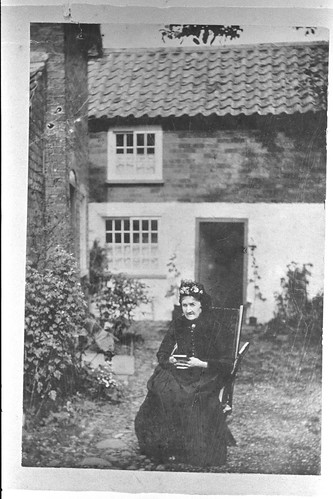
Amongst family photographs is a photograph of Mary in later life. By the time that this photo was taken, she would have either have been Mary Martin, widow, or Mrs Mary Watling(ton). She was married a total of three times.
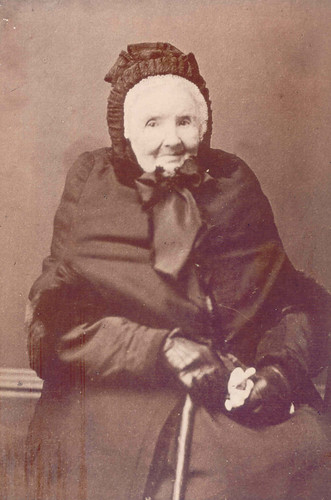
Another photograph is somewhat of a mystery – a carte de visite with the words ‘Aunt Tingey’ written on the back. It remains unclear as to whether this was an elderly maiden aunt, or a wife of a Tingey uncle.
Whilst my own branch was busy living their lives and growing in the Little Downham area of Cambridgeshire, just four miles away in Ely appears to be another family group which I’ve never found a connection to.
Another group of Tingeys appear in Henlow, Bedfordshire. For many years I have been in correspondence with another researcher – but as yet there appears to be no link between the family groups. According to the researcher, there are many gravestones for Tingey name-bearers standing in the parish churchyard.
This unusual surname does have a few variants through the years – ranging from: Tingey, Tingay, Tingye, Tangye, Tyngy Tyngie.
According to John Ayto’s ‘Encyclopedia of Surnames’, Tingey/Tingay are derivative of Tangye. He says that:
“Tangye from the Breton personal name Tanguy, a contracted form of Tanneguy, literally ‘fire-dog’.”
According to The House Of Names.com:
“First found in Cambridgeshire where the name first appeared in the early 13th century.”
Wordless Wednesday: Photography of some young men and their teacher in approximately the late 1940s – early 1950s.
New Year’s Day might be widely celebrated as the beginning of a year, but to many it also represents another occasion too – births, deaths, marriages, baptisms….
So here comes 2012! How do you see in a New Year?
Whilst still just another 24 hours, looking back it has played a role in a range of historic events in my family. Here’s a list of some of them.
On this day: 1st January..
Has someone in your family tree marked New Year’s Day for a different reason other than a new year?
Heir Hunters is now prime-time on BBC 2 in the UK with presenter Lisa Faulkner.
Probate research show Heir Hunters arrives on prime-time BBC tv.

For quite some time now, I’ve been addicted to the daytime television series Heir Hunters, which has screened in the UK for several series.
The premise of the show is to use genealogical research methods to uncover the relatives of people who have died intestate (ie without a Will or any known legally recognised family), leading them to making a claim of the deceased’s estate which would otherwise be absorbed by the government.
The show follows a handful of the companies (mainly Fraser & Fraser, and often Celtic Research) that work against the clock to beat rival companies, to work out family trees and connect real people to their legal entitlement.
This often unearths long-lost and incredible stories about the deceased, or brings memories flooding back to living relatives who lost touch, and in several cases, comes as a complete shock to receive notification that the deceased person even existed.
The series has now been given a prime-time 7pm slot over on BBC 2, where it is now given a much longer programme, and this gives it the chance to add a much more educational and genealogical context – with investigations into the society that the deceased lived in.
Actress and the show’s former narrator since 2008, Lisa Faulkner, now takes to the screen as presenter, bringing interesting and educational interviews with experts and even the to-camera pleas for information on individuals who have been languishing on the government Bona Vacantia list.
The current run of episodes essentially contain the stories used in the last series, but with extra footage and interviews edited in. According to the Heir Hunters twitter feed, a brand new series is complete and ready for transmission.
What do you make of the show? Is the new format better? Did you prefer the shorter programme, or the time of day that it was on? Let me know in the comments below!


 History Repeating