Society Spotlight: How can we help history societies focus on the future?

Every day this week, I’m focusing on History Societies. Three societies have each kindly answered three questions, and I’ll be covering their answers that reveal their needs, challenges, and plans for survival.

I’m a supporter of history societies. I think they’re great resources, and that they play a very important role in preserving and sharing information to communities. However, these treasure troves of information face a real risk without a healthy long-term plan of survival.

Whilst talking with genealogist Linda McCauley a few weeks ago, she recalled a story of a  society in the US that has nearly been wiped out after the recent death of its treasurer. The treasurer had pretty much run the society single-handedly and was the only person who knew where the membership list was kept. Now, that society faces a bleak future unless the list is found by the grieving family when their home is cleared. If not, it brings an end to the individual’s dedicated hard work for which they surely must have hoped would have a long-lasting legacy.

Genealogist Linda McCauley
Genealogist Linda McCauley.

“It’s so easy today for a society to back-up their critical information. All it takes is a few files stored online and multiple officers with the ID and password to access them” – Linda McCauley.

This story struck a chord with me and got me thinking – how can we help history societies survive?

Hold on, why should we help history societies?

Societies are often run by volunteers, and with little or no funding behind them. This means that they rely on the donations from members, events, making a profit on their publications, and membership subscriptions. It also means that they don’t necessarily have the funding to digitise their archive, or to put it securely online for people to browse (or even just to digitally preserve, and/or put a searchable index online).

The kind of records that societies hold varies considerably, but often include items that are otherwise ignored by the larger organisations that have the monopoly on digitizing records and making available online – items include items such as personal collections from local people, self-published family stories, one-off types of items, personal photograph collections, and many other types. These records are likely to be ‘small fry’ for the likes of Ancestry, FindMyPast, Genes Reunited etc, as they won’t have such a wide appeal, and therefore won’t be the money-spinner worth investing in. One society I know, holds their parish gravedigger’s note book, which alongside the parish register, provides a useful corroborative record of burials.

How do history societies want to be helped?

The best way to know the answer to this is to ask them. So I contacted five different UK-based societies to see how they would answer three questions.  Three have replied since I contacted them back on 29th June 2013. The respondent three were:

  • The Society of Genealogists – a large genealogy society which holds the largest collection of parish records and is based in London. It is widely known and visible through the events and training courses that it organises, and appearances on television.
  • The Cambridgeshire Family History Society – a county-wide family and local history society in England, with a wide range of publications, international members, and support courses.
  • The Newman Name Society – a member of the Guild Of One-Name Studies (GOONS), and the first family history society I ever joined, almost 20 years ago.

I asked each of them the same three questions, and for the next five days i’ll be sharing their answers to each question in turn, and looking at ways that you can help your local society, or the society local to your ancestors. The questions were:

  1. What is the society’s biggest need?
  2. What is the society’s biggest challenge?
  3. How does the society plan to preserve its knowledge for the future?

I hope that you will find this series of posts interesting, and perhaps find it inspiring enough to contact your local society and offer them even just a few hours of your time and/or expertise, or at least become a member to help fund them.

If you’re a member of a society already, or already helping a society in some capacity, I’d love to hear from you in the comments below (and feel free to post a link to their website!). Let’s promote them!

Come back tomorrow when I’ll be talking about the death of a family history society.

OFFER: Earn FindMyPast credits with Historic Newspapers

Historic Newspapers have asked me to share their special offer with you – buy a Birthday Newspaper, and get FindMyPast search credits for free!

Do you like reading old newspapers?

I can spend hours looking through them – reading the old adverts (cake advert below is from my Cross family’s Ely bakery), the fascinating insights given by village micro news (along the lines of ‘Mr Roberts played the church organ to a packed crowd’, or ‘Miss Chivers won the flower arranging competition’, etc), those heart-wrenching stories of lost loved ones lost in action, and the scandalous headlines of newspapers from 100 years+ ago.

F Vernon Cross Ginger Sponge cake advert from the Ely Standard, 7th November 1930.
F Vernon Cross’ Ginger Sponge cake advert from the Ely Standard, 7th November 1930. Hungry now?

I’ve got a few old original newspapers on file, although those mainly relate to the early 20th Century British Royal Family – with the death of the current Queen’s father, and her subsequent transformation from a Princess. I also have a few more genealogically relevant ones including a rather horrible account of when my Great x4 Grandmother Mary Clarke appeared in court and was charged and imprisoned for child abuse in 1841. The report includes the words of her and the abused children, and makes for hard reading.

Credits for old news

Historic Newspapers logoI’ve had an email from the team over at Historic Newspapers, who have been reading this blog and very much love old newspapers too. In fact, they love them so much, that they asked if I would share a special offer with you, where you can earn free FindMyPast.co.uk search credits when you purchase any original Birthday Newspaper right back to 1900.

Their offer runs until the end of December 2013, and details about obtaining the credits will be included in your Newspaper order (probably best if you read the full offer info on their website for the full terms).

Which date would you pick, and why? Let me know in the comments below! I’m toying with one of my grandparents’ birthdays – which sees me looking at somewhere between the years 1914 to 1932.

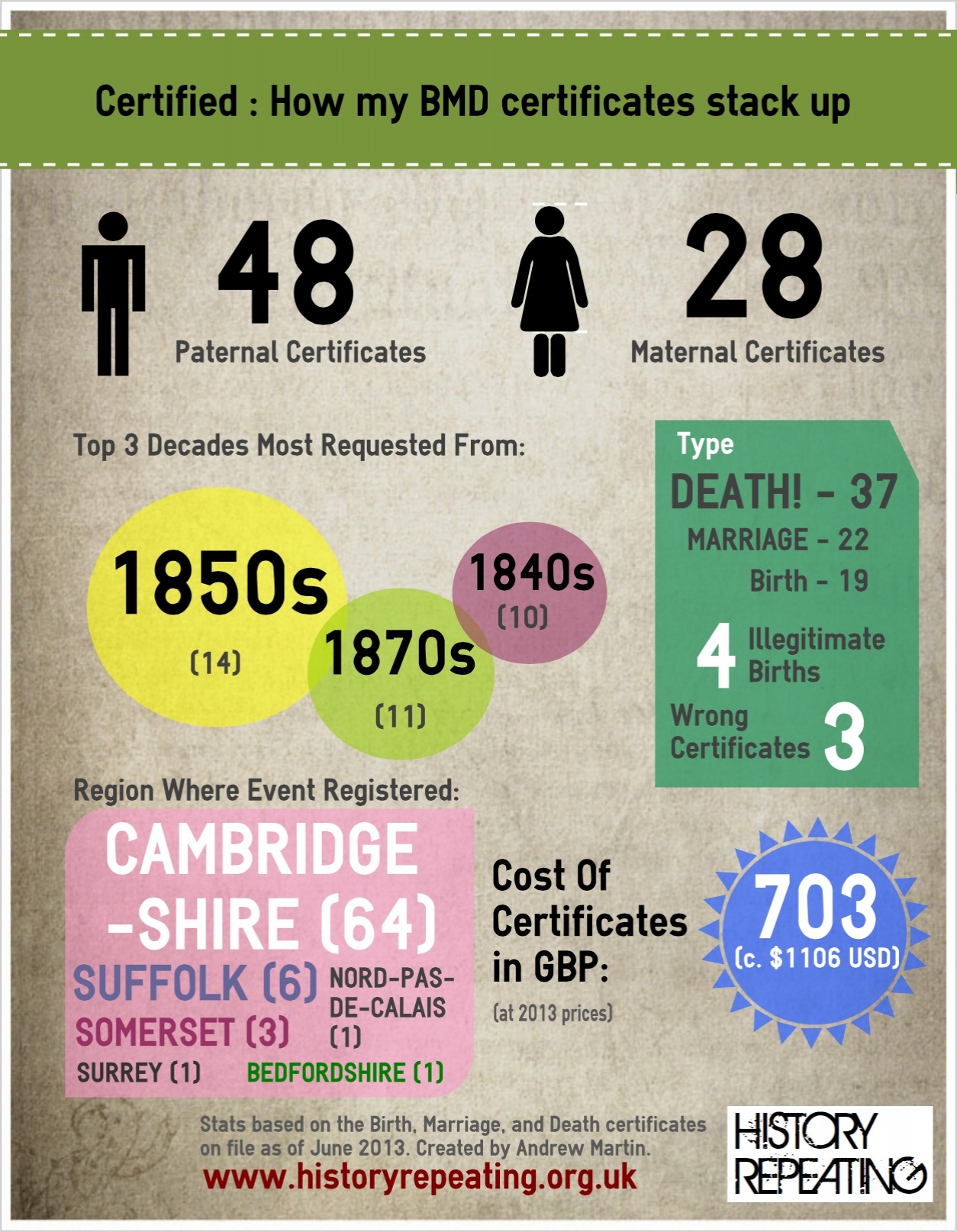
INFOGRAPHIC: My birth, marriage, and death certificate buying habits

An infographic showing how I split my attention and money on birth, marriage, and death certificates. The results of this were a complete surprise.

Turns out, I love death certificates, and spend most of my money using certificates to research my father’s family side. Who knew!?

BMD infographic

Why getting your family tree wrong is the best thing you could do

Why making a mistake in your family tree research is one of the most important things you can do.

Getting something wrong is not something that we like to admit, but it’s probably one of the best things that you could do when researching your family tree.

My sister, who is an avid horse-rider, taught me at a young age the saying ‘You can’t ride a horse until you’ve fallen off’. This easily applies to researching – you can’t research, until you’ve got it wrong.

But… there’s always lots of moaning about the quality of data when you discover online that your family tree has been ripped to bits by another less-careful researcher, thrown back together with some random names from say – Ohio, leaving you obliterated from existence in their tree.

So why is getting a tree wrong actually important?

Scaring away the cuckoo

PatPatPatPatPatMat Great Great Great Great Grandmother, Avis
Avis Wisbey (formerly Martin, née Tall) or ‘Mary Waters’

Discovering an error in your family tree is something that every genealogist should do at least once during their research. If you’ve never done this, then maybe you’re staring at a ‘cuckoo’ – a person who is using your tree to borrow the love and care that you have for your ancestor, when actually they are from a completely unrelated line.

Saying goodbye to that surrogate family is hard. If you’ve invested your time and effort, and perhaps some affection, then it can be a sad moment when you have to lose them.

Admitting your error

Okay, so here we go…

For years, I stared at the photograph above, of my Great x 4 Grandmother – thinking ‘what a great photo’ and ‘how lovely Mary Waters must have been’, when actually, she was Avis Tall.

I’d allowed a simple mistake creep into my research and onto my website – where I’d simply scrimped on spending time checking sources that I had in my files before adding data to my database and to my website.

A Mary Waters did indeed marry a James Martin, and together they had a son also called James Martin, but it wasn’t until revisiting a marriage certificate in my files for James Martin Jnr, that i realised that the father was actually a Robert Martin a couple of villages away, which then led me to finding his marriage to Avis Tall, and then finding references to them having the son called James Martin.

Marriage certificate
Revisiting the marriage certificate gave me a terrible realisation.

This changed my tree significantly, as I’d put a lot of effort into tracing back the Mary Waters and James Martin families, and had even found modern-day relatives who descended from them.

Updating… everything

Once you’ve found that mistake, your attention and eye for detail is swiftly improved. After finding that Mary Waters was completely wrong, I was straight back to my core tree and re-checking my trees using various sources.

Avis Tall as Mary Waters on Ancestry.co.ukI updated my website, I updated my database, and then I updated my distant relatives who had also run with the information i’d fed them.

Whilst my site is updated, even now, years on, the effect of the cuckoo lives on – with my ancestor enjoying an existence as ‘Mary Waters’ in new trees within sites such as Ancestry.co.uk.

Getting it wrong makes your research better

By getting your research wrong, realising it, and correcting it, you end up being a far more diligent researcher. Having got it wrong once, you know the pain and embarrassment of sawing off large boughs of your family tree, and then staring at the weedy twig that’s left behind.

So, before you commit that ancestor to your tree – check. Check again. Then cross-check, or the cuckoos will get you.

How a Care Giver can play a key role in your genealogy research

How a carer could add extra information to your genealogy research.

I had a lovely email the other day from a lady who had found information about one of my late distant Yarrow cousins via Google. She used to be her care giver.

Having realised that she was looking at my Yarrow tree, she decided to drop me an email to tell me about her work caring for one of my relatives in her later years.

A carer with an elderly woman
Carers may hold the key to some of your un-answered genealogy questions.

This took me by surprise, as I’ve not received this kind of correspondence before, but as she mentioned a few specific details about the relative that she would not have found elsewhere, it got me thinking as to just how much information might your relatives be telling, or have told, their carers?

Think about how many nameless faces turn up in antiques and house-clearance stores – those long-lost loved ones who will rarely find their way back into the families they belong to. Yet, a carer may well have heard many stories about the people in these photos, and be able to give you some small clues as to the identities. Alternatively, they may have remembered being told about the childhood lives of your relatives.

Tracking down a carer for your elderly relative may be very difficult, but if they worked as part of a carer company, then you may be able to ask the company to pass on your contact details in a hope that they might respond. With any luck, they may be able to give you some time for a phone interview.

Act fast…

The advice here, would be to act quickly for two reasons:

  1. Stories can fade or become muddled as time goes on, even those stories that have been told every time the busy carer visited.
  2. The caring profession is generally poorly paid (in the UK at least, with some people receiving no pay at all) and therefore carers move around quickly – and internationally – so if you leave it too long, then you may never be able to trace your relative’s carer.

A word of caution though, carers have no obligation to contact you, and they work extremely hard with a lot of clients – and therefore they genuinely may not have any useful information for you. Some carers work in very difficult circumstances, so recalling details may be impossible or painful for them, or simply outside of their confidentiality comfort zone.