Denny Abbey and The Farmland Museum are hosting two workshops on 5th October 2013 for adult family history enthusiasts.
Denny Abbey and The Farmland Museum has announced that it is hosting two half-day workshops for adults interested in genealogy.
On Saturday 5th October, Michael Williamson and Ann Wise will be leading workshops for adults interested in getting started with their family tree, and methods for dating photographs.
Michael Williamson explains how to get started with researching your family tree
2.15pm – 3pm: Dating Your Old Family Photographs
Ann Wise will explain how to use clothing clues within a photograph to work out when it was taken. You can also bring your own photographs along.
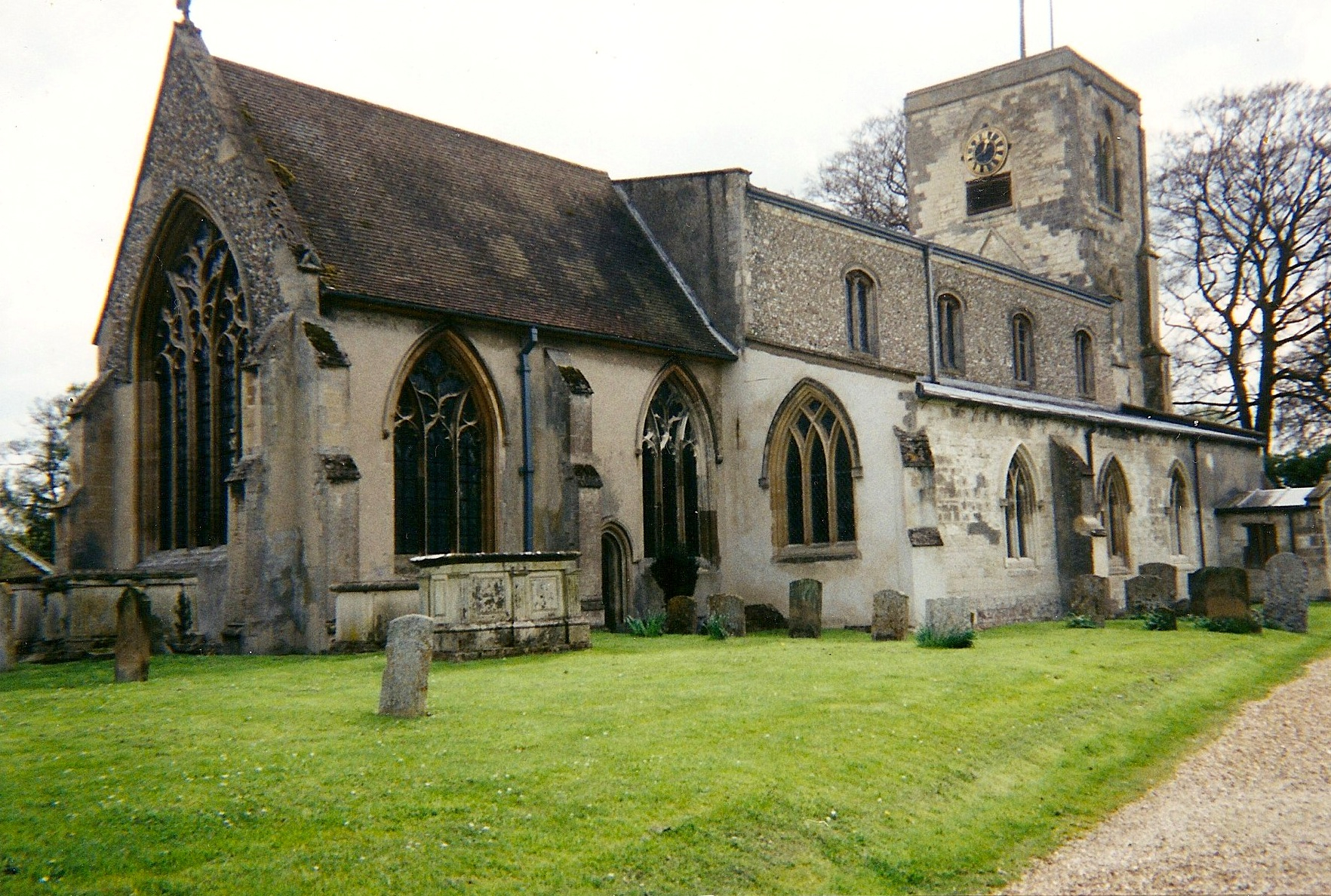
Denny Abbey – its architecture hints at its rich and varied past.
Based near Waterbeach, Cambridgeshire, the site runs a yearly programme of education events, and this year I plan to attend the above event, and also hope to attend the basketmaking course – a skill that was my own Great Grandfather’s profession that kept a roof over his family’s heads.
This week, the Surname Saturday theme stops at the story of the 18th Century unusually named ONG family of Stuntney and Ely, Cambridgeshire.
This Saturday we’re on the trail of the unusual surname of Ong.
The earliest reference that I can find for my Ong family, is the first marriage of my Great, Great, Great, Great, Great Grandfather, Thomas Ong to his first wife Martha Jennings in Stuntney, Cambridgeshire in April 1757.
Stuntney parish church, 1806.
I’ve not found any earlier record for him, but estimating his birth to have been in the 1730s, I have found a few potential matches via familysearch.org in the neighbouring county of Suffolk in its villages of Hepworth and Hinderclay – themselves neighbouring parishes.
Martha was already heavily pregnant when she walked the aisle with Thomas, and they soon welcomed their first son – John Ong – into the family, with him being baptised at Stuntney just four months later.
The couple and their baby shift from Stuntney, to the nearby Ely which it overlooks. Sadly, this happiness was to be short-lived, and Thomas’ luck was going to take a long-running bad turn.
Within seven years, Thomas had lost his wife Martha (d. August 1764), and three sons: John (1757-1758), Thomas (1760-1764) and John (1763). No doubt deep in grief, a widower, and childless, he vanishes for 9 years, returning to parish registers in 1766 at Ely.
In January 1766, he marries spinster Martha Feast, and they are joined by their first child Mary. Sadly, Thomas’ bad luck continues – claiming the lives of their first three children: Mary (1767-1769), Thomas (1769-1773) and John (1772-1773).
It’s not until Thomas’ 7th child (and Martha’s 4th) – Mary Ong – born in 1774, that a child survives into adulthood. Mary was to live until she was 85, and is my Great x 4 Grandmother.
Thomas and Martha continue to grow their family with another 4 children: Martha (1776-?), Thomas (1778-1781), Margaret (1780-?) and Thomas (1783).
Whilst it’s unclear as to what became of Mary’s siblings Martha and Margaret, Mary seems to be the only child of 10 to survive – perhaps accounting for the rarity of the Ong surname.
Mary goes on to thrive – marrying my Great x4 Grandfather Thomas Cross in Ely in 1790, and bearing 14 children (only 3 of whom are known to have died as children).
Mary outlived her husband Thomas Cross by 13 years, dying in February 1859, aged 85.
Variants of Ong
I’ve only spotted two versions of the surname whilst rummaging in the records of Ely and nearby Stuntney.
Ong – the main version
Ing – making one occurrence
However, the surname is so infrequent, that I am suspicious. Only one other ‘Ong’ appears, and as yet, she (Margaret Ong) remains unconnected – but probably the sister of my Gtx5 Grandfather Thomas. At the same time, and in both Ely and Stuntney, are rather a lot of parish register entries for the Long and Young families, and so with little imagination and some illiteracy, you could easily lose a letter or two, throw in an thick rural fenland accent, and you’re soon staring at an ‘Ong’ in a parish register.
A family bible for the Nokes family (seemingly of Essex) sits unloved in the corner of an antiques store in Ely, Cambridgeshire.
‘A present from his father and mother on his 24th birthday’ reads the inscription inside the cover. It’s dated July 30th 1891. A loving gift of a huge family bible, but one that now sits unloved in the corner of an antique store.
Tucked at the back, in the corner, on an old sideboard, I stumbled across this 3-4 inch thick, weighty, black covered (leather?) ‘Holy Bible’. It sits in a display at Waterside Antiques in Ely, Cambridgeshire. I’ve been here countless times before – scouring the items for books, marvelling at the collection of 40s/50s clothing, and checking out any photographs I might find.
This bible has been sat here a long time. I usually come back to it to see whether it’s still there, or to see if it has dropped down from its price tag (currently £80, i think). I can’t justify spending that on something that I wouldn’t use, nor is it related to me, but the curiosity of it is tantalising, so I felt that I should help it on its way home…
I’ve taken some photos. The bible was given to Frederick Nokes in 1891. A few pages further in are the delightful collection of names and dates that any genealogist would love to stumble across:
Given to Frederick Nokes on his 24th birthday in 1891.
First of two pages recording names and dates.
Names and dates inside family bible
Matching with the dates inside the bible (born 30th July 1867), FreeBMD gives one result – Frederick Nokes born in the Braintree (Essex) district, in the September quarter of 1867.
The book also notes the birth of Anna (which Ancestry.co.uk reveals as having the surname Willsher) in 1867, and then notes that they were married in 1892. Unfortunately the bible is devoid of locations, but some more FreeBMD and Ancestry.co.uk rummaging reveals the details here.
On the 1901 census, Frederick and Anna appear at Burrows Lane, Earls Colne, Essex. They are both 34yrs old, and alongside them are two of their children (again, matching the bible), Bertie and Harry. Frederick is noted as being a ‘Painter – Agricultural Machinery’. It is also noted that Frederick was born in Bocking, Essex, whilst Anna was born in Great Tey, Essex.
By the 1911 census, the couple still live in Earls Colne, and appear with 4 of their 5 children (one is noted to have died). As a nice touch, the handwriting on the census form matches that seen for the entry of ‘Winifred Ada Nokes’ in the family bible.
Children of Frederick and Anna:
Gladys Nokes (1893-1894)
Bertie John Nokes (1895-1979)
Harry Nokes (1896-1917)
Winifred Ada Nokes (1902-?)
Robert Frederick Nokes (1905-1965)
The bible goes on to reveal that Anna dies in the Halstead district of Essex in 1963, aged 95, which is all corroborated with the FreeBMD records.
The most recent notation in this book is March 1965, regarding the death of Robert Frederick Noakes – noting that the ‘a’ in Noakes was added by the registrar.
By entering the Nokes data into Ancestry.co.uk (as a new tree) I was then able to explore a bit further – even uncovering photos which are identified as Bertie John Nokes, his wife Sarah, and son Roy.
This amount of personal detail makes me hopeful. Two Ancestry members seemed to know enough information about the Nokes family for me to feel like they would care about this unloved bible. I’ve messaged them both. At the very least, they can see the photos for themselves, but you never know – they might decide to buy it and bring it back into the family.
Do you have a family bible heirloom? Have you ever found a family bible with notes and researched the names?
Skeel – An unusual and widely mis-spelt ancestral surname that appears to have roots in 18th Century Middlesex, is this week’s Surname Saturday themed post.
An unusual and widely mis-spelt ancestral surname that appears to have roots in 18th Century Middlesex.
My most recent Skeel ancestor, Elizabeth, was my 4x Great Grandmother. She was born in 1802 in the village of Swaffham Bulbeck, Cambridgeshire, and was the oldest of a total of ten children – her parents having married the year before her birth.
St Mary’s church, Swaffham Bulbeck, Cambridgeshire.
Elizabeth’s parents were Job Skeel and Elizabeth Richardson. Whilst Elizabeth was born and died in Swaffham Bulbeck (c.1781 – November 1872), Job’s origins were from outside this small village community, although he ended his days there in July 1860.
Skeel in Middlesex
The only clue so far, as to Job Skeel‘s origins comes from the 1851 census (his last) – where it is noted that he is a ‘former Horse Breaker’ and was born Brentford, Middlesex (now part of modern-day Greater London). If his age was correct in 1851 (74 years), it means that he would have been born in approximately 1777.
In 1841, Job is noted as a ‘Fishmonger’ and because this census simply asks if the person was from within the county, it simply says ‘N’ for no.
Whilst there are many Skeels in and around Middlesex during the 1770s, there are also Skeels in Great Yarmouth, Norfolk – where a Job Skeels (of William and Mary) is baptised in 1777, and closer still to Swaffham Bulbeck, the surname appears in Chatteris, Cambridgeshire.
Great Yarmouth might have been where Job lived after his birth, because this would perhaps support why he’d become a fishmonger – with Great Yarmouth having been a major fishing port until it’s decline in the latter part of the 20th Century.
It is therefore unclear as to where his family were from, and whether they had only been in Brentford for a short while, having come from Norfolk or Cambridgeshire previously.
Further research of either the Brentford or Great Yarmouth parish registers may help to confirm his parents, and whether he had any siblings. For now, it remains a mystery.
Variants of Skeel
The surname attracts a number of variants – possibly due to illiteracy, or maybe due to regional accents (perhaps further support of the potential Norfolk connection?).
The Cross family infographic – sharing stats based descendants from Thomas Cross and his wife Ann of 17th Century Ely, Cambridgeshire, England, including family members who emigrated to Australia in the 19th Century.
Riding on the back of the success of my previous (and first) infographic for The Barber family, which provided me with my most popular (traffic-wise) post ever on this blog, and a terrific amount of Facebook shares, here’s my second one featuring my Cross family.
The family are predominantly based within Cambridgeshire, but the data also includes a the many that emigrated to Australia in the mid-nineteenth century.
The Cambridgeshire Family History Society (CFHS) has revealed more details about their event in October 2013 – including free entry!
Following on from last week’s teaser, the details for the 2013 Cambridgeshire Family History Society Fair have been confirmed.
The Cambridgeshire Family History Society has confirmed on their Facebook Page that the event will take place at Girton Glebe Primary School, in the north of Cambridge on October 26, 2013, from 10am to 4pm. That’s six whole hours of genealogy to be had – meeting exhibitors and enthusiasts, and the great thing is that entry to the event is free!
There will also be a programme of expert lectures (which are charged at £2 per head, per lecture), and the details of these will be confirmed in due course. There will also be a free internet research room, run by the Society’s researchers.
In 2012, the Huntingdonshire Family History Society ran The Big Family History Fair which they confirmed would not be repeated this year.
Whilst this event isn’t on the same scale as those such as Who Do You Think You Are? Live or RootsTech, it will no doubt be an essential day out for anyone with genealogy and local history interests in Cambridgeshire and surrounding area.
Parking
There will be free parking on site, and the Citi 6 bus, which runs to and from the city centre every 20 minutes, stops near to the venue.
The Cambridgeshire Family History Society has revealed that a Family History Fair will take place in October 2013.
Last year saw The Big Family History Fair, hosted in St Ives, Cambridgeshire and expertly organised by The Huntingdonshire Family History Society, but sadly the society confirmed that it was not to be repeated this year.
Fortunately, the Cambridgeshire Family History Society have stepped in to fill the gap in Cambridgeshire’s genealogy calendar – and have just announced an event on their Society’s Facebook Page, with ‘fans’ of the page being advised to keep the 26th October clear for Cambridgeshire’s big genealogy event of the year.
The event venue is yet to be officially announced.
The Society also run a comprehensive range of events, ranging from regular themed talks, a club for those who are getting to grips with using computers and the internet, and they are also highly pro-active with transcribing parish registers.
Two 18th century Wills cast light on either sibling rivalry or on a way to avoid the restrictions of the inheritance laws.
Only a short while before their deaths, two 18th Century Barber ancestors who were generations apart, wrote their Last Will and Testaments. Were they trying to bridge family politics, or to cleverly work around inheritance laws?
The Will of Thomas Barber, carpenter of Witcham, 1706
On April 4th 1705, carpenter Thomas Barber of Witcham, Cambridgeshire, wrote his Will. One year later he was dead, aged 71 years.
The Will reveals that Thomas owned five acres at ‘The Dams Heads’ (now appears to be called ‘Dams Head Drove‘). This piece of land forms the centre of his Will and he lays out strict instructions to his children:
‘… I give and bequeath unto Wenham Barber my son and his heirs forever all that my 5 acres of fenn ground be the same more or less lying and being in a drain venn belonging to Witcham aforesaid called ‘The Dams Heads’, provided he and his heirs admit my daughter Winifred ye now wife of Paul Gawthorne and her heirs peaceably and quietly to have hold and enjoy all such fenn grounds as I shall by this my last will and testament give…’
So whilst Thomas leaves his land to his son, he leaves the right to enjoy to his married daughter WinifredGawthorne (Thomas’ half-sister). However, he may have foreseen some half-sibling rivalry, so adds..
‘…but if he or they any ways disturb or molest her or her heirs, then I give the aforesaid 5 acres hereby before given to my said son Wenham Barber unto Winifred Gawthorne my said daughter and her heirs forever.’
By adding this, he is clearly issuing his son Wenham with an ultimatum that allows his half-sister to enjoy the inheritance too.
Thomas goes on to leave his tenement, and 2 acres of land (‘ye Cow Crofts‘ – now Cowcroft Drove) to his other son John Barber – also making him the executor of the Will. John was a son from Thomas’ 2nd marriage – whilst Wenham and Winifred were children of his 1st and 3rd marriages respectively. Was John being trusted to play the diplomat here?
What happened next?
After Thomas’ death, the arrangement must have been in place but just 5 years later, Winifred died aged 36.
Now, had Thomas bequeathed his land to Winifred and not her half-brother Wenham, the 5 acres would have technically been owned by her widower Paul Gawthorne by default due to restrictions on what women could inherit (unchanged until the Married Women’s Property Act of 1870). By Thomas giving the land to his son, but allowing Winifred to enjoy it, he was in essence providing for both of these children, and keeping the ownership within the family.
Thomas’ 1706 Will stated that Winifred’s heirs could enjoy the land forever – although the oldest was just 15 when Winifred died.
Whatever happened after Winifred’s death is unclear, but the land returns to the Barber family, as found in Winifred’s half-nephew’s Will of 1729…..
The Will of Wenham Barber of Witcham, 1729.
Thomas‘ grandson,Wenham Barber of Witcham, wrote his Will on 30th October 1727. A year later at 41, he was dead. His third and final wife, Mary, had just 6 years of life left herself, remarrying in her final year to John Scam of nearby Sutton.
In all, Wenham’s three marriages brought him seven children, but at least three of these died in infancy or childhood, although I suspect that it was actually all but two that were dead by the time he wrote his Will, as they’re the only ones to get a mention.
His children, Wenham Barber (born about 1712) and Robert Barber (born about 1727) are the only two children named in his Will, along with Wenham’s wife (their mother), Mary.
At the time of writing the Will, Wenham owned land in the fertile fens northwest of Witcham, alongside the One Hundred Foot River. The ‘Damhead’ (now appears to be called ‘Dams Head Drove‘) was his main land (although he doesn’t mention its size) and he is careful as to how this asset is handled.
..I give and bequeath unto my wife Mary Barber all thereunto and profits of my Damhead ground abutting upon the 100ft bank which theeshall occupy and enjoy without indistraction for the term of 9 years. Expiring after the date hereof under this condition and limitation that if she ploughs it up or digs any turf in it, she shall forfeit it to my son Wenham Barber to whom I give and bequeath the sum of 20 shillings to be paid to him by my executrix upon the day his time is out and upon default payment she shall resign the aforesaid ground to him. Item at the expiration of the said term of 9 years to be commenced from my decease I give and bequeath all the my said Damhead and ground for ever to my said son Wenham Barber and to his heirs but if he dies before the age of 21 years. Then I give to my younger son Robert Barber.
Wenham’s younger son Robert was baptised at Witcham on 29th October 1727 – just one day before Wenham wrote his Will. Whilst the above is just an excerpt, it is very precise and I wonder where he got the 9 years (not 10) from? Why would he stop his widow from using the land for agriculture?
His Will also notes that the rest of his estate (including 4 cows, 6 heifers, 1 mare, household goods and his purse) were to the value of £17 and 10 shillings.
Again, there seems to be some kind of plan here. No doubt the family had worked long and hard to buy their lands, and so giving them up was something they wouldn’t do easily even after the current holder’s death.
Wenham appears to be restricting his widow Mary – stating that she is not allowed to do anything to the land other than profit from it, otherwise she’d forfeit it to their son. However, it doesn’t state that during the oddly chosen nine years, that Wenham isn’t permitted to farm it. This would leave the farming decisions to his son and heir, and therefore give him an incentive to work and build it up until he himself inherited it for his family.
Wenham Jnr did live beyond the age of 21, married and had at least 4 children. I have not seen Wills of Wenham or his younger brother Robert to see what happened to the land.
The Lythell family name is this week’s Surname Saturday theme, focussing on Stretham and Little Downham in Cambridgeshire.
The Lythell surname, which has many variants in Cambridgeshire during the 19th century, is this week’s ‘Surname Saturday’ theme focus.
My most recent ancestor to carry this surname was my maternal Great x4 Grandmother Rebecca Lythell. She was born in about 1821 in the village of Stretham in Cambridgeshire, and was the third of at least five children to John Lythell and his wife (possibly his 2nd or 3rd wife) Frances Howard.
This couple had five children between 1817 and 1827 (Sarah, William, my Rebecca, Eliza, Ann).
Their daughter Rebecca, gave birth in 1840 to a son called William. She wasn’t married at the time, but soon married William Dewsbury of Stretham. William jnr adopts the Dewsbury surname at his baptism in 1842, taking Lythell to be his middle name. The newly-weds go on to have eleven children, with my Great x 3 grandmother being born in 1851.
John Lythell – serial dad
A few years earlier, Rebecca’s father John (c.1772-1830), appears in the Stretham baptism register with his daughter Alice in 1808, and her mother is noted as ‘Francess’. I’m guessing that this woman was probably my Gtx5 grandmother named above, and if it is, then this baptism occurs seven years before they married in 1815.
Earlier still, John appears in the baptism register this time in 1806, where he is noted as the ‘reputed’ father of Elijah. Interestingly, Elijah is named as ‘Elijah Lithell’ (so confirming the surname when it’s only ‘reputed’) and there’s no mention of the mother’s name. Whether this was an earlier child with Frances, I will never know as his birth is far outside that of the certification. Either way, Elijah grew up to marry and raise his own family of ten children – but more about that in a moment.
But, before all of this, John appears in the baptism register with his first wife Mary (Taylor of Soham, i think!), and they bring five children into the church between 1791 and 1800 (William, Miles, Elizabeth, Thomas and Mary). Mary’s baptism in 1800 seems to be the earliest appearance of the modern spelling of the surname – ‘Lythell’.
In total, John seemingly fathered at least twelve children from a potential 4 relationships.
John’s own parents were John Lithell (bc.1746) and Mary Finch (bc.1748), and appear to have had eight children themselves between 1769 and 1788 in Stretham. John and Mary died within weeks of each other in 1814 and were both buried in Stretham church yard.
Variants of the Lythell surname
Whilst looking at the Stretham parish registers, between 1769 and 1800 I’ve noticed six different spellings for the surname in this village alone. Here’s the full list that I’ve spotted in Cambridgeshire records:
Lythell
Lythall
Lithwell
Lithewell
Lyther
Lither
Liles (potentially)
19th Century Surname Distribution
In 1891, the main location for Lythell family groups is Cambridgeshire – claiming 67% (43) of the total 64 families noted on Ancestry.com’s analysis of the 1891 census. The nearest rival is Yorkshire, with 20% (13 families). Lythell name-bearers continue to live in modern-day Cambridgeshire.
In the 18th century the surname certainly appears many times in Stretham, and a few times in nearby Little Thetford, Wicken, and Little Downham.
‘The Lythell Loop’
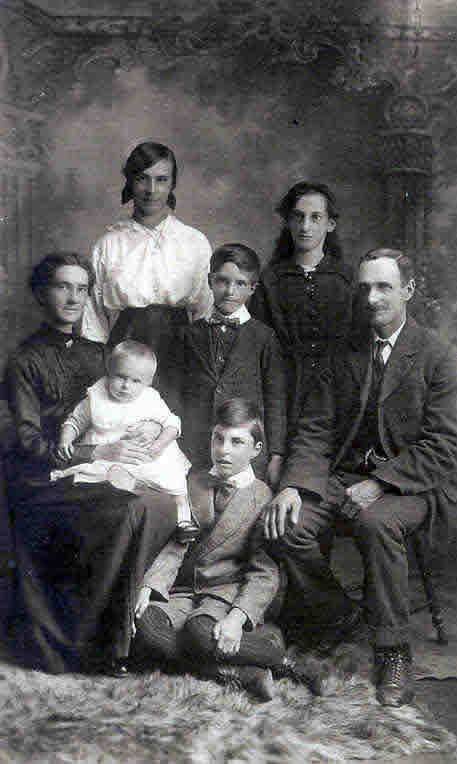
Rebecca Ann Martin (née Lythell) holds her son on the left of this family photo. Rebecca and her husband Walter (far right) are both my maternal and paternal relatives.
A relationship loop has been caused – i’m calling it ‘The Lythell Loop’.
The son of the illegitimate Elijah Lithell mentioned above, was named Murfitt Lythell. After marrying, Murfitt and his wife Mary had at least six children – the penultimate being a daughter named Rebecca Ann Lythell, born in 1879.
Murfitt and his wife settle the family in Little Downham by 1881, and here is where Rebecca meets and marries Walter James Martin in 1901. The couple have six children, including one that’s partly named after her father – a James Murfitt Martin – although sadly he died at less than a year old in 1913.
Walter James Martin was my paternal Great Grandfather’s older brother. So whilst the loop is not genetic (only via marriage), the many relationships of John Lithell would eventually become connected up.

 On Saturday 5th October, Michael Williamson and Ann Wise will be leading workshops for adults interested in getting started with their family tree, and methods for dating photographs.




 History Repeating