Those Top 5 New Year Genealogy Resolutions for 2014

How did i get on with completing my 2014 Genealogy Resolutions? Did I kill off my evil Gtx4 Grandmother? Did I write that book?…

Old Father Time meets the New Year
As Old Father Time breathes his last, 2015 and a whole new year of genealogy awaits!

You might remember that I continued my tradition of setting myself some genealogy themed New Year Resolutions (or ‘Genealogy Resolutions’ as I’m calling them). These were 5 aims for my research during 2014.

Here’s the original Genealogy Resolutions for 2014, but how did I get on?

Well, in true genealogy style (and as I’m sure many of you will be able to associate with), I got sidetracked.

Anyway, here’s the results:

 1. Find More Photos

I managed to find some ‘new’ photos of my ancestors thanks to the kindness of people emailing me, or through the hints on Ancestry, and through exploring the brilliant Cambridgeshire Community Archives Network (CCAN) – a big, online, free-to-use archive of Cambridgeshire images. I’m sure there’s similar ones of these for other areas as the concept is hardly new, but this archive contains quite a few of my ancestors.

However, I didn’t write to the more distant relatives that I had planned to, so I need to pick that up.

My scanned and tagged photo collection in iPhoto, now contains 258 recognised faces. I think that’s quite a nice achievement.

2. Killing off my wicked Great x4 Grandmother

For the second year running, I’ve yet to kill off Mary Clarke (1812-?) – my Gtx4 Grandmother who went to jail for abusing and neglecting her step-children in favour of her own, and served several stints in the workhouse in later life. She vanishes after 1881.

I took a gamble earlier in the year and ordered a certificate, but failed to get the right person.

A lead from the ever helpful Arthur Bird of the Suffolk Family History Society, has pointed me in the direction of Oulton, and a death there, and subsequent burial at a workhouse. If this is her, then I may find that her body has recently been exhumed, or is in fact now beneath, or at least amongst, a modern housing estate.

My next Death Certificate purchase will be the one to confirm/disprove this.

3. Spending 3 Days at Who Do You Think You Are? Live

Whilst I’ve been attending the WDYTYA? Live show for a few years now, 2014 was the first year that I spent all three days there at the London show. I really enjoyed myself, and I’m pleased to say that I felt like I got more out of it, and was really pleased to be able to meet up with familiar faces that I’ve only otherwise ‘spoken to’ via social media.

I look forward to the show in Birmingham, in 2015.

4. Sorting out the babies

I admit that I haven’t done this one at all.

The mass of Yarrow infant births and deaths in Stretham and Little Thetford, and the Martin ones in Little Downham, leave me with a set of certificates to purchase.

This one will have to wait a bit longer.

5. Write that book (or at least start!)

Whilst ‘the book’ remains nothing more than an idea, I have at least been exploring this further even if I haven’t really put too many words down. I do have a few thousand words tucked away in Evernote, but it’s more notation than book.

I’m still stuck as to whether I’d pitch for a novel based on one or a few stories, or stick to a hard fact book, but, as someone who became terminally thrilled by genealogy when I discovered an old tree and some Victorian photos, I’m wondering whether I should aim for something far more visual.

I was pleased to sit in on talks from Kathy Chater, Ellee Seymour, and Richard Benson this year – all being authors and/or journalists who have researched and written family history titles.


How did I do?

So, I completed one, three are in progress, and one I did’t do.

As with resolutions, it’s easy to sit there and come up with them, but the delivery can be difficult – particularly when you find yourself chasing a new and interesting story 5 ancestors away from where you meant to be.

I’ll reveal my New Year Genealogy Resolutions for 2015 shortly, but in the meantime…

Have a very Happy New Year!

Andrew
Thank you for 7 years of reading

Today marks the 7th birthday of the History Repeating blog!

It’s 7 years ago today that I published my first History Repeating blog entry. 

birthday cake with candles
Birthday Cake time! Photo: Will Clayton via Creative Commons.

I picked out a photograph of my Great Grandmother Clara Gilbert, with her siblings, parents, nieces, nephews, and Grandmother, standing outside the family home from about 1911, and decided to blog about it in my first post.

I’d like to thank you all for sticking with me to read my posts, and for all the comments, and sharing of my articles.

In those moments of doubt in December 2007, as to whether anyone would find my posts even the slightest bit interesting, I’m glad I thought ‘oh, sod it’ and clicked ‘Publish’. I’ve enjoyed writing this blog, and have found that it’s been a great way of connecting with more relatives, and helping to get opinions on areas of research that I am unsure of.

If you’re toying with the idea of blogging – do it! Start your blog in 2015.

Thank you.

Start your family tree – the time is NOW

In what is the last few days of 2014, I’m thinking back through to last January and my 2014 genealogy resolutions (more on their progress or otherwise, and my 2015 ones to come).

Man holding magnifying glass and death certificate
I’m feeling a bit overwhelmed by ‘new records’ right now.

This year has been a busy one for genealogy as an industry, and history as a whole, what with some significant world war anniversaries.

Meanwhile, I’ve continued working on my trees, undertaking a couple of bits of free detective work for a friend and also in response to finding a family bible in an antiques store, busily updating my Family Tree UK site with some nice Structured Data for the benefit of Search (yes, my inner nerd has been binging on that), finding a ghost, and joining a one-name organisation that’s found its way through somewhat of a sudden unexpected and perhaps turbulent period of change, I’ve been merrily receiving emails about the latest new sets of hundreds of thousands of newly-available records.

That list of newly available records has kept on growing and growing and that kind of leaves me feeling a bit overwhelmed. I feel like I’ve dropped the ball and let my genealogy badge slip.

Perhaps I should just draw a line, and start again?

Only joking, I’m not about to throw 20yrs worth of work away.

But, there’s so much ‘new’ out there, that I feel a bit lost in the noise again.

This is why, if you’re only just starting, or you’re toying with the idea to explore your tree, or to find out if your old grandmother’s rumours were in any way true or just romanticised whimsy, then this is the time to start it.

Book yourself into a session with your local archives, or talk to your oldest coherent relatives, find out the photos.. but make sure you use the sites that carry the ‘human’ bits of genealogy and record them too – not just the number counts of a census return, but the newspapers, the scraps of info from war records, and the scribbly notes in parish registers.

How does that help me?

What I need to do is climb back down my tree branches and stand at the bottom of the family tree, look upwards, and then slowly learn to climb it again. By doing so, I should find new information that helps to make those old branches grow a little bit more.

In my random casual looks for records against close relatives, these new record sets from the likes of the British Newspaper Archive and FindMyPast, have allowed me to fill in more of the everyday lives of people I thought I had already.

I’ve only just dipped my toes/fingers/nose into their millions of records that they’ve been steadily releasing this year. Kudos to FindMyPast, who despite taking a massive backlash when they altered their website, on a scale that was a-kin to the Ancestry Search Change Disaster (remember that?), I think they have led the way with getting the more numerous and more interesting records into their data-sets.

Also, with the launch of sites like Lives Of The First World War from the Imperial War Museum, the information is not only going to come from record organisations, but also via personal histories through the wisdom of crowds.

A snapshot of Lives Of The First World War stats
A snapshot of today’s Lives Of The First World War stats

Of course I should expect to see ‘new’ information turn up – and I’ve enjoyed this immensely spending more time exploring the Ancestry ‘Hints’, and only recently found some photos of my Great Grandfather – Alfred Newman, aged about 28 (youngest I’d ever seen him previously to that, was in his 40s). I never met him.

Ancestry Hits
All these Hints will keep me busy on Ancestry in the Christmas period.

I’ve yet to delve into School Records, but really hoping to find lots of notes on my Great Grandmother as being a mischievous little devil (I always felt she had a rebellious streak in her).

I’m also yet to explore the new online ‘Find A Will’ service from The Probate Service. I’ve always enjoyed reading Wills, but have very few of them. I have some great transcripts of 16th-19th century ones, and they’ve been perfect for unravelling relationships between generations.

With so much to even start to explore, this is why I almost feel like I did when I first walked into a Records Office (the Bury St Edmunds one).

It is exciting, revealing, overwhelming…. and oh…. wonderfully addictive.

Famberry offering a larger ‘pot’ for your family tree

Famberry logo

I’ve just had news from Steve Bardouille, the co-founder over at Famberry – they’ve just upgraded their package for users.

They’re now offering a massive one terabyte of space to users who sign up (it’s for a limited time – sorry folks, I don’t know how long that means!), but that is a LOT of space to store photographs and memories. Steve estimates that’s about 300,000 photos!

The difference with Famberry, is that it’s a safe and secure environment in which you can build a tree and keep those family memories.

Okay, so the wisdom of crowds is quite a powerful thing, and often opens up avenues of new research, or reaches out to ‘new’ distant relatives, or, if you get as frustrated as me – opens up the possibilities to introduce ridiculous errors courtesy of other less-careful researchers. But, if you’re wanting to collaborate with your relatives in private, then it’s got that box ticked perfectly.

I took a look at online data security in my Privacy and the Genealogist post a few months ago.

Who Do You Think You Are? Live 2015 tickets now on sale

The tickets for the 2015 Who Do You Think You Are? Live show have gone on sale – but this time it’s moving to NEC Birmingham. Will you be going this year?

The tickets for the 2015 Who Do You Think You Are? Live show, have gone on sale.

Who Do You Think You Are? Live 2015 ticket website
The WDYTYA? Live 2015 website started taking ticket sales today.

The show, which arrives at NEC, Birmingham, for the first time this year, once again spans three days – 16-18th April.

Tickets are at £16 for 1 day (adult), £26 for 2 days, or £33 for all three days. You can buy them online from the seetickets website. The show repeats its VIP ticket type (I did this once, and it was nice to have front seats in workshops..).

Once again, it looks like a great varied range of topics, and the ticket page lists the titles of the topics for each day.

Its move to the venue, came after many months of speculation and fear amongst fans and exhibitors before it was officially announced (or as I blogged the leak earlier!). Its move was perhaps forced by the closure of Earls Court exhibition centre – which resulted in events being squeezed out of Olympia and into other venues like London ExCel (which I am very pleased the show didn’t end up in, as it’s awkward to get to!).

I attended all three days of the 2014 show, and I’m drawn to doing that again as I had a really good time. However, this was added to by also being in London – a city I am familiar with. This time, Birmingham is somewhere I’m not familiar with, so perhaps this time it might take some extra planning on my part – not least the journey there.. which is far more complicated.

Will you be going?

Surname Saturday: The Crisp family

Today’s SURNAME SATURDAY themed post takes a look at the CRISP family of Cambridgeshire, and unravels an old family story.

Today’s Surname Saturday theme follows the CRISP family, and it’s also home to one of the earliest verbal family stories that I ever heard in my research, some 19 years back.

The story went something like this:

“Your great great great grandmother was married to a Mr Crisp. They had a son, and then Mr Crisp died. She remarried to your great great great Martin grandfather, and that’s where we descend from.

Their son, married a woman called Selina. They had a number of children, moved up north, and most caught measles. Mr Crisp Jnr and most of the children died. His widow Selina, returned and lived near Soham, Cambridgeshire.”

Fairly vague, and probably not an uncommon style of storytelling of family rumours. But, there’s some interesting story details in there, and considering that this would have happened so long ago, it’s interesting to see that it survived into living memory.. so there must be something in it, and someone who has reason to believe it, right?

Putting it on the back-burner, as it’s a ‘sideline’ family, from whom I don’t descend, I parked it for about 19yrs whilst I focussed on the addiction that is tracing ancestors.

I was tidying up some old files again, and a slip of paper summarising the story above fell out. In all those years, the amount of, and types of, records available online has absolutely snowballed, and so i thought that I would casually go rummaging.

Finding Crisps in the records

(Face it, you knew I was going to put that pun down here somewhere).

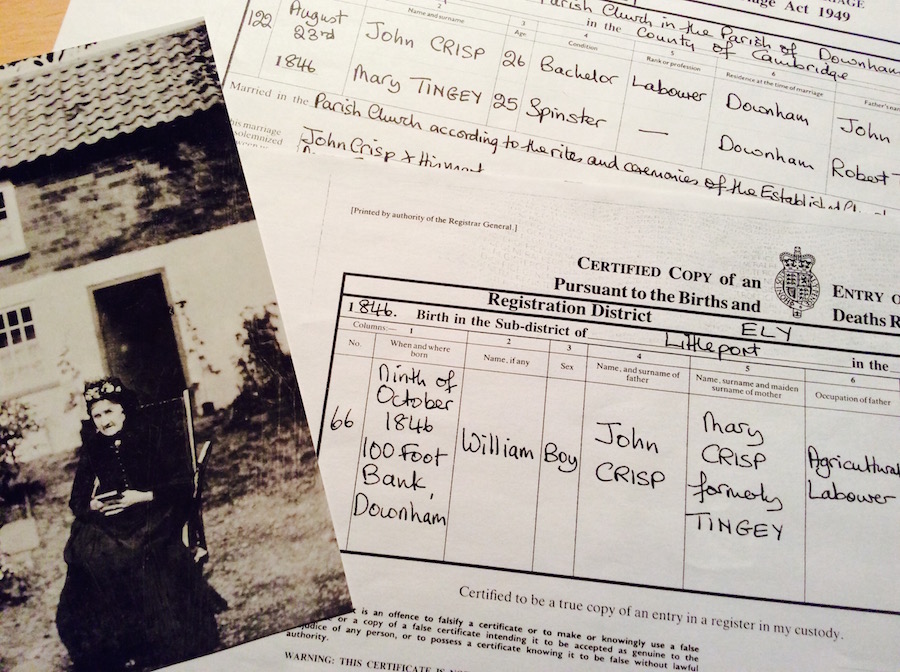
A photograph of Mary Crisp (née Tingey, later Martin and Watling), with copies of her marriage certificate to John Crisp, and the birth certificate of their only son, William Crisp.

I already had Mr Crisp Jnr’s (William Crisp) birth certificate from 1846, and the marriage and death certificate of his father John Crisp (m: 1846, d: 1847). By July 1850, widow Mary Crisp (née Tingey) had married her second of three husbands – my great great great grandfather – James Martin.

William Crisp remains with his mother for the 1851 and 1861 censuses in Little Downham, at the household of his step-father. In fact, the 1861 census lists him as William Martin, rather than William Crisp.

Things get rectified by 1871, when his Crisp name is reinstated. Here, he’s living in the fenland parish of Isleham. This village isn’t far from Soham, and is not a parish that any of my other relatives appear to have passed through (hence having not stumbled across him before).

With the census found, it told me that he was now 24yrs old, living at Lark Farm Cottage, with his wife Tabitha, and their 2mth old son John (in memory of both of their fathers). A quick dig on Ancestry, and FreeBMD showed that Tabitha was most likely Tabitha Large.

Where was the Selina that the story had spoken of?

Another census shows the family at the West Bank of River Lark in the parish of Isleham, Cambridgeshire for 1881. William was ’30’, and heading up a family of 6 children (John, James, Rosetta, Eliza Ann, Susan, and Mary) with Tabitha.

However, by the 1891 he’s missing, and so is Tabitha. Was this the tragedy with measles?

The North?

A little further digging, and some of the Crisp children turned up – still living at West Bank, but this time, George Butcher is head of the household, with Tabitha (now Butcher). A young Alfred Butcher is also included in the household, born about 1890.

Next stop was the Isleham parish registers to find out what’s been going on.

Here, I find that Tabitha Large (confirmed!), and William Crisp, having married on 20th May 1869 at Isleham parish church, went on to have eight children between 1871 and 1886.

FreeBMD notes that William died in in 1886, but Isleham and Soham don’t contain his burial. I shall have to explore this further. His burial did not take place in his native Little Downham, Ely Cemetery, Wicken, Fordham, or a number of other nearby churchyards.

Having lost William for now, I continue after Tabitha, but I soon find that she’s missing too… only to find her in 1901, aged 47 years, up at 29 Charles Lane, Milnrow, Lancashire, England.

There’s that ‘move up North‘ then.

Into the mills

At this time, George is noted a labourer at a Brickyard. Tabitha’s son Isaac Crisp is noted as a ‘Cotton Presser’, Rosetta Crisp as a ‘Woolen Weaver’, Eliza Ann Crisp as a ‘Pattern Card Room Hand’, and Mary Crisp is noted as a ‘Bread Maker’. It’s possible that the children were employed at the nearby Ellenroad Mill. Clearly the mills were putting a roof over the family’s head.

By the time of the 1911 census, it’s revealed that Tabitha has had 4 children and that 3 of them died. This must surely refer to her children with George Butcher, but i’ve not yet checked for their names.

The Traveller’s Rest

Whilst I lose George after 1911 (was this the measles?), Tabitha ends her days back at  the aptly named ‘The Traveller’s Rest‘ in Towns End, Soham, Cambridgeshire on 29th June 1921. She was 69 years old. Why was she back there?

Well, her second child, James Crisp (known as ‘Jim’) is noted as Publican – presumably of The Traveller’s Rest. He is noted as an executor of her estate.

But what about Selina?

Twenty-five years before Tabitha’s death at James’ pub in Soham, he had walked the aisle on 17th October 1896…. when he married Selina Collen. Selina outlived James (who died in 1944), having raised a family of at least five children with him.

Unravel those stories and memories

So, what turned out to be a snippet of oral history, handed around and down my branch of Martin family, which is vaguely related to the Crisp family (William Crisp is apparently my Half Great Great Great Uncle!), it turns out to be loaded with facts… albeit somewhat jumbled.

There’s still a few loose ends – death certificates will, or newspaper articles might, reveal details of whether the measles story is true. The identity of Selina was also generation out, and the wrong bit of family went ‘up North’ – it was all in the story.

For me, it proves that those little oral snippets, or those scribbled notes, are just as important as those official records. In fact, they are often more interesting. Using official records to help untangle these family stories is the trick…. regardless of how long you take to start work on them!

Happy hunting!

Andrew

Wordless Wednesday: Sea Cadets

Today’s Wordless Wednesday themed post is a 1940s photograph of my grandfather at his Sea Cadet Corps.

Sea Cadets in Cambridgeshire, approx 1945

Is there a ghost in my family tree?

It’s not every day that you find a possible relative who was reportedly haunting a street. I turn ghost-hunter, meets ghost-buster, to see whether there’s any truth in the story.

I love a good ghost story, and more so the ones that are written about the area that I know well.

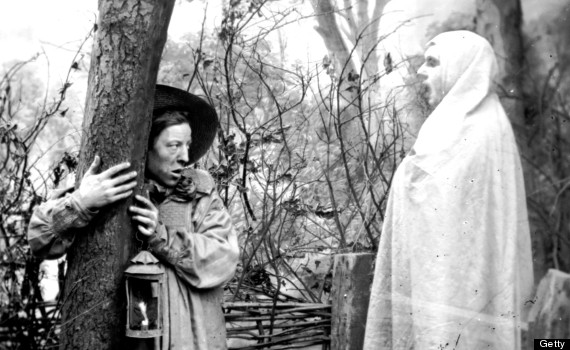
A victorian photograph of a mocked haunting
Did Jeremiah Newell return from the grave? Does he return, looking for his bed? Photo: Getty

There’s lots of ghostly stories about Cambridgeshire – ranging from ghosts of Oliver Cromwell, to the beastly Black Shuck. I’ve even been shut in the pitch black of Peterborough Museum basement overnight with night vision cameras. I’m a complete sceptic, and one that doesn’t get scared.

On one of my many ventures into bookstores, I picked up ‘Ghosts & Legends of Cambridgeshire‘ by Polly Howat (1998, Countryside Books), and when I got to page 41, I found myself reaching for a pad, pencil, census returns and parish register transcripts.

Howat’s story is about a Jeremiah Newell of Ely, Cambridgeshire. This uncommon surname and the location fits perfectly with my Newell family tree.

According to her write-up, Jeremiah, or Jerry to the locals, liked a drink. And on one night he had been drinking in his local pub – The Royal Oak on the corner of Potter’s Lane and Back Hill.

The Royal Oak pub, Ely, Cambridgeshire
The Royal Oak pub (now private house) sits on the corner of Potter’s Lane and Back Hill, Ely. Photo: Simon K.

He would have waved goodbye to (or been ejected by) landlord William Fenn, and made his way down the side of the pub towards his bed in Potter’s Lane. It appears to have been his last.

It’s safe to assume that Jeremiah was likely to be somewhat drunk as he staggered that short familiar few meters home.

The next morning, the residents discovered Jeremiah curled up, on top of a dung heap. Presumably, this would have seemed warm and comfy to a drunken Jeremiah, and perhaps he mistook it for his bed… but he had died during the night.

The Cambridge Chronicle of 17th November 1866 backs up the story  – with a guess at what Jeremiah had slept in or on, and complete with quotes from two residents who witnessed Jeremiah’s return (one of whom appears to be quite the wordsmith).

Cambridge Chronicle 17th November 1866
The Cambridge Chronicle report of Jeremiah’s death and subsequent haunting of Potter’s Lane residents in Ely. Copy held at the Cambridgeshire Collection.

The newspaper article suggests an exorcism was requested by residents, but it is not clear whether it ever took place (not sure where i’d find that information), or whether the drama of the story led the reporter or their contacts, to stray a little from reality.

The Stamford Mercury

The Stamford Mercury, which is not the local newspaper, and perhaps therefore has a different set of reporters, carries a very different story. I found a copy of this on FindMyPast. It’s dated from the day of Jeremiah’s funeral (2nd November 1866), and so doesn’t make reference to his ghostly return.

The Stamford Mercury claimed:

  • Jeremiah Newell was found alive in a puddle by a gas man (the gas works were right nearby)
  • Jeremiah Newell was escorted to The Black Swan pub – next to The Royal Oak (and just off to the left of the photo above).
  • Jeremiah Newell was given beer, demanded gin, and then hit his head after dozing and falling over.
  • Jeremiah Newell was laid outside in the sunshine but was found dead shortly after.

These events are completely different from the other two, and I’m tempted to believe that the report from the non-local Stamford Mercury may well be more accurate.

Finding the facts on Jeremiah Newell’s death

Believer or non-believer bit aside, how can I get closer to telling the proper version of this fun story on Halloween?

To try to help me resolve this, I ordered his death certificate (to find cause and location), and I contacted the team at Cambridgeshire Archives to attempt to locate a copy of the Inquest.

Sadly, floods in the 1960s decimated a lot of Ely records (including the 1861 census), and according to the Cambridgeshire Archives team, it seems that the inquest book covering this period was lost. This is a big shame for unpicking this story.

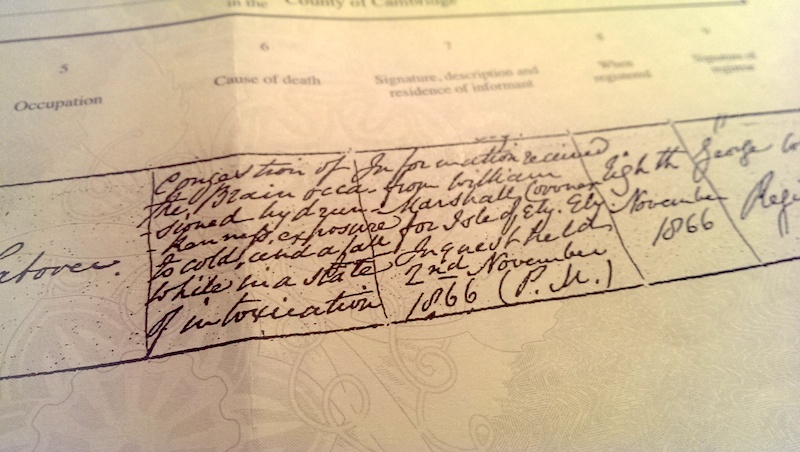
Jeremiah  Newell's death certificate, noting his cause of death.
Jeremiah Newell’s death certificate, noting his cause of death.

As for the death certificate, it revealed that he died on Halloween – precisely 148 years ago today.

In what is probably one of the fullest descriptions given in a ‘Cause of death’ column that I’ve yet seen:

“Congestion of the Brain occasioned by drunkenness, exposure to cold, and a fall whilst in a state of intoxication”

The informant box is equally crammed with writing:

“Information received from William Marshall Coroner for Isle of Ely, Ely. Inquest held 2nd November 1866 (P.[?].)”

So, it seems that Jeremiah died following The Stamford Mercury’s account of events.

Perhaps with his death taking place on 31st October 1866 – Halloween – the residents had taken the opportunity to dramatise his departure, when really he was just victim to his alcohol abuse.

I imagine that the Inquest may have specified any evidence of the gas man, and also which pub he died in, but that now remains a mystery.

Is Jeremiah Newell related?

He’s in the right place, at the right time, but linking him up has proved a little tricky.

Jeremiah was the second of three known children – John (b.c.1809), Jeremiah (b.c. 1814) and Mary (b.c. 1816). All were baptised at Holy Trinity, Ely, Cambridgeshire, as the children of John Newell and his wife Alice (née Block/Black).

Whilst it’s possible to see them together in 1841 and 1851, it’s the earlier records beyond Jeremiah’s Newell grandparents that are ambiguous with common names.

My Newell’s remain in Ely either side of the dates that I’ve found for Jeremiah, his parents, and his nieces and nephews. The connection remains elusive, but tantalisingly close. I guess this bit will haunt me a bit longer.

Jeremiah Newell’s timeline:

  • Jeremiah Newell was baptised on 25th June 1814, at Holy Trinity church, Ely, Cambridgeshire.
  • He was the second of three known children of John Newell (soldier) and his wife Alice (née Block).
  • Jeremiah appears to have married widow Susannah Bidwell (née Pigeon) on 4th September 1858 at Ely.
  • Jeremiah died on 31st October 1866, of injuries sustained whilst drunk, and in cold weather.
  • Jeremiah was buried, aged 52yrs, on 2nd November 1866 at Ely cemetery.
  • The burial register notes him as having lived on ‘Back Hill’ (which is the adjoining road).
  • The Cambridge Chronicle reported the haunting on 17th November 1866.
  • Polly Howat’s book, re-tells the story, 132 years after his death.

Does the ghost of Jeremiah Newell continue to wander Potter’s Lane?

I’ve previously wondered whether the dead could help solve genealogy puzzles, so perhaps I should pop along tonight to see if Jeremiah is willing to talk…. and clear up the confusion over what really did happen that fateful night in 1866.

He might even be stone-cold sober by now.

Happy Genealogy Halloween!

Cambridgeshire Family History Fair 2014

A look back at the Cambridgeshire Family History Fair, which took place on October 25th 2014 at Girton, Cambridge.

Yesterday saw the second Cambridgeshire Family History Fair take place – a free genealogy and local history event held in Girton’s Glebe School on the north side of Cambridge.

The Main Hall at the Cambridgeshire Family History Fair 2014.
The main Exhibition Hall at the Cambridgeshire Family History Fair 2014.

This year’s fair seemed much busier than last year, and although it seemed that there were fewer talks (one room, rather than two), this didn’t seem to affect the hustle and bustle in the main exhibition hall.

I went along for the whole day (10am-4pm), as I had my eye on 3 of the 4 expert talks, and also had a few genealogy hurdles that I wanted to try to resolve with the Suffolk Family History Society and the Norfolk Family History Society. I also hoped to bump into the postcard stall that I’d seen at last year’s fair… as I had a specific card to find.

Mike Petty MBE: Resources for Researching Cambridgeshire

My first talk of the day was the first time that I had attended a talk by Mike Petty MBE.

His fifty years of collectively working with the likes of The Cambridgeshire Collection, the Cambridgeshire Association for Local History (for which he is currently President), writing a weekly column for the Cambridge News, and being a seasoned lecturer and author for all things Cambridgeshire, has earned him an unrivalled knowledge of the history of the county, and the resources available to research it.

Mike admitted he’s not a genealogist – he’s a historian. This actually makes him a perfect speaker to genealogists, as his talk showed a full room how to get beyond the basics of censuses and BMDs, by digging out the more interesting information about Cambridgeshire that is tucked away in newspapers, in photographs, maps, and books.

As the audience were quickly scribbling down notes, Mike continued to show how to use online indexes to help make your next visit to a Cambridgeshire archives resource more time efficient. He spoke passionately about the vast card indexes that hold so many clues to resources, but which are themselves tucked away due to space limitations.

I’ll definitely make more effort to attend his talks in future – I feel like he could have talked for hours.

Postcard hunting

With a break between talks, I set myself off to see if I could find the Desira Postcards stall that I visited last year, and where I had bought one of two postcards of my Cross family’s bakery shop on Forehill, Ely.

Thankfully, the postcard I saw last year was still within their collection, so (ignoring the £8.50 price tag) I bought it, as it’s an example of how Frederick Thompson Cross was advertising his business. He died in 1911, after which his son Frederick Vernon Cross took over.

Advertising postcard for Frederick Thompson Cross' tea rooms on Forehill, Ely, prior to 1911.
Advertising postcard for Frederick Thompson Cross’ tea rooms on Forehill, Ely, prior to 1911.

Carl Warner: Crowdsourcing History at IWM Duxford

Having enjoyed the collaborative crowdsourcing Lives Of The First World War project that IWM launched earlier this year, I was keen to see what Carl Warner (Imperial War Museum Duxford’s Research and Information Manager) was going to tell us about their Second World War project: American Air Museum.

IWM American Air Museum
The IWM American Air Museum website has launched.

This time, Carl explained that IWM has just launched a new website containing around 15,000 photographs of the USAAF, and that members of the public can register and then add their own, whilst also discuss other images – in a hope to bring names to faces and places, and record the memories of those who remember the presence of American Airmen in Cambridgeshire during WWII.

My own Grandmother remembers the American airmen near Mepal, Cambridgeshire, and like many of her generation, it’s pretty much a story about eating ‘candy’ given to them. Little could she understand then as a child, that when she waved them off as they flew away, that many would never return.

Kathy Chater: How To Write Up Family History

Ex-BBC Researcher, turned professional genealogist, historian and author, Kathy Chater was my third and final expert speaker to listen in to. Her career background, like that of Richard Benson, would give me the impetus and expert advice I need to decide on how best to write up some of my own family history stories beyond the realms of this blog, and a characterless list of names and dates.

Kathy’s advice on breaking down your mountain of research into chunks and focussing on telling each piece of one person’s life at a time, certainly felt to me like a much easier approach. She then suggested that you could then weave a few of these into a story – trying to bring in national, international, social and family events to flesh out the stories and set your ancestor into context.

I’ve certainly been looking at how national and world events may have impacted on my relatives – looking at trends in silk and cotton weaving, the impact of the railways, enclosure acts, Cambridgeshire drainage acts, and of course the horror of wars.

Like Mike Petty, Kathy recommended turning to newspapers – not just the stories, but the adverts and reviews too – all which would help you to understand the world in which your relatives lived.

It was refreshing to hear Kathy give a shot of reality with her comments on being realistic about the publishing of the book – recommending that you should probably just stick to publishing it yourself within your family, and not a publisher. She amplified a message that I’ve heard regularly – file a copy of your book with relevant archives and organisations.

Recharged with enthusiasm to get stuck in to what was the 5th of my 5 New Year Genealogy Resolutions for 2014, I hope to at least be able to decide whether I’m going to aim for a novelised or non-fiction approach.

Another great genealogy fair!

I’d like to say thank you to all of the speakers that I saw, and also to the hard work of the Cambridgeshire Family History Society team who organised the event. It’s great to see this growing, and I look forward to next year’s event.

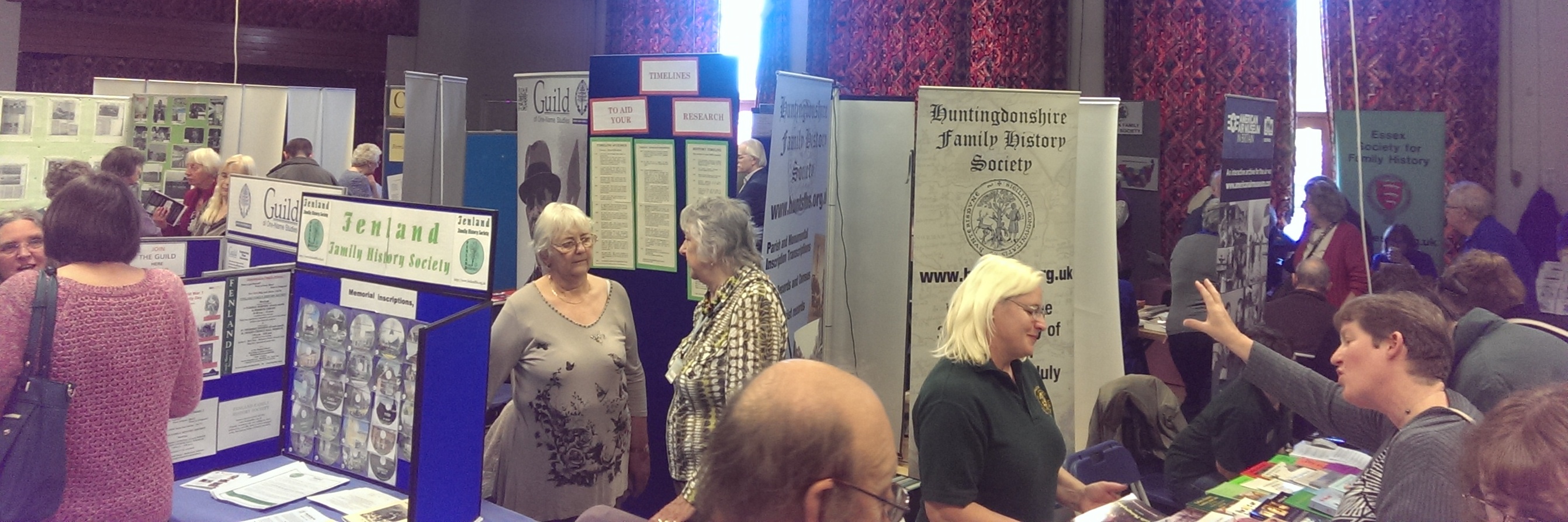
Exhibitors at The Cambridgeshire Family History Fair 2014.

In the meantime, The Big Family History Fair organised by the Huntingdonshire Family History Society returns in May 2015.

Surname Saturday: The Haylock family

This week’s SURNAME SATURDAY themed post looks at the HAYLOCK family of Ely, Cambridgeshire, England.

This week’s Surname Saturday themed post, takes a look at my Haylock family connection, living in Ely, Cambridgeshire, during the 18th and early 19th Centuries.

I’ve seen the Haylock family turn up amongst the branches of my relatives, but only recently have I stumbled across them in my ancestry.

The most recent ancestor to carry this name was my 6x Great Grandmother, Mary Haylock, wife of my 6x Great Grandfather, Francis Newell.

St Mary's Church, Ely
St Mary’s Church, Ely. Photo: Robert Cutts via Creative Commons.

Mary was one of at least three (perhaps five) children of John Haylock and his wife Elizabeth (my 7x Great Grandparents). It seems that Elizabeth’s maiden name was Elizabeth Parson, but there is a bit of questioning here, as whilst a John and Elizabeth Haylock had two sons (both named John) in 1769 and 1770, the only marriage for a John Haylock and Elizabeth at any time around those dates, is actually in 1772 in a marriage at St Mary’s Church, Ely (right place) – after their baptisms (wrong time), and just before Mary’s (maybe not so wrong after all).

I’m therefore documenting it, but treading carefully with this option.

Therefore, the confirmed legitimate children were:

  1. Mary Haylock b.c.1773 d.Jul/Aug 1826 (my ancestor)
  2. Sarah Haylock b.c.1776 (and witness at Mary’s marriage to Francis Newell)
  3. Flanders Haylock b.c.1779 (son)

I’m related to ‘Little John’

Whilst the legend of Robin Hood may well have been a fabricated story, ‘Little John’ does indeed sit in my ancestry.

My 7x Great Grandfather John (mentioned above) is noted at the 1773 baptism of daughter (and my 6x Great Grandmother) Mary as ‘little John’.

I’m pretty sure we’re not talking height here, it’s far more likely to have related to his position in family hierarchy – and is probably the son or grandson of another still living John Haylock.

This is where my trail goes cold for now.

However, the Ely Haylock family turn up a few times in other branches of my ancestry including as spouses in my Newman and Yarrow trees. I also once had an English teacher called Mrs Haylock.

Variants of Haylock

In my research in just the St Mary’s parish register of Ely, Cambridgeshire, I have found six variants of Haylock. Those being:

  • Heylock
  • Healock
  • Hellock
  • Helock
  • Harlock
  • Herlock

Some of these variants interchange during the same year, an indication at just how volatile the spelling was, how low literacy was, or how thick the fenland accent was carried across. As this just represents one parish, I’m sure there will be other variants.

There’s even a memorial tablet from 1863, to a Charles Theodore Harlock who drowned aged 29. I’ve no idea if he might be related, but could no doubt determine his immediate ancestry through the records and available censuses.

Origins of Haylock

Ancestry.com suggests that the origin of the name Haylock comes from an old Anglo-Saxon personal name.

They also show that in 1891, Cambridgeshire was home to 23% of all of the UK’s Haylock name-bearers.