Why keeping up with the neighbours is important in genealogy

If you’re not examining your ancestor’s neighbours, then you could be missing some key information.

These days, quite a lot of people have no idea who their neighbours are – their names, what they do, where they work etc, and the only interaction may be a quick ‘hello’, a nod, or occasionally collecting parcels from each other.

It’s just a sad sign of the times that as our lives become busier, and as families become more geographically spread, that we just don’t have the time or inclination to socialise with the people who live just a few feet away.

It’s not always been like this though – looking to the censuses of at least the early 1900s, you may discover that your ancestor’s neighbours play a much more significant role in your family.

‘Neighbours. Everybody needs good neighbours’

When the 1861 census took place, the enumerator for Swaffham Bulbeck in Cambridgeshire, England, visited Village Street and noted down the names and details of everyone there including four families who were all living nextdoor to eachother – each with different surnames.

1861 census return for Village Street, Swaffham Bulbeck, Cambridgeshire.
The 1861 census of Village Street in Swaffham Bulbeck, shows a number of families.

The enumerator may well have known the Newman, Skeels, Fordham and Levitt families seen in the example above, but the census does not shed any light onto the significance of the proximity of these 18 people.

The 18 people on this census folio are actually four generations of the same family, and this folio is a snapshot of how they had stayed together as the families grew. By trawling back to the 1851 census, you are able to find the core family again, in a much smaller family group.

The seventy-seven year old widow, Elizabeth Skeels, née Richardson, is the great grandmother and matriarch of the family. She appears here in 1861 as living just feet away from her daughter’s (Elizabeth Levitt, née Skeels) family, and is surrounded by the families of her daughter’s oldest children (Emma Newman, née Levitt and Harriet Fordham, née Levitt) whilst the younger children are still at home.

At first glance, I would have spotted Skeels, or if i had been in Newman or Levitt ‘research mode’ I’d have seen them and not necessarily spotted or realised the importance of the families around them.

So, keeping an eye on what’s happening nextdoor on the census returns can help you in your research.

Four families in a row is probably my best when it comes to related neighbours – can you beat that? Or have your ancestors had a famous/infamous neighbour? Let me know in the comments below.

Wordless Wednesday

Wordless Wednesday – Ernest Herbert Barber (1902-1983) in his garden circa. 1954.

Ernest Barber in his garden

What happens when expectant parents are overcome by Jubilee fever?

What happens when expectant parents are overcome with Jubilee fever?

Amidst all the celebrations seen recently with Queen Elizabeth II’s golden and diamond jubilees, I wonder whether expectant parents have felt inspired to mark the occasion? Go back to Queen Victoria’s jubilees and I can find two examples in my family tree.

Queen Victoria wearing her small diamond crown in 1882.
Queen Victoria’s jubilees inspired expectant parents. Photo: Alexander Bassano.

George Juble Bishop was born in Wicken, Cambridgeshire as the last of the 18 children of James Simpson Bishop and his wife Ann (née Bowers) in 1887. This was of course the year of Queen Victoria’s Golden Jubilee – which kicked off on 21st June. George was baptised the month beforehand.

His mother died when he was 2yrs, and his father when he was 14yrs (in 1901). He appears on the 1901 census living in nearby Cottenham with his older sister Mary Ann Bishop who has since married John Rayment. When he reached 35 in 1922, he is found leaving the UK and emigrating to Australia, where he can be found living in Flinders, Victoria, Australia as recent as 1963, by which time he is in his late 70s.

Arthur Jubilee Barber was born in the year of Queen Victoria’s diamond jubilee – 1897 – to Reuben Barber and his wife Elizabeth (née Dewsbury) of Witchford, Cambridgeshire.

Arthur was widely known as ‘Juby’ and on the 1911 census, he even appears as ‘Jubilee Barber’ aged 13. It seems that he died in 1959 up in Staffordshire, but this is not for certain – as i seek further evidence to support this.

The name itself seems to have been unisex, with a Jubilee Barber marrying Thomas Hockaday in Melcombe Regis, Dorset in 1850. Perhaps this Jubilee was named after the celebrations relating to King George III’s jubilees.

The death of a child

William Martin died aged 10 in 1890 when he was entrusted with a horse and cart. The Factory Act (1891) could have protected him and many others from a working childhood.

Long before health and safety was invented, before ‘risk assessments’ unified a workforce with a sigh, and compulsory education was implemented, children were commonplace in factories, mines and other workplaces.

William was the fourth of the twelve children of my Great Great Grandparents, James Martin and his wife Sarah Elizabeth (née Giddings), and one of two of their children to die that year.

An inquest was held at Pyemoor, on the body of William Martin, a boy of ten years of age. He was entrusted, the previous day, with a horse and manure cart. He was lifted on the horse and afterwards found face downwards on the ground with an internal injury and died before the doctor arrived. The jury returned a verdict of “Accidental Death”, expressing their disapproval of children so young being entrusted with a horse and cart, the boy’s master being one of the jury – 31st July 1890.

Like most of those families living in fenland during the 19th century, children working in agriculture meant that the family could afford to keep food on their table and avoid the workhouse.

Whether William, at 10yrs of age, was employed or whether he was just there, is unclear (‘master’ may have been employer or his father), but his accidental death would never have been an easy situation to deal with.

The Factory Act (1878-1901)

The Factory Act (1878) meant that children under the age of 10 could not be employed in any trade, and that compulsory education ran up until the age of 10.

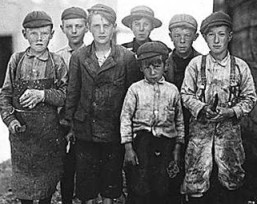
Group of child workers from the 19th century.
A group of unknown Victorian child workers.

This act was key at keeping the youngest of children away from dangerous environments such as mills, mines, glassworks, and other industries with heavy machinery – or at least it meant that those who continued to employ children under 10 could be prosecuted (and this was quite common).

The act also meant that 10-14yr old children were allowed to work half-days.

The act was revised again in 1891, upping the age to 11 years, and again with the introduction of The Factory and Workshop Act in 1901 to 12 years.

The slow pace of laws to protect children in the UK, and the harsh reality of bringing up a family on a railway labourer’s wage, may have contributed to William going to work at aged 10 on that fateful day.

When a Princess became the Queen

On 6th February 1952, King George VI died, and Queen Elizabeth II began her reign. Elizabeth’s reign is the second longest, beaten by her Great Great Grandmother, Queen Victoria.

The Daily Express front page on Thursday February 7th, 1952.

“The King, who retired to rest last night in his usual health, passed peacefully away in his sleep early this morning”.

Those were the words from Sandringham at 10:45am on 6th February 1952 – the day that Princess Elizabeth became Queen.

Princess Elizabeth and her husband, the Duke of Edinburgh, were staying in the Treetops Hotel in Kenya – unaware that the King had died during the night at Sandringham. At 2.54pm (11.54am London time), the Duke was told of the King’s death and he delivered the news to is wife.

Delayed by thunderstorms, the new Queen and her husband flew back to London.

Queen Elizabeth II was crowned on 2nd June 1953, also becoming ‘Head of the Commonwealth’ – a title held previously and only by her father. Now at 86 years old, she marks her 60th year as Queen with a 1,000 boat strong floatilla on the River Thames through London, whilst numerous community events are staged up and down the country.

Queen Victoria still the longest reigning monarch

Queen Victoria by George Hayter
Queen Victoria by George Hayter (1860)

Queen Victoria still holds on to the longest reign – reaching just over 63 years (1837-1901) – with Queen Elizabeth II now just three years behind by celebrating her Diamond Jubilee in 2012. King George III ranks as third with a reign that lasted just over 59 years (1760-1820).

Click the image below for a video of the elderly widowed Queen Victoria arriving at a garden party in her honour.

Video of Queen Victoria at a Garden Party
Click image for a video of Queen Victoria arriving at a Garden Party.

Victoria celebrated her Golden Jubilee in 1887, and her Diamond Jubilee in 1897. Victoria died in 1901, with the throne passing to the current monarch’s grandfather, King George V.

Wordless Wednesday – Ann Bowers carte-de-visite

Wordless Wednesday – Ann Bowers carte-de-visite

Ann Bowers (1843-1889)

National Mills Weekend 2012

National Mills Weekend 2012 – visiting The Great Mill at Haddenham, Cambridgeshire.

This weekend has been National Mills Weekend in the UK.

The Great Mill
The Great Mill at Haddenham, Cambridgeshire.

I only realised that this was the weekend – but I was able to make the journey to The Great Mill at Haddenham, just 5 miles from me. The weekend also coincided with Haddenham’s ‘Blossoms and Bygones’ event, so the village was decked in bunting, musicians, fair rides and vintage vehicles.

I’d been to the Mill a couple of years previously and the current owners were very kind to show me around this 5-storey mill both then and now.

The reason I first went along originally was because of the unfortunate and violent death of my Gt x 5 Grandfather, Philip Newman, a miller and baker, died when he was caught in the workings of a mill.

Inside The Great Mill
The mill is essentially a vast wooden machine.

The mill (seemingly known most recently as ‘Neville’s Mill’) where he met his gruesome end no longer stands, but The Great Mill was standing opposite ‘killer mill’ back in 1809 when the accident happened. I wanted to find out what it would have been like to be inside a windmill similar to the one that my ancestor would have worked.

Neville's Mill, Haddenham
A photo of Neville’s Mill which stood opposite The Great Mill and killed my ancestor in 1809.

The Great Mill was built in 1803 by Daniel Cockle, and it’s still clear today as to what an engineering feat it was, with cogs, wheels, bells, sails all over the place – each with their own specific purpose in cleaning grain, moving it around, grinding it, sifting it etc.

The Mill was handed down through the Cockle family for almost 100 years until 1901 when it passed to the Peters family. It then moved on to the Lawrance family in 1906 until becoming unloved in 1980.

It stood derelict until 1992 when it was restored. 20 years on, and the Mill is undergoing a new restoration with the kerb (the part up in the top that allows the entire cap and sails to change direction) needing some attention.

The current owners are busily restoring it, and hope to one day have it working again like the one a few miles away in Wicken (which i visited on National Mills Weekend in 2010).

National Mills Weekend 2010: Wicken
The working windmill in Wicken village, Cambridgeshire.

If you’ve never been inside a windmill, i recommend it. It is cramped, there are lots of awkward stairs/ladders to navigate, but it’s a wonderful experience. I imagine that millers like my ancestor Philip, would have been able to quickly ascend and descend those ladders, fueled by necessity.

If you’re lucky to go into a windmill with its sails working, then you will soon realise the sheer power and complexity of them. And you’ll realise too that they aren’t noisy.

Where once every village had a windmill, there are just a scattered few. The cheaper costs of importing grain from the likes of Australia in bulk and then milling it at the UK ports rather than sending vast amount of grain inland, quickly terminated the nation’s windmills and made our millers jobless. By the end of the 1940s/50s, working windmills were all but a thing of the past.

Why I love the 1851 UK Census

Why I Love The 1851 Census: Despite having used 8 different censuses, the 6th census (1851) is my firm favourite – and here’s why…..

Whilst the 1940 US Census continues to cause a storm with genealogists across the Atlantic, I’ve fondly turned to my favourite UK census of them all – the good ol’ 1851.

A page from the 1851 Census.
The 1851 census builds bridges between data.

I’ve used 8 UK censuses in my research – 1841-1911 – and each one is different – adding or omitting different questions, but it’s the UK Census that took place on the night of the 30th March 1851 that’s my favourite. Here’s why…

Building data bridges

I use the 1851 census to verify information that I’ve picked up from the scant data of the 1841 census. This enables me to build bridges with data – following families from the 1841 census, through to the 1861 census.

The 1851 census also gives the opportunity to verify those people who were alive before 1837 when certification was introduced for births, deaths and marriages. Whilst the 1841 census captures a more of those people, it’s not much more than a head-count with poor spelling and some seriously unreliable ages.

More household detail

The 1851 census was the first to ask and record answers about relationships between household members. This piece is very useful – again helping me decipher the 1841 and pre-certification records.

The 1841 did ask whether people were born in the same county as that which they were being recorded in – so gave a ‘yes’ or ‘no’ answer in the county box, but the 1851 census goes further by also recording the parish AND county of birth. It also records whether the person had a disability – namely blind or ‘deaf-and-dumb’.

The State Opening of The Great Exhibition in 1851
The Great Exhibition took place in 1851.

The 1851 census also asks for more detail about occupations – and it’s here that you can find some interesting insights into what your family members did, and it can give you an insight into where in the social classes they would have sat.

The 1851 census has been publicly available since 1912 as it was not covered by the 100 year retainer rule. I have no idea what the demand was like back in 1912 when it became available, but I doubt that it matched the US 1940 Census demand – which saw 37 million website hits overload the website within 8 hours.

Were people queuing up in the streets in 1912 to read the 1851 census? I’m guessing they probably weren’t.

Why not love the 1911 UK census?

Just for the record, the 1911 census is a close second – for the sentimental moment you see your ancestor’s handwriting, and the very useful ‘years married’, ‘number of children born’ and ‘number of children living’ data.

The reason that the 1911 census is not my first love is partly down to being of an age where I personally knew many people who were alive during this period, and still know relatives whose siblings were born before it took place. Also, being part of a relatively close family, I’ve found the 1911 census not as revelational as it’s 1851 counterpart.

Which is your favourite census and why?

Tweet your love for the 1851 Census RIGHT NOW!

Tombstone Tuesday – William Heylock of Abbotsley

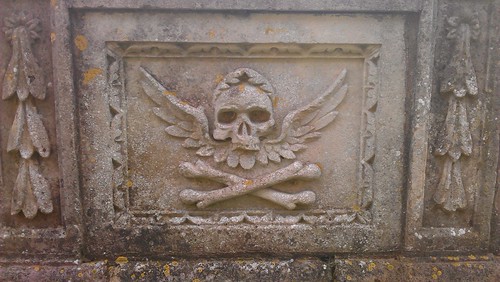
Tombstone Tuesday – A weekly blogging meme. This week it’s an ornately carved tomb of William Heylock in the churchyard of Abbotsley in Huntingdonshire, England.

Ornate carvings on a tomb in Abbotsley
William Heylock's grave at Abbotsley has ornate carvings.

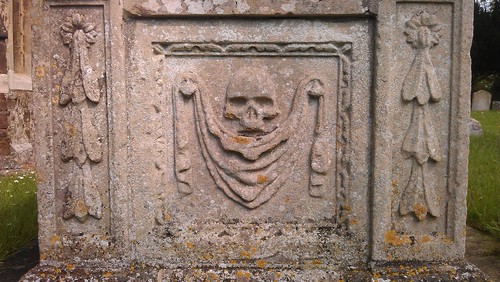
Spotted this tomb with ornate carvings on it at the weekend in Abbotsley, Cambridgeshire (or Huntingdonshire as it was when the person was buried). The tomb belongs to William Heylock, the son-in-law of the then vicar James Aspinall at the time of William’s burial in 1688.

William’s tomb is part of a memorial to his generosity – he had given £5 per year (remember, this was written in 1688. £5 in 1688 had the same spending worth as £437 in 2005) to the poor people of the parish each year, and £1 to the vicar each year.

Ornate carvings on a tomb in Abbotsley
Another carving design on William Heylock's tomb

He also gets a mention inside the church. Notes suggest that his family held land in Hertfordshire and Bedfordshire – which probably accounts for his wealth.

The Big Family History Fair 2012

The BIG Family History Fair 2012 – the Huntingdonshire Family History Society event took place this weekend.

This weekend I went along to the BIG Family History Fair 2012 at St. Ives, Cambridgeshire (alright, Huntingdonshire).

The BIG Family History Fair banner
The demand for that ample free parking was a little underestimated.

The event, which was organised by the Huntingdonshire Family History Society took place at The Burgess Hall and soon packed out their car-park. Fortunately for me, my gym is right next door, so I arrived early for a workout before heading nextdoor for some serious browsing amongst the crowds.

For those of you not in ‘the know’, Huntingdonshire stood as an administrative county until 1974, when it was absorbed by its neighbour and became a district of Cambridgeshire. The up-shot of this is that researching the records means you need to remember that pre-1974 the county is Huntingdonshire, and its records are held in Huntingdon.

The event took place across two floors – two halls brimming with stands from those now familiar companies and societies like S&N Genealogy, the Cambridgeshire Family History Society,  the Fenland Family History Society, and My History. Upstairs were a series of talks organised by the hosts.

As you entered the venue, the team from Family History Magazine were by the door, and everyone was handed a Huntingdonshire Family History Society bag containing a free issue of the magazine (plus some leaflets, a Hunts FHS notebook and pencil – nice!)

Shoppers at family history stalls
Just a few of the stalls – a mixture of societies and commercial companies.

I went along to Maureen Nicholls‘ free ‘Illustrating Your Family History’ talk – a captivating and fun 40 minute talk on ways to bring interest to those data heavy trees, charts and documents that the genealogist spends their time producing. Some great ideas came to light – including the reminder that when you’re lost for a photo of YOUR ancestor doing something – show a representative image of the types of schools, costumes, work that ancestors lived through – instead of admitting defeat because you don’t have a photograph of THEM in that scenario.

Maureen’s delivery was as engaging as her ideas, and she offered an occasional glimpse of her own research – an aunt who died on-board the doomed SS Princess Alice, her family tree cross-stitch that went to the House Of Lords, and her penchant for jellied eels (yuck!).

Potton parish church, Bedfordshire
I bought the Potton parish church registers on CD-rom.

I’d already decided what my purchase of the day was going to be, and so having achieved the largest ‘tweet-up’ that Huntingdonshire has probably ever known by meeting up with fellow twitterer Jane ‘@RamblingGenes‘ Freeman – who proudly showed me her new Flip-Pal Scanner (see, told you I wouldn’t tell anyone you bought one), I moved over to my target – the Bedfordshire Family History Society stand which was busy but very helpful and where I managed to purchase the Potton parish registers on CD-rom.

I was really pleased to see the range of companies and societies represented here – it was always going to feel different from a Who Do You Think You Are? Live, but it seemed to be well organised and attended.

The goodie bag!
The goodie bag!

I did feel the venue was a bit hot and stuffy, and the bar-staff seemed a little surprised that people wanted drinks and food at the drink and food bar – definitely not the organisers fault here though.

The added bonus for me was that it was very local, and of course FREE to attend!

I look forward to next year’s show – hopefully it will one day be on for a whole weekend, or on for longer than 10am-4pm with lots more useful genealogy talks.