The Cambridgeshire Family History Society (CFHS) has revealed more details about their event in October 2013 – including free entry!
Following on from last week’s teaser, the details for the 2013 Cambridgeshire Family History Society Fair have been confirmed.
The Cambridgeshire Family History Society has confirmed on their Facebook Page that the event will take place at Girton Glebe Primary School, in the north of Cambridge on October 26, 2013, from 10am to 4pm. That’s six whole hours of genealogy to be had – meeting exhibitors and enthusiasts, and the great thing is that entry to the event is free!
There will also be a programme of expert lectures (which are charged at £2 per head, per lecture), and the details of these will be confirmed in due course. There will also be a free internet research room, run by the Society’s researchers.
In 2012, the Huntingdonshire Family History Society ran The Big Family History Fair which they confirmed would not be repeated this year.
Whilst this event isn’t on the same scale as those such as Who Do You Think You Are? Live or RootsTech, it will no doubt be an essential day out for anyone with genealogy and local history interests in Cambridgeshire and surrounding area.
Parking
There will be free parking on site, and the Citi 6 bus, which runs to and from the city centre every 20 minutes, stops near to the venue.
Author Anne Brontë’s headstone has been given an erratum plaque by the Brontë Society. Should headstones be corrected or left as a historical object?
Have you ever seen a headstone that carries incorrect information? Should it be corrected? Left as a historical object? Or should a correction be added?
I have just read this BBC article relating to the correction of an error on author Anne Brontë’s grave in Scarborough, North Yorkshire.
The error, her age at death, which should have been 29 rather than 28 years, has stood in the churchyard since 1849, but now the Brontë Society has made the corrections by adding a plaque alongside the original standing stone.
This is not the first time her headstone has been corrected – her sister Charlotte arranged the correction of five earlier errors.
Elizabeth Yarrow’s headstone doesn’t match burial records on several counts.
This reminds me of my own Great x 5 Grandmother, Elizabeth Yarrow (née Wright), whose own age, date, and year of death differs by two years depending on whether you’re reading the headstone, or one of the two parish registers that record her burial.
Dates range from 1837 to 1839, and her death seems to not to be covered by certification.
What do you think? Is it right to correct a headstone, preserve it with its error, or add an ‘erratum’?
May 2013 is ‘Local and Community History Month’ in the UK.
May is Local and Community History Month in the UK.
From 1st-31st May, communities throughout the UK will be reconnecting with their past as part of The Historical Association’s ‘Local and Community History Month’.
A series of events run by libraries, museums, archives, and local history societies will invite the public to get involved and mark the month-long campaign.
The Cambridgeshire Family History Society has revealed that a Family History Fair will take place in October 2013.
Last year saw The Big Family History Fair, hosted in St Ives, Cambridgeshire and expertly organised by The Huntingdonshire Family History Society, but sadly the society confirmed that it was not to be repeated this year.
Fortunately, the Cambridgeshire Family History Society have stepped in to fill the gap in Cambridgeshire’s genealogy calendar – and have just announced an event on their Society’s Facebook Page, with ‘fans’ of the page being advised to keep the 26th October clear for Cambridgeshire’s big genealogy event of the year.
The event venue is yet to be officially announced.
The Society also run a comprehensive range of events, ranging from regular themed talks, a club for those who are getting to grips with using computers and the internet, and they are also highly pro-active with transcribing parish registers.
Two 18th century Wills cast light on either sibling rivalry or on a way to avoid the restrictions of the inheritance laws.
Only a short while before their deaths, two 18th Century Barber ancestors who were generations apart, wrote their Last Will and Testaments. Were they trying to bridge family politics, or to cleverly work around inheritance laws?
The Will of Thomas Barber, carpenter of Witcham, 1706
On April 4th 1705, carpenter Thomas Barber of Witcham, Cambridgeshire, wrote his Will. One year later he was dead, aged 71 years.
The Will reveals that Thomas owned five acres at ‘The Dams Heads’ (now appears to be called ‘Dams Head Drove‘). This piece of land forms the centre of his Will and he lays out strict instructions to his children:
‘… I give and bequeath unto Wenham Barber my son and his heirs forever all that my 5 acres of fenn ground be the same more or less lying and being in a drain venn belonging to Witcham aforesaid called ‘The Dams Heads’, provided he and his heirs admit my daughter Winifred ye now wife of Paul Gawthorne and her heirs peaceably and quietly to have hold and enjoy all such fenn grounds as I shall by this my last will and testament give…’
So whilst Thomas leaves his land to his son, he leaves the right to enjoy to his married daughter WinifredGawthorne (Thomas’ half-sister). However, he may have foreseen some half-sibling rivalry, so adds..
‘…but if he or they any ways disturb or molest her or her heirs, then I give the aforesaid 5 acres hereby before given to my said son Wenham Barber unto Winifred Gawthorne my said daughter and her heirs forever.’
By adding this, he is clearly issuing his son Wenham with an ultimatum that allows his half-sister to enjoy the inheritance too.
Thomas goes on to leave his tenement, and 2 acres of land (‘ye Cow Crofts‘ – now Cowcroft Drove) to his other son John Barber – also making him the executor of the Will. John was a son from Thomas’ 2nd marriage – whilst Wenham and Winifred were children of his 1st and 3rd marriages respectively. Was John being trusted to play the diplomat here?
What happened next?
After Thomas’ death, the arrangement must have been in place but just 5 years later, Winifred died aged 36.
Now, had Thomas bequeathed his land to Winifred and not her half-brother Wenham, the 5 acres would have technically been owned by her widower Paul Gawthorne by default due to restrictions on what women could inherit (unchanged until the Married Women’s Property Act of 1870). By Thomas giving the land to his son, but allowing Winifred to enjoy it, he was in essence providing for both of these children, and keeping the ownership within the family.
Thomas’ 1706 Will stated that Winifred’s heirs could enjoy the land forever – although the oldest was just 15 when Winifred died.
Whatever happened after Winifred’s death is unclear, but the land returns to the Barber family, as found in Winifred’s half-nephew’s Will of 1729…..
The Will of Wenham Barber of Witcham, 1729.
Thomas‘ grandson,Wenham Barber of Witcham, wrote his Will on 30th October 1727. A year later at 41, he was dead. His third and final wife, Mary, had just 6 years of life left herself, remarrying in her final year to John Scam of nearby Sutton.
In all, Wenham’s three marriages brought him seven children, but at least three of these died in infancy or childhood, although I suspect that it was actually all but two that were dead by the time he wrote his Will, as they’re the only ones to get a mention.
His children, Wenham Barber (born about 1712) and Robert Barber (born about 1727) are the only two children named in his Will, along with Wenham’s wife (their mother), Mary.
At the time of writing the Will, Wenham owned land in the fertile fens northwest of Witcham, alongside the One Hundred Foot River. The ‘Damhead’ (now appears to be called ‘Dams Head Drove‘) was his main land (although he doesn’t mention its size) and he is careful as to how this asset is handled.
..I give and bequeath unto my wife Mary Barber all thereunto and profits of my Damhead ground abutting upon the 100ft bank which theeshall occupy and enjoy without indistraction for the term of 9 years. Expiring after the date hereof under this condition and limitation that if she ploughs it up or digs any turf in it, she shall forfeit it to my son Wenham Barber to whom I give and bequeath the sum of 20 shillings to be paid to him by my executrix upon the day his time is out and upon default payment she shall resign the aforesaid ground to him. Item at the expiration of the said term of 9 years to be commenced from my decease I give and bequeath all the my said Damhead and ground for ever to my said son Wenham Barber and to his heirs but if he dies before the age of 21 years. Then I give to my younger son Robert Barber.
Wenham’s younger son Robert was baptised at Witcham on 29th October 1727 – just one day before Wenham wrote his Will. Whilst the above is just an excerpt, it is very precise and I wonder where he got the 9 years (not 10) from? Why would he stop his widow from using the land for agriculture?
His Will also notes that the rest of his estate (including 4 cows, 6 heifers, 1 mare, household goods and his purse) were to the value of £17 and 10 shillings.
Again, there seems to be some kind of plan here. No doubt the family had worked long and hard to buy their lands, and so giving them up was something they wouldn’t do easily even after the current holder’s death.
Wenham appears to be restricting his widow Mary – stating that she is not allowed to do anything to the land other than profit from it, otherwise she’d forfeit it to their son. However, it doesn’t state that during the oddly chosen nine years, that Wenham isn’t permitted to farm it. This would leave the farming decisions to his son and heir, and therefore give him an incentive to work and build it up until he himself inherited it for his family.
Wenham Jnr did live beyond the age of 21, married and had at least 4 children. I have not seen Wills of Wenham or his younger brother Robert to see what happened to the land.
The Lythell family name is this week’s Surname Saturday theme, focussing on Stretham and Little Downham in Cambridgeshire.
The Lythell surname, which has many variants in Cambridgeshire during the 19th century, is this week’s ‘Surname Saturday’ theme focus.
My most recent ancestor to carry this surname was my maternal Great x4 Grandmother Rebecca Lythell. She was born in about 1821 in the village of Stretham in Cambridgeshire, and was the third of at least five children to John Lythell and his wife (possibly his 2nd or 3rd wife) Frances Howard.
This couple had five children between 1817 and 1827 (Sarah, William, my Rebecca, Eliza, Ann).
Their daughter Rebecca, gave birth in 1840 to a son called William. She wasn’t married at the time, but soon married William Dewsbury of Stretham. William jnr adopts the Dewsbury surname at his baptism in 1842, taking Lythell to be his middle name. The newly-weds go on to have eleven children, with my Great x 3 grandmother being born in 1851.
John Lythell – serial dad
A few years earlier, Rebecca’s father John (c.1772-1830), appears in the Stretham baptism register with his daughter Alice in 1808, and her mother is noted as ‘Francess’. I’m guessing that this woman was probably my Gtx5 grandmother named above, and if it is, then this baptism occurs seven years before they married in 1815.
Earlier still, John appears in the baptism register this time in 1806, where he is noted as the ‘reputed’ father of Elijah. Interestingly, Elijah is named as ‘Elijah Lithell’ (so confirming the surname when it’s only ‘reputed’) and there’s no mention of the mother’s name. Whether this was an earlier child with Frances, I will never know as his birth is far outside that of the certification. Either way, Elijah grew up to marry and raise his own family of ten children – but more about that in a moment.
But, before all of this, John appears in the baptism register with his first wife Mary (Taylor of Soham, i think!), and they bring five children into the church between 1791 and 1800 (William, Miles, Elizabeth, Thomas and Mary). Mary’s baptism in 1800 seems to be the earliest appearance of the modern spelling of the surname – ‘Lythell’.
In total, John seemingly fathered at least twelve children from a potential 4 relationships.
John’s own parents were John Lithell (bc.1746) and Mary Finch (bc.1748), and appear to have had eight children themselves between 1769 and 1788 in Stretham. John and Mary died within weeks of each other in 1814 and were both buried in Stretham church yard.
Variants of the Lythell surname
Whilst looking at the Stretham parish registers, between 1769 and 1800 I’ve noticed six different spellings for the surname in this village alone. Here’s the full list that I’ve spotted in Cambridgeshire records:
Lythell
Lythall
Lithwell
Lithewell
Lyther
Lither
Liles (potentially)
19th Century Surname Distribution
In 1891, the main location for Lythell family groups is Cambridgeshire – claiming 67% (43) of the total 64 families noted on Ancestry.com’s analysis of the 1891 census. The nearest rival is Yorkshire, with 20% (13 families). Lythell name-bearers continue to live in modern-day Cambridgeshire.
In the 18th century the surname certainly appears many times in Stretham, and a few times in nearby Little Thetford, Wicken, and Little Downham.
‘The Lythell Loop’
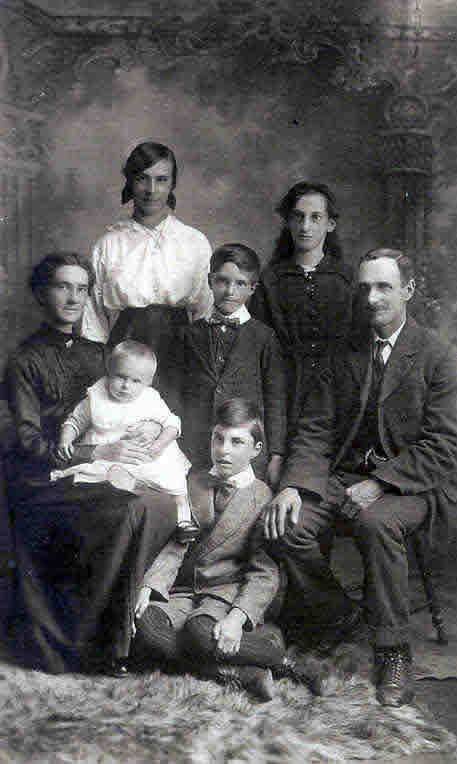
Rebecca Ann Martin (née Lythell) holds her son on the left of this family photo. Rebecca and her husband Walter (far right) are both my maternal and paternal relatives.
A relationship loop has been caused – i’m calling it ‘The Lythell Loop’.
The son of the illegitimate Elijah Lithell mentioned above, was named Murfitt Lythell. After marrying, Murfitt and his wife Mary had at least six children – the penultimate being a daughter named Rebecca Ann Lythell, born in 1879.
Murfitt and his wife settle the family in Little Downham by 1881, and here is where Rebecca meets and marries Walter James Martin in 1901. The couple have six children, including one that’s partly named after her father – a James Murfitt Martin – although sadly he died at less than a year old in 1913.
Walter James Martin was my paternal Great Grandfather’s older brother. So whilst the loop is not genetic (only via marriage), the many relationships of John Lithell would eventually become connected up.
The pop-up family of Boulter are the subject of this week’s Surname Saturday theme. Can you shed any light on this name in Cambridgeshire, England?
An unusual family name that stays in one village – simply popping up in records and then vanishing again.
My Boulter line came to an end when my maternal Great Great Grandmother Elizabeth Boulter married John Freeman Dewey in 1878 at the tiny village of Wentworth in Cambridgeshire.
Elizabeth’s parents were Robert Boulter and Mary Ann Moden who also married at Wentworth. After marrying in 1852, the couple went on to have 10 children with Elizabeth being the oldest. Out of the ten children, seven of them were daughters (one of whom did not survive infancy).
The earliest Boulter ancestors i’ve found so far is William Boulter and his wife Ann Covell – Robert’s parents. They married in 1815 (again, in Wentworth), and had at least four children – 3 sons and a daughter. I don’t yet know where William came from before his marriage to Ann – although she was from the neighbouring village of Witchford, so perhaps William was living in Wentworth in 1815.
John Boulter (right), my Gt Gt Grandmother’s illegitimate first child, with his son Edward ‘Happy’ Boulter (left) – the only part of the Boulter family that I have photographs for.
The mysteriousness of the family continues, with only one part of the Boulter family (not ancestral) that I have photographs of in my collection (see above) – given to me by a fellow researcher (and distant relative). The photo shows John Boulter(right), the illegitimate first son of my Gt Gt Grandmother Elizabeth Boulter, who was born five years before she married my Gt Gt Grandfather John Freeman Dewey. John Boulter occasionally takes the surname of Dewey in census returns, but this may have been more an attempt to hide the stigma attached to illegitimacy than it might have been to suggest that John was actually his father. In fact, when John got married in 1896, he names his father as ‘John Boulter – deceased’ – did he ever know the truth, or was he using his step-father’s first name?
John Boulter moved to London when he was just 17 where he married Alice Watts and started a family of 11 children (the photo shows him with his third son Edward). Eventually, he joined the Corporation of London as a groom and often rode First Postilion on the Lord Mayor of London’s coach during the annual show.
Distribution of the surname
With Robert and Mary’s family consisting of a larger number of female children than male, it may go some way to explaining how/why the surname has struggled to survive in the area – with the name becoming redundant upon marriage.
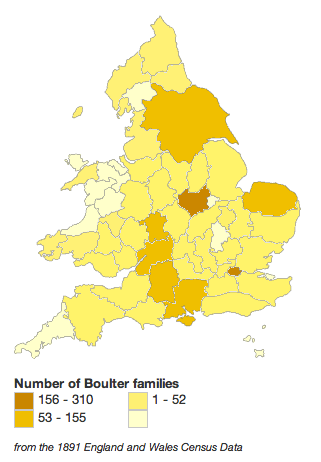
Ancestry.com’s mapping of the distribution of Boulter families in England, according to the 1891 census.
Ancestry.com have plotted the 1891 census data for the surname, allowing me to see the distribution of 1,661 Boulter families (note – not individuals). According to this data, Cambridgeshire had just 21 families with the surname. Norfolk is the 4th highest concentration of Boulter families with 102 – with it being a neighbouring county, this data might suggest that the family went there or even came from there. Unsurprisingly London led the way with 310 and Leicestershire came second with 240 families. Wiltshire was third with 121.
Origin of the surname
John Ayto offers a couple of different origins for the surname, probably due to it’s common misspellings. In his book ‘Encyclopedia of Surnames‘
he suggests that the origin is either from a ‘maker of bolts’ (as in for arrows or crossbow); a name given to someone short and stocky; or to the name of someone who sifts flour (from the Middle English term ‘bolten’ – to sift flour).
Where next for research?
I hope one day to find a photograph of my Gt Gt Grandmother Elizabeth Dewey (née Boulter), particularly as I have a photo of her husband, and I know where her grave is. She is my closest ancestor of whom I don’t have a photograph.
As for finding the surname’s next generation back – I’ll be resuming the search in neighbouring parishes for clues (Witcham and Sutton are top of my list) on William’s parents, and I’ll be checking Wills to see if there are any clues left there.
If you have stumbled across this unusual name in your research, please do drop me a line!
Combining my love for genealogy and infographics – yes! it’s a genealogy infographic.
I’d been looking for an excuse to combine my love for infographics (small chunks of information delivered as graphics) with my love for genealogy, and now I’ve achieved it. Here’s my first attempt at combining the two.
Using the data buried in my Reunion10 Mac software (see Reports > Statistics), I’ve managed to pull some key figures from the data I have against my maternal Barber family in a bid to make genealogy that little bit more interesting for those relatives who nod and smile when you start talking about ‘the tree’ and hand them a print out showing names of people they’ve never heard of. Maybe this format will help capture their interest and give them some interesting/quirky facts to remember.
An infographic created using my Barber family data.
I had quite a bit of fun making this, so will probably create some more in due course.
Click the image if you want to see a larger version.
Why making a mistake in your family tree research is one of the most important things you can do.
Getting something wrong is not something that we like to admit, but it’s probably one of the best things that you could do when researching your family tree.
My sister, who is an avid horse-rider, taught me at a young age the saying ‘You can’t ride a horse until you’ve fallen off’. This easily applies to researching – you can’t research, until you’ve got it wrong.
But… there’s always lots of moaning about the quality of data when you discover online that your family tree has been ripped to bits by another less-careful researcher, thrown back together with some random names from say – Ohio, leaving you obliterated from existence in their tree.
So why is getting a tree wrong actually important?
Scaring away the cuckoo
Avis Wisbey (formerly Martin, née Tall) or ‘Mary Waters’
Discovering an error in your family tree is something that every genealogist should do at least once during their research. If you’ve never done this, then maybe you’re staring at a ‘cuckoo’ – a person who is using your tree to borrow the love and care that you have for your ancestor, when actually they are from a completely unrelated line.
Saying goodbye to that surrogate family is hard. If you’ve invested your time and effort, and perhaps some affection, then it can be a sad moment when you have to lose them.
Admitting your error
Okay, so here we go…
For years, I stared at the photograph above, of my Great x 4 Grandmother – thinking ‘what a great photo’ and ‘how lovely Mary Waters must have been’, when actually, she was Avis Tall.
I’d allowed a simple mistake creep into my research and onto my website – where I’d simply scrimped on spending time checking sources that I had in my files before adding data to my database and to my website.
A Mary Waters did indeed marry a James Martin, and together they had a son also called James Martin, but it wasn’t until revisiting a marriage certificate in my files for James Martin Jnr, that i realised that the father was actually a Robert Martin a couple of villages away, which then led me to finding his marriage to Avis Tall, and then finding references to them having the son called James Martin.
Revisiting the marriage certificate gave me a terrible realisation.
This changed my tree significantly, as I’d put a lot of effort into tracing back the Mary Waters and James Martin families, and had even found modern-day relatives who descended from them.
Updating… everything
Once you’ve found that mistake, your attention and eye for detail is swiftly improved. After finding that Mary Waters was completely wrong, I was straight back to my core tree and re-checking my trees using various sources.
I updated my website, I updated my database, and then I updated my distant relatives who had also run with the information i’d fed them.
Whilst my site is updated, even now, years on, the effect of the cuckoo lives on – with my ancestor enjoying an existence as ‘Mary Waters’ in new trees within sites such as Ancestry.co.uk.
Getting it wrong makes your research better
By getting your research wrong, realising it, and correcting it, you end up being a far more diligent researcher. Having got it wrong once, you know the pain and embarrassment of sawing off large boughs of your family tree, and then staring at the weedy twig that’s left behind.
So, before you commit that ancestor to your tree – check. Check again. Then cross-check, or the cuckoos will get you.
This week’s Surname Saturday theme looks at the POLL family of Norfolk, their silk weaving roots, and fascination with Hebrew names.
This week’s Surname Saturday theme posting takes a look at the Poll family – one of the few Norfolk families in my tree.
My most recent ancestor to bear the surname of Poll was Elizabeth Poll, my Great Great Great Great Grandmother, who was born on 12th April 1796 in the market town of Wymondham, less than 10 miles from Norwich, in Norfolk.
Elizabeth was the oldest of the ten children of silk weaver Ishmael Poll and his wife Mary Fiddamont. Ishmael and Mary had married just 13 days prior to Elizabeth’s birth.
The couple went on to have 9 other children – including an unbroken line of 6 daughters before having their first son – then two more daughters – and ending on their youngest child in 1816, also a son.
Elizabeth married my great x4 Grandfather John Howlett in Wymondham, Norfolk on 17th May 1824, and my ancestry then passes through them and their son Thomas’s brief life.
Silk Weaving in 19th Century Norfolk
On the 1841 census, Elizabeth’s father Ishmael, is noted as a silk weaver despite his advanced years (he was 70yrs old). He dies in April 1847, predeceasing his wife Mary, who then appears on the following 1851 census living alone as a pauper.
Ishmael is most likely to have apprenticed for many years in the skills of producing beautiful quality silk weaving, and he would have most likely have worked from home, using huge weaving machinery.
It’s understandable to see why Mary was living in poverty after Ishmael’s death, as his trade was so highly skilled, that it is unlikely that she could have simply continued it on after his death without having had training.
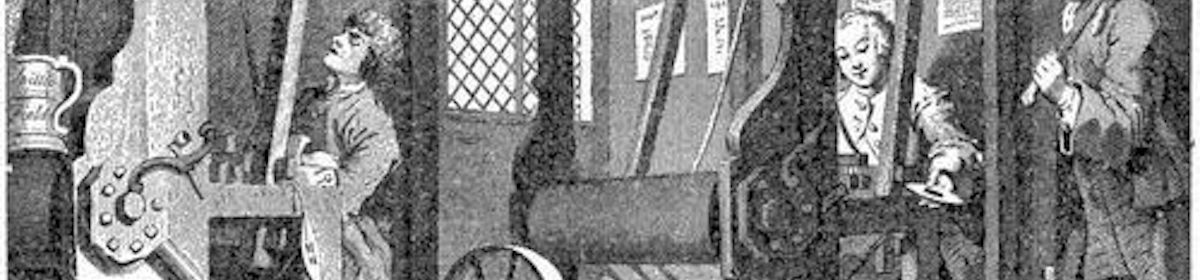
A 1747 illustration of weaving from a series by Hogarth (The Industrious and the Lazy Apprentice) [Public domain], via Wikimedia Commons.
Hebrew names
The Poll family is not only unusual in my research because it comes from Norfolk, but it also provides me with some of my most usual names (in comparison to the rest of my family tree) in the 18th Century – Ishmael (male) and Keranhappuck (a female name) – both featuring in the Hebrew bible.
What inspired the use of these names, when the rest of the Poll children were fairly common names?
Earliest Ancestors
The earliest ancestors in my Poll tree are my Great x 7 grandparents – Simon Poll and his wife Ann. They would have been born around 1720, seeing that their son (my next ancestor – Great x6) was James Poll, born in 1741. James married a Mary Syers and they were the parents of Ishmael.







![By Hogarth (The Industrious and the Lazy Apprentice) [Public domain], via Wikimedia Commons](https://historyrepeating.org.uk/wp-content/uploads/2013/03/hand-loom_weaving1.jpg)
 History Repeating