5 great Cambridgeshire life museums you’ll also find on Twitter

Alongside genealogy, sits my interest in local history, and so I’m no stranger to many of the great museums we have here in Cambridgeshire – as they are incredibly insightful on the historical context in which my ancestors lived.

Many museums have adopted social media, seeing its importance in connecting community to its history, and using it to promote events and give behind the scenes glimpses of their work and activities that would otherwise go unseen by the public. Many are using multiple channels like Facebook, Google+ and YouTube, and some are also blogging.

Here’s 5 of my favourite Cambridgeshire Museums that are also using Twitter. They’re in no particular order, as i have no wish to be barred from these great places!

1. Denny Farmland Museum and Abbey

There’s lots to be found at this part-English Heritage site. The Farmland Museum acts as a great reminder of the lives of my agricultural ancestors, with the fantastic backdrop of an Abbey.
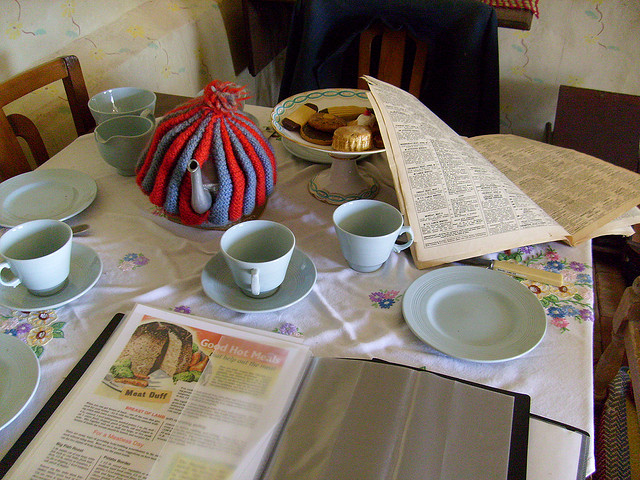
Teatime
Eternal teatime (perfect!) in the period cottage at Denny Farmland Museum and Abbey.

The period cottage is a great place to explore, and really reminds me of some of the ‘gadgets’ that my great grandparents had.

2. The Norris Museum

The Norris Museum sign
The Norris Museum, St Ives, Cambridgeshire.

The Norris Museum is my closest museum. It’s a little tucked away through a doorway, and across a garden, beside the river in St Ives, but once inside, you’ll find that the museum is packed with local artefacts – ranging from dinosaurs, Romans, Oliver Cromwell, those witches of Warboys, and ice skating. There’s much more too, and a regular series of events and exhibitions.

You can find them on Twitter at @TheNorrisMuseum

3. Peterborough Museum

Edwardian Operating Theatre at Peterborough Museum
The Victorian Operating Theatre at Peterborough Museum – the museum was once a hospital, and so this room has been returned to look like it once did.

I first visited Peterborough Museum with a couple of the team from Living TV’s Most Haunted show, as part of an overnight ghost hunt event! There’s no better way of getting to know a museum, than being locked in the cellar in the pitch dark at 2am.

Since then, the museum underwent a year-long radical remodelling with a £3.2m price tag – and is now vastly improved (although I can’t vouch for that cellar yet). New rooms and displays, with greatly improved cabinets and touch-screen information points, make the museum much more interesting and interactive. They’ve even added a cafe.

The Changing Lives collection documents Peterborough’s 200 year evolution from village to industrial city – using film, audio, and a range of objects – and is a useful reference point for anyone researching family life in this area.

You can find them on Twitter at @Vivacity_Museum

4. Ely Museum – at The Old Gaol

I’m a Friend of Ely Museum, and have been for a few years. There’s a couple of reasons behind this, and they’re both through my genealogical research.

Firstly, during the 1816 Littleport Riots, one of my 5x Great Grandfathers (John Goltrip) was arrested and accused of stealing some silver spoons. He would have been held prisoner here, in this old gaol. The museum has mocked-up what the cells would have looked like, along with the restraints that the prisoners would have been constrained with.

Inside the Cells
A recreation of what conditions would have been like inside the gaol. My ancestor would have spent some time here in 1816 after his role in the Littleport Riots.

Secondly, in another room there’s a ventriloquist’s dummy and a series of theatre posters – these relate to my distant cousin Vernon Cross (3rd cousin, once removed no less!) – who not only ran the family bakery on Forehill, and was a ventriloquist and magician, but he also founded a huge collection of antiquities, which have since gone on to form an important part of the museum’s collection. A function room at the museum was named after him.

The museum is new to Twitter, but you can find them at @ElyMuseum.

5. The Cambridge & County Folk Museum

Cambridge & County Folk Museum
The Cambridge & County Folk Museum. Photo: Janet Swisher via Creative Commons.

The Cambridge & County Folk Museum stands not far from the Cambridgeshire Archives. It is home to a great collection of local artefacts that depict every-day life in the city and in the surrounding fenland. It’s been a while since i’ve visited, but I remember walking in and spotting many items that I remember my grandparents and great grandparents having in their homes.

You can find them on Twitter at @FolkMuseum.

What about the rest?

There’s around 30 museums in Cambridgeshire. Some of them are also using social media. Aside from Following or Liking them, why not visit when you’re next in the area?

Check out my Twitter list of Cambridgeshire Museums.

VOTE: Your favourite episode from the first half of Who Do You Think You Are? (UK, Series 10)

Vote for your favourite episode of the first half of the 10th UK series of Who Do You Think You Are?

We’re unbelievably halfway through the tenth UK series of Who Do You Think You Are?.

Not all of the celebrities that I suspected, have appeared in this first half, and some I didn’t guess correctly, or didn’t even guess at all.

Which episode, from this first half of this series, is your favourite? Vote now – the poll closes in 1 month, by which time, we’ll almost be at the end of the series.

Wedding Wednesday – 1929

This week, we’re off to 1929 for Wedding Wednesday – to my great grandparents’ wedding at Wilburton, Cambridgeshire.

In this week’s Wedding Wednesday blog post, it’s the turn of my Great Grandparents, who married on All Fool’s Day in 1929.

Here’s the happy couple, standing outside my great grandmother’s parents’ house at Wilburton, Cambridgeshire.

Newlyweds Ernest and Maude Barber
Ernest and Maude – married on 1st April 1929.

Here’s the happy couple again, this time with their wedding group – the groom’s half-brother Walter ‘Curly’ Hopkin, and the bride’s younger sisters.

Barber and Yarrow marriage, 1929

One of the bridesmaids is still alive, and has just turned 102 years old. My Great Grandmother (the bride), her sister, reached 104.

Ernest and Maude enjoyed 56 years of marriage, until Ernest’s death in 1985.

I spent the weekend in the 1940s

Spent the weekend in the 1940s – meeting Winston Churchill, watching a Spitfire flying around, eating spam sandwiches, and escaping Nazi officers.

I’ve just returned from a trip with friends, to the 1940s, where I saw Prime Minister Winston Churchill, some Nazis, was treated to a Lancaster Bomber and a Spitfire fly-by, and I ate some spam.

2d!
The NAAFI canteen was packed full of people having the tea, bread pudding, jam, and spam sandwiches.

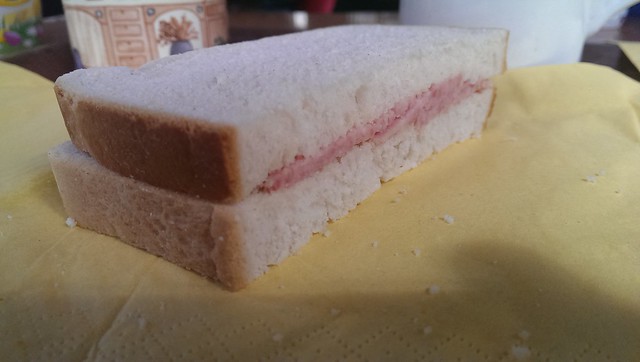
Speaking of which… I did eat it. The blank flavour, and synthetic texture reminded me of when I last had it in about the 1980s. Despite it providing a useful food source back then, it’s pretty much sneered at these days despite still being in production and readily available (someone/thing must be eating it!).

The Spam Sandwich

Lucky the Pigeon
Around 250,000 Pigeons were used during the second world war to carry secret messages home in some of the most deadly battlefields, often from behind enemy lines, over the fighting and in to the British officer’s hands. The acts of the pigeon saved thousands of soldiers. Apparently this little chap is called ‘Lucky’.

NAZI soldiers

Ran in to these chaps. Thankfully my limited German allowed me to escape… although it was fraught with danger.

Nazis

Nazis

Doctor Carrot

A wartime poster encouraging healthy eating – and getting children to eat Vitamin A (a deficiency can lead to blindness).

Which will be no trouble, as there’s plenty of fresh vegetables growing in the garden:

A 40s house

Will post the Spitfire and Lancaster Bomber fly-past videos later (they’re taking a while to down/upload).

Check out the Ramsey 1940s Weekend website for more.

Wedding Wednesday – 1925

This week for Wedding Wednesday, I’ve gone back to 1925, to the wedding of my Great Grandparents Ernest Dewey and Susan Moden at Ely, Cambridgeshire.

This week’s Wedding Wednesday blog post, visits Ely in 1925, when my Great Grandparents were married.

After a nine year courtship, that reached back from November 1925, and into the First World War, Ernest Edward Thomas Dewey and Susan Jane Moden were wed at St Mary’s Church.

I’ve only stumbled across two photographs from this wedding, and neither of these show the bride or groom.

Here’s the first photograph – in very poor condition – showing their bridesmaids and the best man.

Bridesmaids Gladys (left) and Grace (right) with the mystery Best Man (centre).

Their bridesmaids were Ernest’s cousin Gladys Anderson, and Susan’s younger sister Grace Violet Moden. Here is the other photograph, which has clearly been better looked after.

Gladys Anderson and Grace Moden in 1925

The best man is currently nameless, but a newspaper check should hopefully reveal his identity.

Ernest had many brothers, and Susan had just one. This man could easily be any one of those siblings (as was seemingly often done in this part of the family), or someone entirely different.

Wedding Wednesday – 1953

The first of my Wedding Wednesday blog series, travels back to the sleepy village of Wentworth, Cambridgeshire in 1953.

In the first of my Wedding Wednesday blog series, I’ve decided to travel back to 1953, when my maternal grandparents walked the aisle during April.

In the tiny village of Wentworth, my grandparents married. My grandfather being 21 and my grandmother being 20.

Here’s the final moments of my grandmother as a single woman, on the arm of her father. She was his only child.

Pamela and father Ernest Herbert Barber 1953

And a little bit later, the happy couple emerge. Kudos to my grandfather there for that severe ‘short-back and sides’ look.

The happy couple

And here are the bridesmaids in line.

Pamela Barber's bridesmaids

Some of the wedding party, which includes my Grandparents, Great Uncle, Great Grandparents, and Great Great Grandmothers.

Wedding Family Group

The proud parents – my Great Grandparents – (L-R) Ernest Herbert and Maude Barber, with Susan Jane and Ernest Edward Thomas Dewey.

Parents at wedding

Finally, Starr & Rignall (a popular photographer’s studio) produced a series of colourised versions of some of the photos. Here’s one of them to give you an idea of the dresses.

Colourised 1953 Wedding Group

Royal couple welcome a new Prince

Royal Baby fever – what might the Duke and Duchess of Cambridge decide to call their young Prince?

After much speculation over the gender of the latest Royal baby, the Duke and Duchess have become the proud parents of a son, a Prince.

Back in November 1948, the young Princess Elizabeth delivered her son, and heir. Apparently it was some time before he was named – Charles – a historical name, last bore by King Charles II whose own father (Charles I) was executed at Whitehall in 1649. Charles II had a large number of illegitimate children, but died without an heir – with the throne passing to his brother, James II and VII.

Princess Elizabeth’s choice may have been one that represented a new, fresh, start for the post-war monarchy.

Daily Graphic - Son born to the Princess

Prince William’s own name had not seen use since for a King since William IV, who died in 1837 without a surviving legitimate heir, and so his throne went to his niece, Princess Victoria of Kent.

So who will our Prince be?

By the time the Prince ascends the throne, we may have already had a Charles III (or as suspected, George VII), and a William V.

Will the new Prince become Edward IX? Henry IX? George VIII? Or will he tread the path of his earlier ancestry?

  • Prince Richard? – embracing the current popularity and interest seen for Richard III?
  • Prince Albert? – an affectionate reference to Queen Victoria’s consort?
  • Prince Leopold? – Victoria’s youngest son?
  • Prince Arthur? – a name steeped in myths, but also used in both Princes William and Charles’ names.

Further back – Saxon, Scottish, and French Kings

  • Prince Duncan? – Scottish King Duncan II died in 1094.
  • Prince Athelstan? – there has only been one King Athelstan, and he died in 939.
  • Prince Cnut? – King Cnut died in 1035
  • Prince David? – King David II was the last, dying in 1371.
  • Prince Edmund? – King Edmund II (Ironside) was the last, dying in 1016, reigning for just 7 months. This name would perhaps be blighted too, by Prince Edmund, the Blackadder – a popularly unpopular TV character.

    Actor Rowan Atkinson as the weasley Prince Edmund, the Black Adder.
    Actor Rowan Atkinson as the weasley Prince Edmund, the Black Adder.
  • Prince Robert? – the last King Robert was Robert III who died in 1406
  • Prince Louis? – whilst Louis features in William name, the last King Louis was the French King Louis, who spent a period ruling over about half of England, but he conceded the throne in 1217.
  • Prince John? – there has only been one King John.

I’m guessing that we’ll see a Prince Frederick or ‘Freddie’, or perhaps Prince Arthur.

We’ve already seen signs that Prince William likes to tread new ground, so we might even get a brand new name. According to James Brighton at BabyNames.co.uk, the top 5 boys names in the UK in 2013 are (in order): Noah, Oscar, Oliver, Isaac, and Jacob.

We’ll have to wait and see….

Baby Fever!

With the Royal Baby mania sweeping the media, I dusted off my own baby book, and took myself back to a time when things were a little simpler.

Okay, so whilst there’s a lot of royal baby fever sweeping the media, I’ve dusted off the baby book that my mother kept in my first few years. I’ve also got my sister’s book too. Do you have something similar to these?

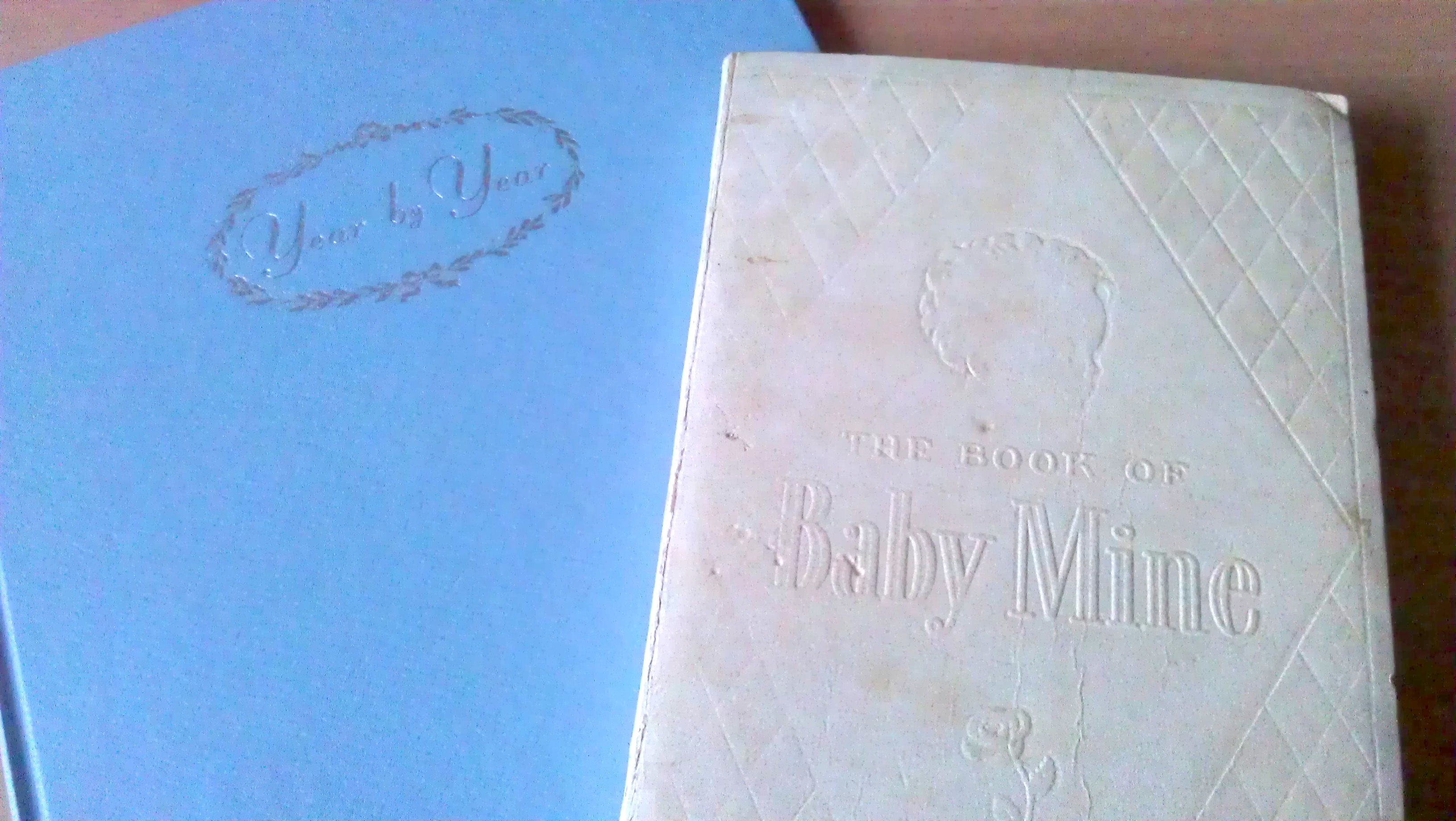
Two books containing the first years of a baby's achievements

The blue one is my baby book – printed by Wm. Collins Sons & Co Ltd of London & Glasgow. It’s illustrated throughout (see example at foot of this post).

Inside are a collection of notes written mainly by my mother, but include some of my own writing later on where i’m listing and describing my birthday presents (apparently my sixth birthday presents included “marbles, a r2d2, a smurfland, cars”).

It’s funny reading this back. I’m the second baby, but it’s clear that every entry was written here with a great sense of pride at my achievements. Even my first haircut gets a mention – with a lock of my extremely blond hair, carefully tucked away in a little airtight bag that’s taped to a page.

Apparently it took me 5 weeks to smile and 12 weeks to laugh. By the time I was 5 months old, i’d mastered that old ‘got big toe in mouth’ trick – a great ice breaker!

At 6 months i’d mastered my first word ‘dad’. Sorry Mum, but you had your turn within the next 6 months alongside ‘bow-wow’ and ‘no’.

Both books are fascinating, all carefully noting baby’s progress – weight, words, birthday presents, crawling/standing, and scattered with photographs and names of gift givers (and their gifts).

Independently from these books, the other day I was looking through a photograph album that my aunt had lent to my mother (so that i could look through it, and scan what i wanted), and I found the earliest photo i’ve ever seen of myself – just 4 days old.

For William and Catherine, their baby will be well documented. Probably one of the most documented babies yet. They probably won’t need to keep their own record, but I bet they do.

I know for one thing, that if and when it’s my turn, I’ll be keeping a book too, and perhaps in another 35 years, you’ll read the next generation’s blog post about it here too!

Have you ever stumbled across a baby book in your family? How did/do your family record their new arrivals?

baby illustration

Gordon and the Giant Cake

A mystery photograph of my great uncle Gordon Dewey, staring into a bowl of cake mix.

Found this unusual old photograph in a photo album – it’s been through some tough times, so I thought I better scan it before it gets any worse.

A man and three women with a large bowl of cake mix

The man in the photograph is my grandfather’s youngest brother, Gordon Dewey. Quite why he’s with three women staring into a large bowl of cake mix is a complete mystery. I think the photograph is possibly one taken by a newspaper photographer – due to the original’s size and paper – it being different from all other photos in the collection.

At a guess, the woman on the far left is his girlfriend, Maisie, who appears in a couple of other photographs and is someone that my grandmother remembers, but I have no record of her surname.

Sadly, Gordon died aged 20 from a brain haemorrhage in November 1954. He never married, and he died without issue.

Poll shows 50% of respondents want Ancestry’s ‘old search’ to remain

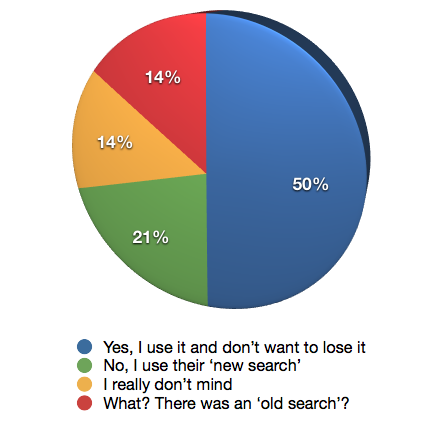
Results from the poll question ‘Ancestry are ditching their ‘old search’ tool. Are you sad to see it go?’ reveals that half of respondents want ‘old search’ to remain.

For the last few days, genealogists have been airing their concerns about Ancestry.com’s decision to kill off it’s ‘old search’ tool. A poll conducted on this website finds that 50% of the respondents want ‘old search’ to remain.

Ancestry.com 'old search' poll results

Questioning the quality of the Ancestry ‘new search’ search results in discussions on blogs, on twitter, and in LinkedIn groups, professional genealogists and amateur family historians alike have been vocal in their concerns at the demise of ‘old search’. Those who want ‘old search’ to remain, claim that it provides more exact matches and fewer ‘padded out’ results (the ‘padding’ being photos and member tree matches – both of which are known to be blighted by swathes of incorrect information).

However, almost a quarter of respondents said that they use ‘new search’ and the remainder were split between those who ‘don’t mind’ (14%), and those who were not aware that there are two different searches (14%).

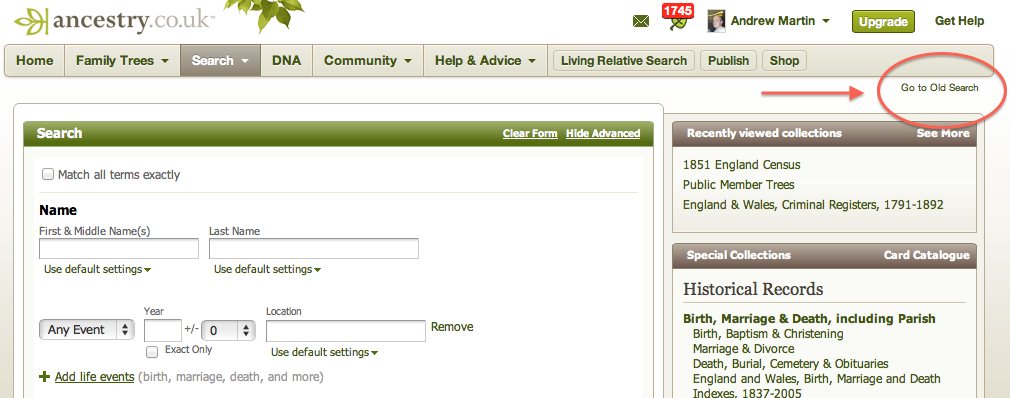
Unsure whether you’re using new or old? Here’s how to tell…

Checking which Ancestry Search you're using
Checking which Ancestry.co.uk Search version you’re using

Visit Ancestry.com (or .co.uk as in the screenshot above). Click ‘Search’ in the navigation, and then check over to the right. Whichever version it names here, you’re using the other one!

Ancestry.com claim that they are taking notice, and have launched a survey to collect the responses from users.

The poll on this site ran from June 29 – July 5 2013.