Society Spotlight: What is a history society’s biggest need?

Three history and genealogy societies reveal what they feel that their society, and societies like them, see as their biggest need.

In today’s Society Spotlight themed blog post, I reveal the answers to the first question that I asked the societies:

What is the society’s biggest need?

Before approaching the societies, I had a few ideas as to what the themes of this answer might be – people, time, items/records. However, I was surprised that the other of my guesses – a financial theme – doesn’t get mentioned here.

Here’s what the society representatives had to say:

Society of Genealogists logoAbbie Black, The Society of Genealogists (SoG)

“A society’s biggest need is dedicated individuals who want the work of a society to succeed. Volunteers make up most of the workforce of societies, and they do excellent work in continuing the goals of preserving the past. Volunteers digitize documents, create indexes, and help members of the society do effective research.”

“In larger Societies like the Society of Genealogists paid professional staff are also important to a society’s function; they provide professional expertise and competencies, not only in subject specialisms as genealogists or librarians but in management accountability, finance and human resources. Genealogical Societies with professional staff are more common in the USA but the SoG is unique in the UK.”

Robert Newman, The Newman Name Society

Newman Name Society logo“Our biggest need is for more members and for people to share their Newman record finds so that we can build up our archive.”

Lisa Newman, The Cambridgeshire Family History Society

Cambridgeshire Family History Society logo

“I would say our biggest need is to encourage the next generation so that we maintain interest in the future in order to fund projects that preserve original material.”

“We also need support from the FFHS and (in a perfect world) the big internet sites to encourage people to join FHS’s.”

“With ever increasing competition from the big internet sites, why would someone join a society when they think all of the answers are available at the touch of a button? My colleague this week asked me if she typed her name in ancestry.co.uk would it work out who was related to who in her family? I think I visibly deflated at that point!  So I guess we also need to educate people to manage their expectations!”

What do you think?

What do you think of the society responses – any surprises? Leave a comment below, or join in the discussion over on LinkedIn.

In tomorrow’s Society Spotlight posting I ask the societies ‘What’s the Society’s biggest challenge?‘.
Society Spotlight: The death of a family history society

Society Spotlight: In today’s post, I cover the demise of The Cross Family History Society – seemingly a one-person society, that ended with the death of its founder.

In this, the second of my history society themed blog posts, I take a look at a society that helped me significantly with my research, until one day the silence fell.

Some history societies were born out of an individual’s love of an interest (perhaps a particular industry, or geographical place), and grow until it becomes all consuming for the founder. This leaves the society and its precious work at risk of dying with its founder (as we heard yesterday from Linda McCauley).

Cross Family History Society

Silence

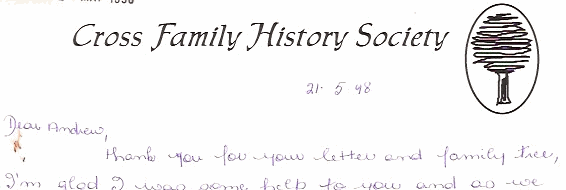
Back in the late 1990s, I was in contact with a Pam McClymont from Australia. She was the sole worker behind The Cross Family History Society, and she had amassed a vast amount of information about the surname and its journey to Australia from its home in Ely, Cambridgeshire.

Her research enabled me to point me towards answers for vast parts of my own Cross family tree (making it easier to verify the data from the UK too). She didn’t have email, or a website, and I don’t think she had a computer either, as she would mail me vast amounts of paperwork covered in her handwritten notes, and even a self-published ‘Who’s Who’ guide (this was typed).

Who's Who Cross Family Vol 1 - Pamela McClymont
Who’s Who Cross Family Vol 1 – Pamela McClymont

Suddenly the correspondence stopped. I wondered whether my letters back to her had been lost in the mail, but I found out just under a year later via another researcher who was more local to her, that the reason for her silence was because she had died.

It now makes me wonder whether I hold her most up-to-date research, and what percentage of her work, and whether I have a duty to perform by making it available in some way – perhaps find a way to obtain permission to create Volume Two, perhaps create it as an eBook to help reach a new audience?

What should I do?

Have you been a member of a family history society that ended abruptly? What happened next? Did the society’s trove of information make it into safety, or has it been lost forever?

Leave your comments, thoughts, and experiences in the space below, or join in the discussion over at LinkedIn, and perhaps you can help save another one from an untimely end.

Come back tomorrow where we look at the first of the three questions posed to the Societies – What is the Society’s biggest need?

Society Spotlight: How can we help history societies focus on the future?

Every day this week, I’m focusing on History Societies. Three societies have each kindly answered three questions, and I’ll be covering their answers that reveal their needs, challenges, and plans for survival.

I’m a supporter of history societies. I think they’re great resources, and that they play a very important role in preserving and sharing information to communities. However, these treasure troves of information face a real risk without a healthy long-term plan of survival.

Whilst talking with genealogist Linda McCauley a few weeks ago, she recalled a story of a  society in the US that has nearly been wiped out after the recent death of its treasurer. The treasurer had pretty much run the society single-handedly and was the only person who knew where the membership list was kept. Now, that society faces a bleak future unless the list is found by the grieving family when their home is cleared. If not, it brings an end to the individual’s dedicated hard work for which they surely must have hoped would have a long-lasting legacy.

Genealogist Linda McCauley
Genealogist Linda McCauley.

“It’s so easy today for a society to back-up their critical information. All it takes is a few files stored online and multiple officers with the ID and password to access them” – Linda McCauley.

This story struck a chord with me and got me thinking – how can we help history societies survive?

Hold on, why should we help history societies?

Societies are often run by volunteers, and with little or no funding behind them. This means that they rely on the donations from members, events, making a profit on their publications, and membership subscriptions. It also means that they don’t necessarily have the funding to digitise their archive, or to put it securely online for people to browse (or even just to digitally preserve, and/or put a searchable index online).

The kind of records that societies hold varies considerably, but often include items that are otherwise ignored by the larger organisations that have the monopoly on digitizing records and making available online – items include items such as personal collections from local people, self-published family stories, one-off types of items, personal photograph collections, and many other types. These records are likely to be ‘small fry’ for the likes of Ancestry, FindMyPast, Genes Reunited etc, as they won’t have such a wide appeal, and therefore won’t be the money-spinner worth investing in. One society I know, holds their parish gravedigger’s note book, which alongside the parish register, provides a useful corroborative record of burials.

How do history societies want to be helped?

The best way to know the answer to this is to ask them. So I contacted five different UK-based societies to see how they would answer three questions.  Three have replied since I contacted them back on 29th June 2013. The respondent three were:

  • The Society of Genealogists – a large genealogy society which holds the largest collection of parish records and is based in London. It is widely known and visible through the events and training courses that it organises, and appearances on television.
  • The Cambridgeshire Family History Society – a county-wide family and local history society in England, with a wide range of publications, international members, and support courses.
  • The Newman Name Society – a member of the Guild Of One-Name Studies (GOONS), and the first family history society I ever joined, almost 20 years ago.

I asked each of them the same three questions, and for the next five days i’ll be sharing their answers to each question in turn, and looking at ways that you can help your local society, or the society local to your ancestors. The questions were:

  1. What is the society’s biggest need?
  2. What is the society’s biggest challenge?
  3. How does the society plan to preserve its knowledge for the future?

I hope that you will find this series of posts interesting, and perhaps find it inspiring enough to contact your local society and offer them even just a few hours of your time and/or expertise, or at least become a member to help fund them.

If you’re a member of a society already, or already helping a society in some capacity, I’d love to hear from you in the comments below (and feel free to post a link to their website!). Let’s promote them!

Come back tomorrow when I’ll be talking about the death of a family history society.

OFFER: Earn FindMyPast credits with Historic Newspapers

Historic Newspapers have asked me to share their special offer with you – buy a Birthday Newspaper, and get FindMyPast search credits for free!

Do you like reading old newspapers?

I can spend hours looking through them – reading the old adverts (cake advert below is from my Cross family’s Ely bakery), the fascinating insights given by village micro news (along the lines of ‘Mr Roberts played the church organ to a packed crowd’, or ‘Miss Chivers won the flower arranging competition’, etc), those heart-wrenching stories of lost loved ones lost in action, and the scandalous headlines of newspapers from 100 years+ ago.

F Vernon Cross Ginger Sponge cake advert from the Ely Standard, 7th November 1930.
F Vernon Cross’ Ginger Sponge cake advert from the Ely Standard, 7th November 1930. Hungry now?

I’ve got a few old original newspapers on file, although those mainly relate to the early 20th Century British Royal Family – with the death of the current Queen’s father, and her subsequent transformation from a Princess. I also have a few more genealogically relevant ones including a rather horrible account of when my Great x4 Grandmother Mary Clarke appeared in court and was charged and imprisoned for child abuse in 1841. The report includes the words of her and the abused children, and makes for hard reading.

Credits for old news

Historic Newspapers logoI’ve had an email from the team over at Historic Newspapers, who have been reading this blog and very much love old newspapers too. In fact, they love them so much, that they asked if I would share a special offer with you, where you can earn free FindMyPast.co.uk search credits when you purchase any original Birthday Newspaper right back to 1900.

Their offer runs until the end of December 2013, and details about obtaining the credits will be included in your Newspaper order (probably best if you read the full offer info on their website for the full terms).

Which date would you pick, and why? Let me know in the comments below! I’m toying with one of my grandparents’ birthdays – which sees me looking at somewhere between the years 1914 to 1932.

Wordless Wednesday – posing in 1953 and 1973

Wordless Wednesday: Both sets of maternal Great Grandparents pose in 1953 and then again in the same formation, 20 years later in 1973.

Barber and Dewey great grandparents pose for a photo in 1953
Both sets of Maternal Great Grandparents in 1953…
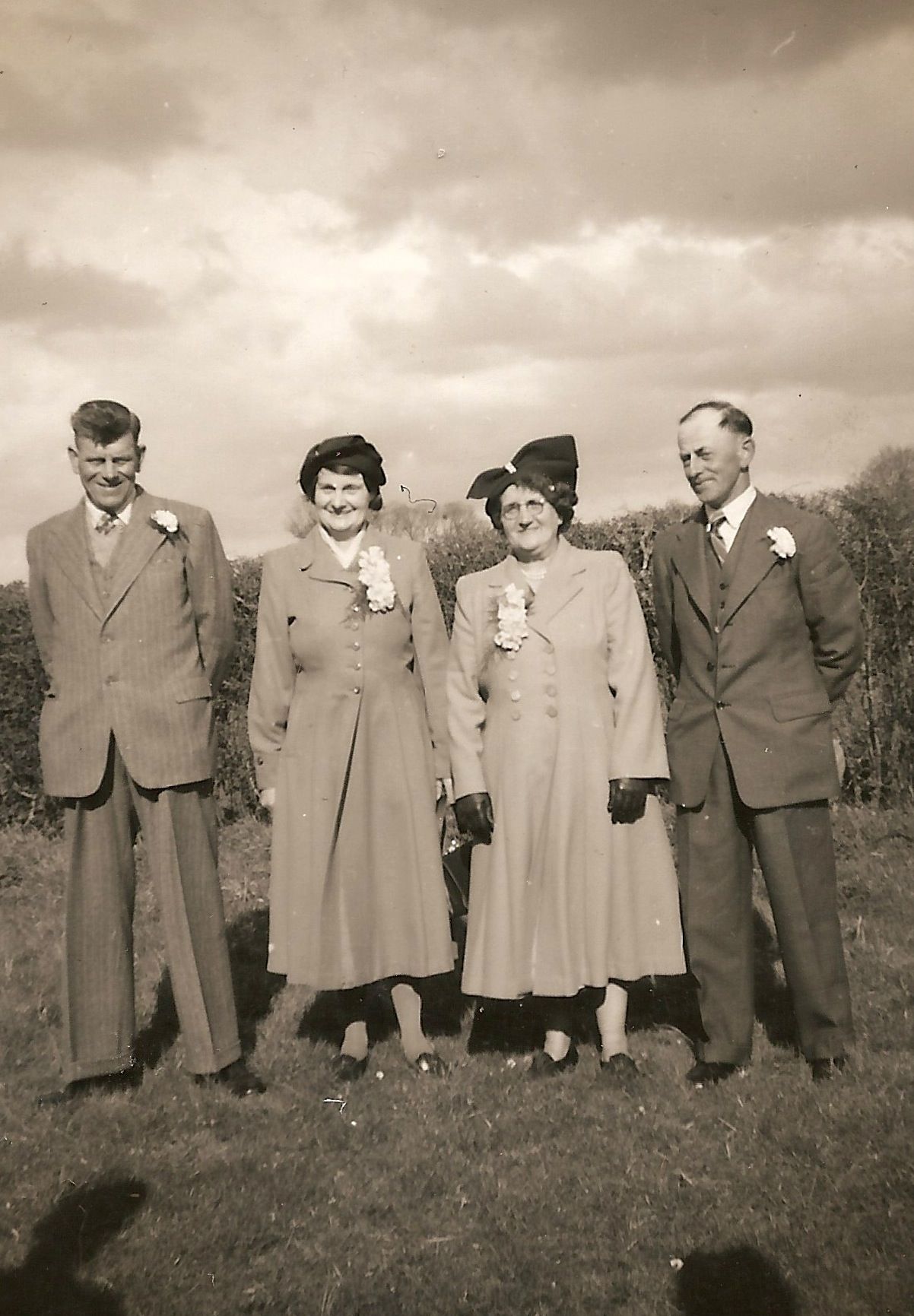
Ernest and Maude Barber, with Susan and Ernest Dewey, at the wedding of their granddaughter Glenda Ann Dewey to Stephen Leslie Martin at Witchford, 1973.
and by complete serendipity, they pose in the same order 20 years later, in 1973.

VOTE: Your favourite episode from the second half of Who Do You Think You Are? (UK, Series 10)

Vote for your favourite episode from the second half of the 10th UK Series of BBC One’s Who Do You Think You Are?

So, the tenth series of the UK version of Who Do You Think You Are? has ended.

Following on from my poll on the first five episodes, it’s time to vote for your favourite episode from the second half of the series.

Voting lasts for one month.

Cambridgeshire Family History Fair 2013 – expert sessions announced

The Cambridgeshire Family History Fair 2013 speakers and topics have been announced by the Cambridgeshire Family History Society.

The Cambridgeshire Family History Society has confirmed the speakers and topics for this year’s Cambridgeshire Family History Fair.

Cambridgeshire Family History Society logo

Back in April this year I wrote about the forthcoming Cambridgeshire Family History Fair that was planned for 26th October. It felt a long way off, but now it’s almost upon us, and the Cambridgeshire Family History Society appear to have the preparations and great topics all lined up.

Announced on the Society’s Facebook timeline, the list of guest speakers consists of experts in local history and wider research methods.

The sessions are listed as:

  • War Memorials – Martin Edwards
  • 200 Years of Civil Registration – Louisa Glover
  • Computer Research – Helen Tarbox
  • Identifying & Dating Victorian Photos – Tom Doig
  • Newspapers – Mike Petty
  • Using The National Archives – Simon Fowler
  • 20th Century Research – Ian Waller

As mentioned in an earlier post, the event is free to attend, although the sessions do have a small fee (payable/bookable on the day).

The Fair is on 26th October 2013, 10am – 4pm, at Girton Glebe School. Check the Society’s website for the latest information about what’s on, and travel/parking information.

Brown & Co (Ely) Ltd shop frontage re-appears on Forehill

An old shop sign re-emmerges on Forehill, Ely, right nextdoor to the former bakery of my Cross relatives. But what’s the history?

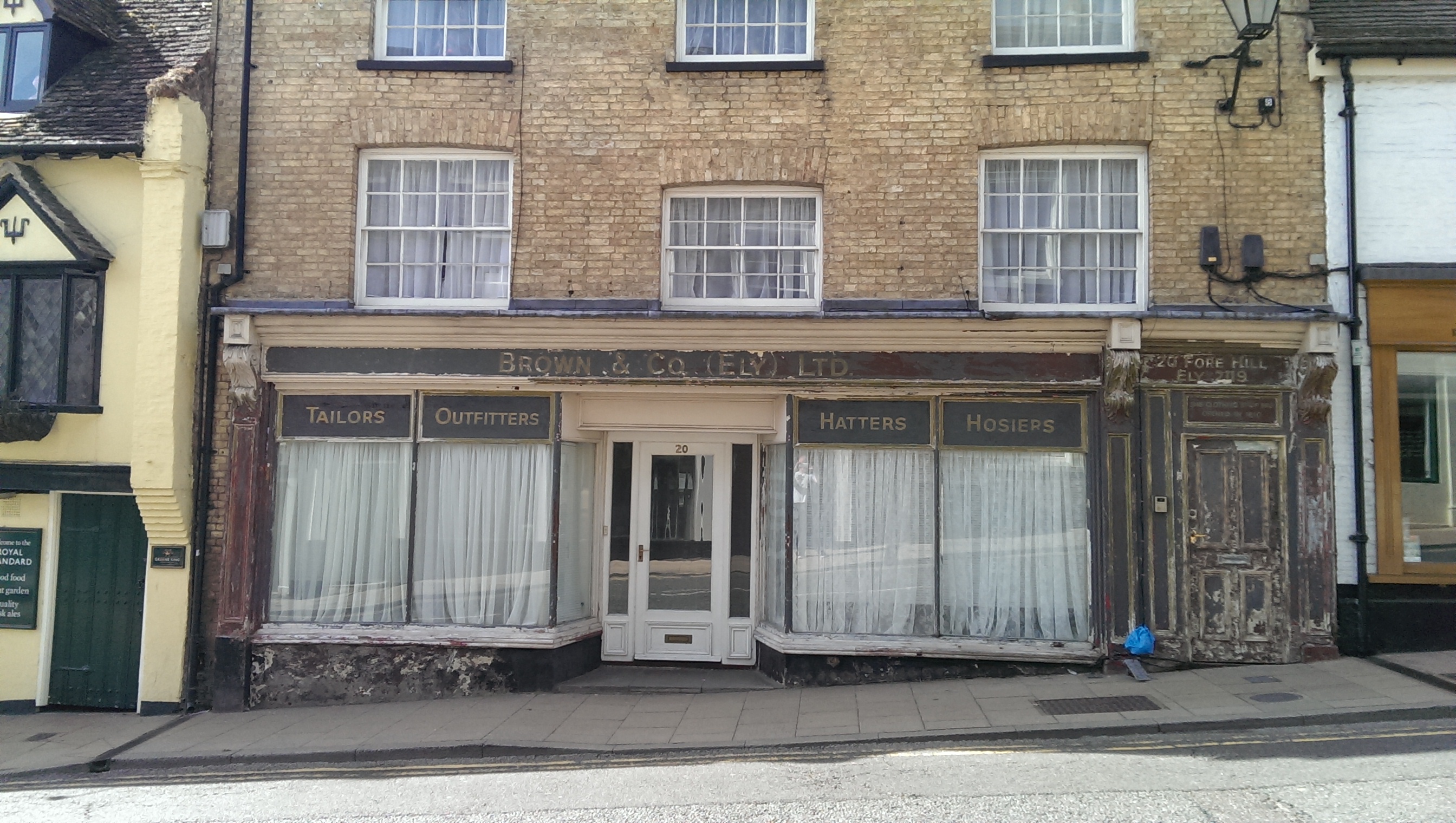
On Sunday, I was enjoying strolling in the sunshine in Ely, when I stumbled across this piece of work-in-progress on Forehill. Intrigued, I couldn’t resist a rummage in the records…

IMAG0198
A close-up of the elaborate painted shopfront and proud historical signage.

Fortunately for me, immediately next door, is The Royal Standard pub, which was once two properties – the upper-hill part (and nearest to this shop, and shown in yellow below) was the bakery of Frederick Thompson Cross (my Great Grandmother’s second cousin, twice removed), and later his son Vernon Cross, both relatives of mine.

IMAG0199
The shopfront of Brown & Co. (Ely) Ltd uncovered on Forehill, with the elaborate door on the right. The yellow painted building was home to the Cross family bakery.

1901

The 1901 census reveals that Forehill was home to a range of businesses – including confectioner, publican, watchmaker, baker (my family), a boarding house, and a clothier.

The sole clothier on the street, and so likeliest candidate for this shop was Alfred Hammence, aged 51 in 1901, from Ely. With his wife Hannah, they were immediately before the Cross family on the census return.

Alfred and Hannah were joined by their daughters Lilian Mary (22) and Ellen Eugene (20), and Edward Spelman, a 25 year old assistant clothier.

1891

Ten years earlier in 1891, Alfred and Hannah are at the same address, and this time, the location is clearer, with the census naming ‘The Royal Standard’ pub on the other side of the Cross’ bakery. Alfred and Hannah are joined by six children, a boarder, and a servant.

1891 Census for Forehill, Ely
Alfred Hamence, and neighbours the Cross family, on Forehill, Ely, in 1891. Click to see census on Ancestry.co.uk.

1881

Ten years earlier still, Alfred, now aged 31, is living at the property with his wife Hannah and their three sons Bertram (5), Hubert (3), and Ernest (1), and two daughters Lillian (2), and Ellen (2 weeks old). Also with them is William Malthouse, a 21 year old ‘clothier’s assistant’ from Hull, Yorkshire, nurse Lucy Mann (55) from Exning, Suffolk, and servant Elizabeth Lofts (17) from Little Downham.

Next door, in what was yet to become the Cross’ bakery, lives John G Benson, a baker from Norfolk. Frederick Cross at this time was living at home a few streets away in Waterside, where he’s noted as a ‘baker’.

1871

Stepping further back, in 1871, a 21 year old Alfred Hamence is noted is now an Assistant at the same shop – the shop itself being managed by Benjamin Bagg (30), who is noted as ‘head’ of the household, and as a ‘Tailor’s foreman and manager’ from Bethnal Green, Middlesex. Along with Benjamin and Alfred are, Benjamin’s wife Caroline (30), their son Ernest (2), daughter Minnie (8 months), Benjamin’s sister Sarah (35), and William Dobson Carr (14), a ‘clothier’s apprentice’ from Whetherby, Yorkshire.

Again, what was to become the Cross’ bakery, was a bakery already, but it is now run by John Moore, a 41 year old ‘miller and baker’ from Mendham, Suffolk.

Sadly, the 1861 census for Ely was lost in a flood, so my view further back is obscured.

1911

Coming forward again to 1911, Alfred, now 61 years old, remained at the address, as an ‘outfitters manager’, but he is joined by his wife of four years, Agnes Ellen, who at 44 years old, is 17 years younger than her husband. The couple live only with another assistant, Russell George Jude – a 24 year old ‘outfitters shop assistant’ from Mildenhall, Suffolk.

Ornate Evidence

Whilst the ornately decorated sign claims that ‘this clothing shop was opened in 1810′, I don’t have evidence to support that, not least because I don’t have access to any trade directories, or deeds, and of course the useful censuses don’t stretch far enough back, but there seems to be some essence of truth to the business’ longevity here.

Quite who ‘Brown’ was, and going by the suggestion of the shop sign, where the rest of his shops were – that’s all currently beyond the records I can search right now.

I have photographs of my Cross’ bakery nextdoor from 1892, 1896, 1906 and 1960 (as published in Vernon Cross’ autobiography ‘Cross Words’, but all give only about a 1 brick width insight into the style of Mr Hamence’s shop front.

What next for Alfred Hamence’s shop?

I’m hoping that whoever is carrying out this restoration, isn’t about to apply a layer of gloss over this terrific, and historical, signage, and that it will once again be boarded over and preserved, in hiding, for another generation to stumble across on a sunny Sunday.

Technorati ID: YWK5DF32HQB7

Surname Saturday: Gillions

This week’s Surname Saturday themed posting looks at my family name of GILLIONS from Bedfordshire, England.

This week’s Surname Saturday post takes a look at my Gillions family living in 18th Century rural Bedfordshire, England.

The earliest ancestor that I’ve located was my Great Great Great Great Great Paternal Grandfather, William Gillings, born in about 1730 at Dunton, Bedfordshire. He appears to have been the son of John and Mary Gillings, and the oldest child of three – although his two younger siblings (Sarah – 1732, and John – 1734) were baptised in nearby Wrestlingworth.

Gillions in Wrestlingworth, Bedfordshire

Wrestlingworth, Bedfordshire
Wrestlingworth parish church in Bedfordshire, was no stranger to my Gillions family.

William appears to marry Elizabeth Miller on 25th January 1763 at Wrestlingworth, when he was about 33 years old, and she was 32. The couple had at least 4 children – my Great x4 Grandmother Susan (often ‘Susannah’) in 1771, Elizabeth in 1771, Mary in 1774, and William in 1777. Sadly, Elizabeth died in 1780 at the age of about 49.

Three years later William walked the aisle again at Wrestlingworth to marry Sara Fielding on 16th September 1783. William was again widowed in 1807, and he followed Sara to the grave in 1810 at the age of 80.

My most recent ancestor being my Great x 4 Grandmother Susan Gillons, was baptised on 24th November 1771.

Heading to Gamlingay

Gamlingay parish church, Cambridgeshire
Gamlingay parish church – what led Edward and Susan to marry here in 1795?

She married Edward Gilbert on 2nd March 1795 at Gamlingay, Cambridgeshire – a village on the border of Bedfordshire and Cambridgeshire. There’s no indication as to why they married here, as I can’t see any other church records relating to this village. Neither were from this village (he was from Abbotsley, she being from Wrestlingworth), so perhaps they met here? Maybe their local church was undergoing repairs? Perhaps they didn’t get on with their local vicar? Perhaps they married here in secret and against their parents’ wishes? Further examination of the Gamlingay records will probably reveal more, or nothing else, leaving it purely to speculation of a BAFTA kind.

The couple had nine children –

  • Sarah bc.1795
  • George
  • Mary bc.1799
  • Elizabeth bc.1802
  • William bc.1803 (my Great x 3 Grandfather)
  • Ellen bc.1804
  • Eliza bc.1809
  • John bc.1813
  • Frances bc.1818

Living in poverty with a disability in 1851

With nine children, and Edward on a meagre labourer’s wage, the family fell on hard times. By 1851, and with their children grown up, Edward and Susan turn up with their second eldest married daughter Mary Cade in Abbotsley. Susan is noted as ‘blind’, as is her son-in-law Thomas Cade, whist Mary is noted as deaf.. leaving Edward aged about 77 and the only member of the household with his sight and hearing. Both he and Susan are unsurprisingly noted as ‘paupers’. Times must have been so hard for them.

Susan died in 1859, aged about 88. She’d outlived Edward, who had died in 1852.

Variants of Gillions surname

I’ve spotted that this surname has several spellings, and so it adds to the fun of locating my ancestors. These variants include:

  • Gillians
  • Gillions
  • Gillings
  • Jillings
  • Jullions

Wedding Wednesday – 1929 (another visit)

This week’s Wedding Wednesday themed post stays in 1929, and visits George Moden and Lily Dewey as they walk down the aisle at Wentworth church, Cambridgeshire.

We’re staying in 1929 for this week’s Wedding Wednesday themed blog post.

This time, it’s the turn of George Edward Moden and Lily Dewey, at Wentworth, Cambridgeshire.

George Edward Moden and Lily, 1929
The second Moden/Dewey marriage – George’s sister had already married Lily’s cousin.

George was the youngest brother of my Great Grandmother Susan, whilst Lily was also related – being a distant cousin to Susan’s husband (and my Great Grandfather) Ernest Dewey.

This wedding also provides me with the largest photograph in my collection – an entire family group – featuring everyone from parents to bridesmaids, to best man and the vicar.

George Edward Moden and Lily Dewey's Wedding, 1929
A great 1929 wedding photo. Parents are seated at the far ends of the front row, with the bridesmaids either side of the newlyweds. The best man stands immediately behind them, and the rest is filled in with family, and the vicar. (Click for big)

The great thing about these wedding photos, is that it’s perfect for finding photos of relatives that you might not otherwise ever discover. A photograph of a great aunt for example, might never materialise because her own family have kept those.. but with these kind of group wedding pictures, you get a wide net with which to catch a family (and most smile).

In this example above, i’m fairly confident that nearly all of the people in this photograph are relatives of mine – from both the bride and groom’s sides.

George Edward Moden and Lily Dewey

The couple enjoyed 54 years of marriage until Lily died in 1983. George survived her by 15 years – dying in 1998 – not long after I began my research. I never met him, but his recollections were crucial to my early Moden research.