This week’s Surname Saturday theme is the surname of DEWSBURY from the villages of Soham, Barway, Wilburton, Stretham and Little Thetford in Cambridgeshire.
This week’s Surname Saturday blogging theme focuses on my ancestors with the Dewsbury surname.
The most recent ancestor in my tree to carry the Dewsbury name was my Great Great Grandmother – Elizabeth Dewsbury, who was born in Stretham in 1851 to William Dewsbury and his wife Rebecca (née Lythell).
Sadly, I have no photographs of a Dewsbury, or any of my direct Dewsbury ancestors, which has probably made this branch one that has seen me pick up the research, and put it down, time and time again.
Whilst Elizabeth married into the Barber family in 1871, ending the run of the name in my ancestry, her siblings and her father’s family continued to live and work in the surrounding villages – in particular those of Wilburton, the hamlet of Barway, Soham, and also with some staying in Stretham.
18th Century
Heading backwards four generations, to Elizabeth’s Great Great Grandparents (and my 7x Great Grandparents), you find John Dowsborough and his wife Edith (née Langford). They married on 3rd October 1749 in Soham, Cambridgeshire.
They had at least nine children. The last being born in about 1768, a year before what appears to be John’s burial at Ely Holy Trinity (where is he noted as ‘from Half Acre in Soham‘).
The earliest of their children that I have found, was my 6x Great Grandfather, William Dewsbury, who was born in about 1753. By 1769, at just 16yrs old, he walked down the aisle of Soham parish church with Elizabeth Cook, who was undoubtedly already pregnant with the couple’s first (of ten) children.
Sadly, this first child, a girl called Elizabeth, didn’t survive long – having been baptised on 9th and buried on 13th of November of that same year.
Their next child, born in about 1770, was my 5x Great Grandfather, Edward Dewsbury, who is noted as a ‘farmer‘ in 1814. He lived until June 1836, when he died in the village of Wilburton.
Edward married Sarah (her surname, and their marriage still remains aloof), and the couple appear ten times in baptism registers between 1795 and 1816. They had nine daughters and one son – the latter being my 4x Great Grandfather, another William Dewsbury, born in about 1811, and the father of Elizabeth, my final Dewsbury ancestor.
Families nearby
There are many Dewsbury name bearers in these villages around Ely, making it complicated to break them into small family groups, so I’ve been looking at other Dewsbury name-bearers in the villages to see if I can group those together and therefore help to eliminate or assign the many name duplicates to those other branches. It’s a great way to thin out the records.
This Will from 1756, gives a small clue to a family group of Edward, his wife Elizabeth, his married daughter Mary, and his son John.
This 1756 Will from an Edward Dewsbury, names his wife as Elizabeth, a daughter Mary, and a son named John.
I’ll now know that this group belongs together, but I am going to put them aside for the short-term because they aren’t the ancestral branch that I’m looking for.
Dewsbury Name Variants
The surname seems to take on no less than 14 different spellings – ranging from the most common spelling of Dewsbury to a wealth of variants, often interchanging in the same parish’s registers:
Dousberry
Dowsbury
Deusberry
Dewsberry
Dewesbury
Dowsborough
Disborow
Disbrow
Disborowe
Dousbury
Dawsberry
Desbery
Dewsborough
A second line
In addition, a Dewsbury family also marries into my Yarrow branch at Little Thetford, Cambridgeshire.
Whilst I’m yet to connect them, I am expecting them to appear somehow, given that the village in which they live, is a hamlet of Stretham, just a few miles apart.
The first appearance of Dewsbury (any spelling) in Little Thetford, is the baptism of John Dewsbery, son of Edward and Elizabeth, on 9th January 1725. Perhaps this is the family group mentioned in the Will?
Not only that, but their Secretary Jan Cooper did such a good job, that I even registered as the worldwide name research point for a surname. I challenged them with three of my more unusual surnames in my ancestry, and they only had one of them (Dewey). I chose to register Yarrow (the other was Moden, and in hindsight, I could probably have tested a few more like Tingey).
My GOONS badge
I’ve been aware of their work (which began in 1979), and have often seen them at talks, but this was the first time I’d actively talked with them.
Minutes after becoming their newest recruit, I discovered that I had joined the ranks of a number of genealogy chums who are also fellow GOONS surname registrants. All were hugely positive of the Guild, and of the supportive approach between members, and registrants.
Armed with the induction pack and a detailed guide titled ‘Seven Pillars of Wisdom‘, I shall endeavour to record and data crunch all Yarrow name-bearers that I can find, or that find me. I shall be absorbing the guide over the next week, and start my data trawling.
In the meantime, if you’re a Yarrow, have Yarrow ancestors or relatives, or have information about Yarrow surname bearers, then I’d like to hear from you (feel free to leave comments below).
I’ve just set up @YarrowGOONS on Twitter, to help me reach out and connect with the surname connection.
Day Three – the final day of the 2014 Who Do You Think You Are? Live show at London’s Olympia.
I’m writing this at the end of the third and final day of Who Do You Think You Are? Live. I’m home, and can honestly say that I throughly enjoyed myself.
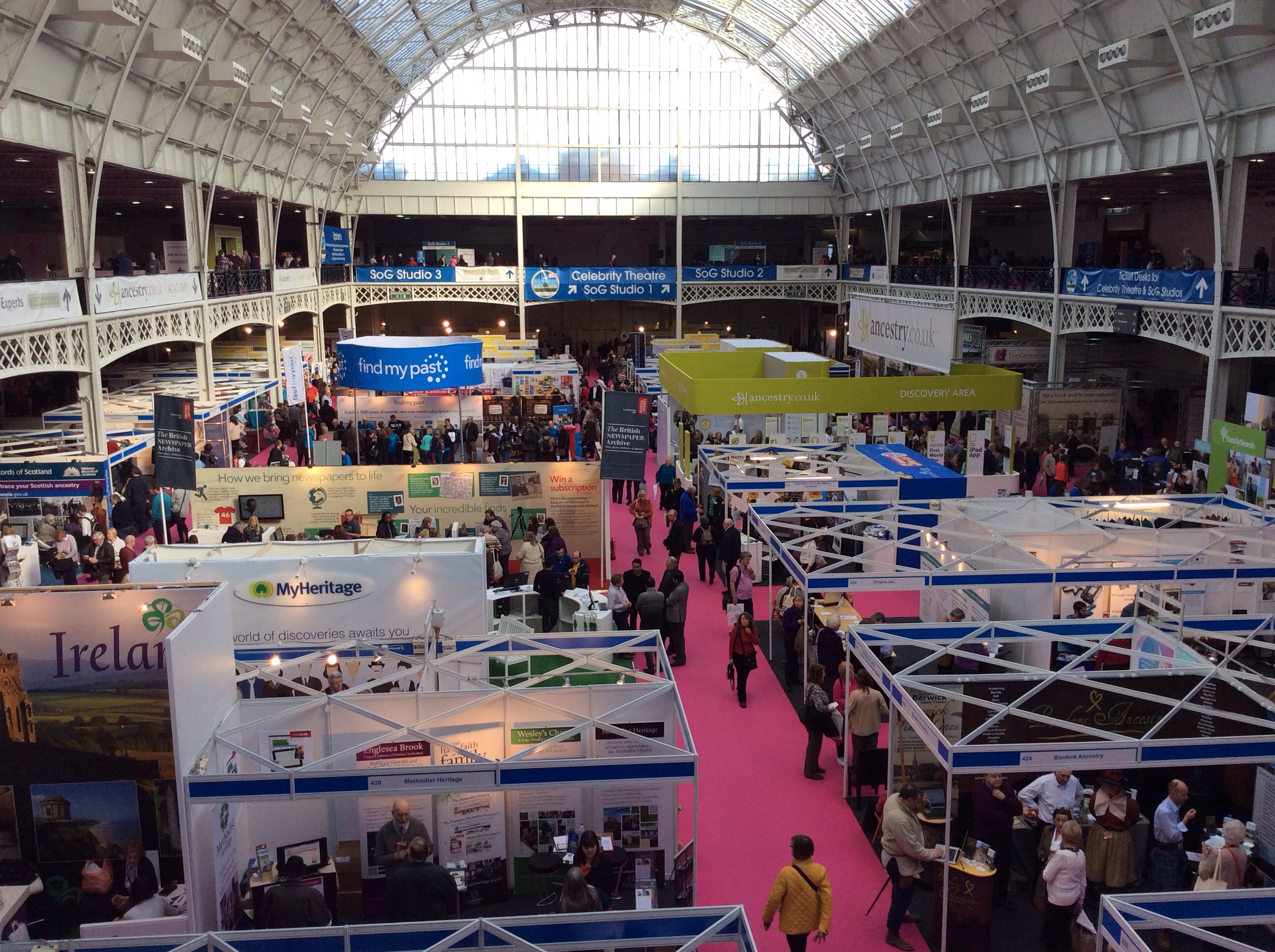
Some of the Family History Society stands at lunchtime on Day 3 of WDYTYA? Live 2014
I arrived at about 9:45 this morning, after yet another wonderful walk through Hyde Park in the sunshine (still definitely Winter mode). Whilst there was no queue outside Olympia, I managed to get in just before the mass of visitors who were walking over from Olympia station arrived at the doors.
I must confess that I didn’t make it to Michael Gandy’s talk – I chose it as I briefly have a family that lived in London for about 10 years, and occasionally through history a marriage turns up in its parishes. The queue was long, and so I decided to bail, and regret missing it based on the comments I’ve since heard and seen on twitter.
However, I am very glad that I finally caught a Celia Heritage talk though, as her talks and work has always come with such positive praise. Plus, I’ve really been enjoying reading Wills and even the Probate Calendars that I’ve found on Ancestry.co.uk.
I’ve got copies of Wills that hint at family feuds, and ones that detail every spoon and bowl. Those latter ones don’t seem like much now, but as Celia’s talk suggested, it wasn’t just the better-off people that wrote them.
Through case studies from her own tree, Celia was able to show how it is important to view the full Will, as they carry so much information about relationships (not just siblings, spouses, and children, but cousins can turn up too), and locations. She also highlighted the importance of looking around at the same surname in roughly the right area, and seeing whether you can find some potential connections in Wills – in a hope that their Wills will mention your branch and help link it all together.
The Babbage Breakthrough
It was my first venture to Who Do You Think You Are? Live (2011), when I dragged along a selection of my handwritten notes, expecting to find a whole new swathe of ancestors in some monumental research breakthrough.
I soon found it wasn’t really that kind of event, and that I should use the show to learn about new techniques, new technology, and discover about new resources that can help my breakthroughs, and for the years since, I’ve stuck to this notion.
Devon Family History Society stand at WDYTYA? Live 2014
So it was a surprise to find myself sitting alongside the very helpful Terry Leaman – Vice-Chairman of the Devon Family History Society looking at a baptism list of my Babbage relatives.
Thankfully, my iPad has Reunion 10 (Mac only genealogy software) on it, so I was able to jump straight into the right tree and check my current research against the results – it matched – and with a few extra children in their records, and a completely new set of baptism dates for all of them to add to my research. A quick print-out and donation later, and I was off to sit down and add the data to my files.
#WDYTYAlive #tweetup
There were a few tweet-ups this year, and I managed to get in on one of them, and serendipitously right in the foreground of the commemorative photo. As ever, it was great to meet new people, finally meet some not-so-new Twitter/blogging chums, and to once again see friends made at previous shows.
Here’s one tweet-up photo from genealogist Luke Mouland..
If you’re intrigued as to quite what a ‘tweet-up’ is, or concerned about what people do at a ‘tweet-up’, then essentially it’s an impromptu small-scale flashmob, organised via Twitter, where people turn up to meet those sometimes anonymous/faceless Twitter users, or to meet up with Twitter users that you’ve got to know well. Tea, coffee, or alcohol is usually consumed.
Bonding over genealogy (and a hotdog)
Just prior to the tweet-up, I sat upstairs reading emails, when a retired man asked if he could sit at my table to eat (as there were no other free tables). Of course I didn’t refuse, and so we got chatting. He said that he’d travelled from Essex and that this was the second day for him, but his first ever visit to a show like this. He said he’d been meaning to come to something like this for ’20 years or more’, but just hadn’t found the right show.
He said he’d been enjoying the talks on day one, and was going to spend his second day looking around the stands.
We talked for about 15 minutes in all, about the WDYTYA? TV show (he isn’t a fan of celebrity culture, and we both kind of nodded in agreement), and we talked about all the great innovations, and how we’d both done our stints sifting through microfiche, film, registers, and transcripts for hours looking for names that were never there.
I’ve no idea who he was, but just for those 15 minutes, the world got a little bit smaller, and that wonderful ability of genealogy to bond people together, proved once again to have worked at ease without boundaries. I left him finishing off his hotdog, and made my way over to the IWM demo I’d booked….
I’m really keen to get using this site, and was also keen to find out about tagging people in a photo (which could be a war memorial), and also about the educational programme that I hope is sitting behind this site, and the opportunity for it to become a key resource in classrooms and universities.
I also met up with Steve Bardouille and Ola Dada from the team at Famberry – a relatively new, but fairly well established in the US company, that is specialising in creating secure spaces and tools for people to privately build family trees in collaboration with a closed or invite-only audience.
They’d been talking to a few different people at the show, and wanted to meet with me to find out what thoughts I had about what I’d want to see from their product as a family history researcher, as they are keen to grow their UK audience.
2015 at Olympia, London?
As the show had moved forward a weekday, there was no opportunity for Sunday visitors. This had let me to wondered whether the would-be Sunday visitors would turn up today, and it certainly seemed to be the case. It was much busier than Thursday and Friday, and at a guess, it was a busier Saturday than last year.
Day 3 of Who Do You Think You Are? Live 2014
Day One’s (Thursday) visitors seemed to be on par with this year’s (and previous) Friday visitors, so I’m not entirely sure that the change has done the show any favours (last year saw 13,941 visitors). Couple this with the end of the District Line rail service from Earls Court to Olympia during the week (it only ran today), and it feels like it’s getting difficult for the 3 day show to stay at Olympia.
After speaking with a couple of reliable sources on stands, I realised that there was no mention of next year’s show. Usually by now, we’ve heard that the following year’s show dates, and last year I remember seeing a stand selling tickets to this year’s show. But nothing.
Is there something going on? Is the show to end? Or are we to shift location? Hopefully not London Excel (I find it dreadful to get to – another show I go to, has just switched to there, so I’m no longer attending). Maybe, as rumour rumbles, Who Do You Think You Are? Live 2015 will be in Birmingham? We’ll just have to wait and see.
I thought i’d try to get the answer myself from the WDYTYALive team’s twitter account, but maybe they can’t confirm anything just yet. I’ll let you know if I get a reply.
Hey @WDYTYALIVE there seems to be a quiet concern over whether there will be a 2015 show. Any news? #wdytyalive
In better news (well, for me at least), I found Olympia’s wifi was finally flawless. I can only hope that it’s the same quality/system at Earls Court 2, where I’m visiting on Tuesday.
So, in conclusion, I really enjoyed the show. I really enjoyed all three days. I enjoyed my hotel stay and beautiful Hyde Park ‘commute’. As ever the SOG workshop speakers were brilliant, and the mixture of stands really helped to fuel my time in-between the talks.
Thank you, to the team at Who Do You Think You Are? Live, to the team at the Society of Genealogists, and to the team at Olympia.
Day Two of the 2014 Who Do You Think You Are? Live show at London’s Olympia.
After a late night at the annual FindMyPast dinner, i creaked out of bed and headed across a beautifully sunny (but assuringly still Winter) Hyde Park for the second of three days at Who Do You Think You Are? Live 2014. I’m quite enjoying this ‘commute’!
Sunshine beams into Olympia for day two.
I got to Olympia just a few minutes after opening, but there was no queue. A small queue remained at the cloakroom and the workshop ticket desk, but both were fast moving.
Her talk covered how to approach family history for magazines and newspapers, how to pitch to editors, and how to get writing.
She highlighted that when writing, you should always think about the reader. The audience. Who are they? Will they want to read this? She also advised that when writing an article, you should start with your best anecdote, and end on one too.
Do mention the War
After Cassie’s talk finished, I then spent time exploring the stands over in the new Military History section on the upper floor.
Audrey Collins talks ‘Discovery’ at The National Archives stand at Who Do a You Think You Are? Live 2014
Here I found The National Archives (with Audrey Collins talking about on-site ‘Discovery’), and the exciting looking Lives Of WW1 from the Imperial War Museum.
Lives of WW1 talk at Who Do You Think You Are? Live 2014
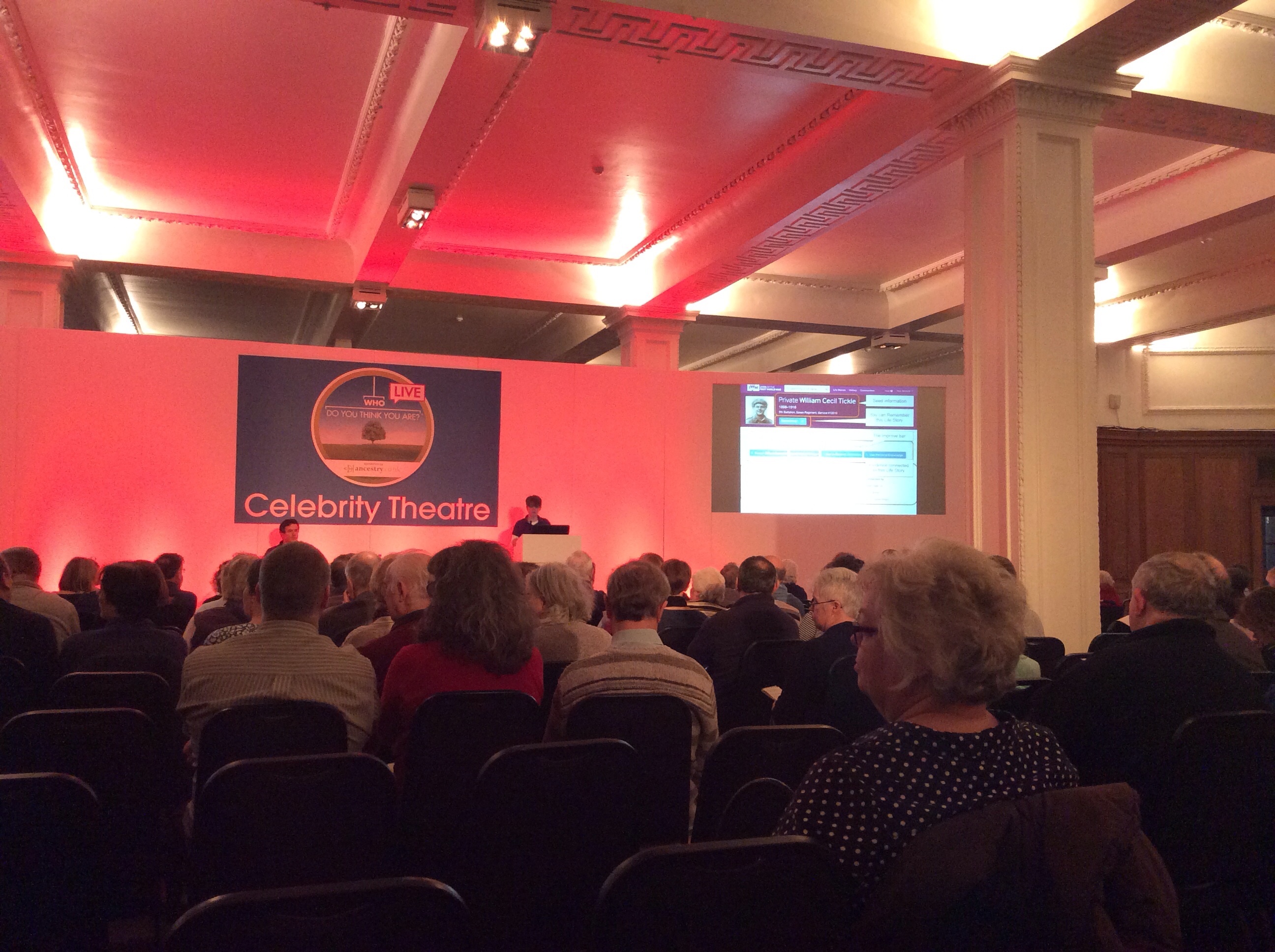
I was fortunate to attend the Keynote from Lives Of The First World War with Melanie Donnelly and Luke Smith, expertly compared by Else Churchill and her roaming mics. They were able to explain the initial test conducted in 2011 on Flickr, and the subsequent development of the project to the now, 2-day old, showcased product.
It’s yet to be publicly launched – they quoted May 2014. It certainly looks like a great resource for creating what is essentially a memorial Facebook-style profile of people who lived and died in the First World War, complete with photos, audio, video, documents, stories, and community.
Eric Knowles at Who Do You Think You Are? Live 2014
Was pleased to spot the legendary Eric Knowles again, deep in conversation with a hopeful heirloom keeper.
I’m now off for a ‘tweet up’ at the Hand and Flower pub opposite the event venue…. so I best leave that out of today’s blog post!!
Day one of three, from the 2014 Who Do You Think You Are? Live show at London’s Olympia.
Today has been the first day of Who Do You Think You Are Live? 2014 at London’s Olympia.
Day One of Who Do You Think You Are? Live 2014
This is my fourth year here, and for the first time, I’ve booked a hotel, and I’m going to be here for all three days of the show.
Hopefully I can find enough to keep me entertained, and looking at the workshop schedule, this is going to be fairly easy.
The first year that I visited (back in 2011), I hadn’t booked myself onto any talks/workshops, and so found the whole event initially interesting, but not able to sustain my interest for a whole day – and I considered skipping it the following year.
Thankfully I didn’t, and I’ve been coming back ever since.
Angels, Cushions, Books, and Sin
I arrived at about 10am, complete with case (which, together with my coat, I swiftly consigned to the cloakroom).
I soon spotted Jackie Depelle, and her now infamous WDYTYALive themed hat, and after a quick hello, found my way to my first lecture session ‘Write Your Life Story’ with Michael Oke of Bound Biographies.
He explained how he fell into publishing through helping an elderly man write his life story. He went on to explain how best to get your own life story down – highlighting the need to record all the tiniest pieces of information you can, in order to help the reader remember you, or to picture or connect with the person or people you’re writing about.
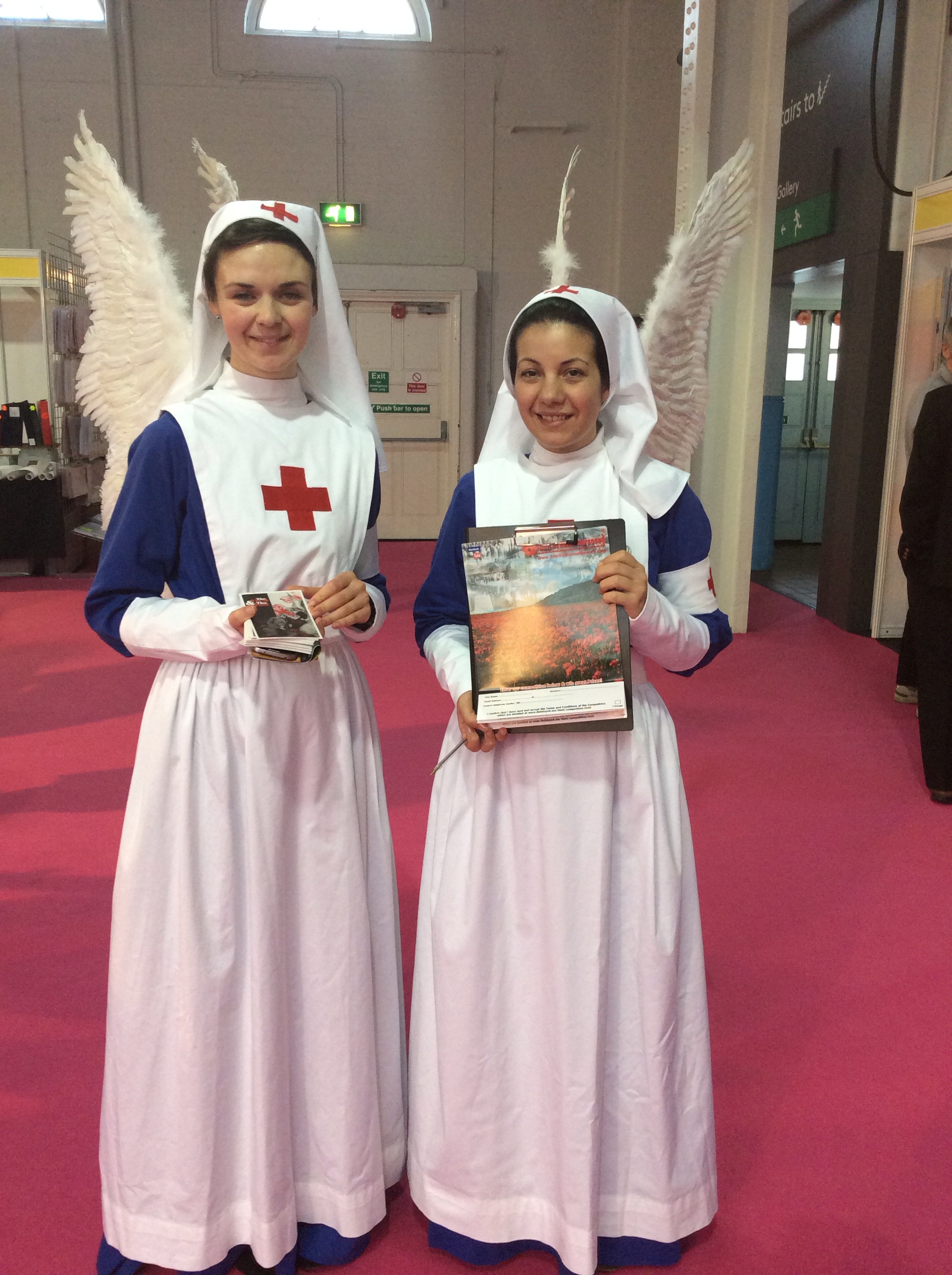
Whilst leaving his session, I thought I’d died, when I bumped into these two angelic nurses…
Angel nurses from spiritofremembrance.com
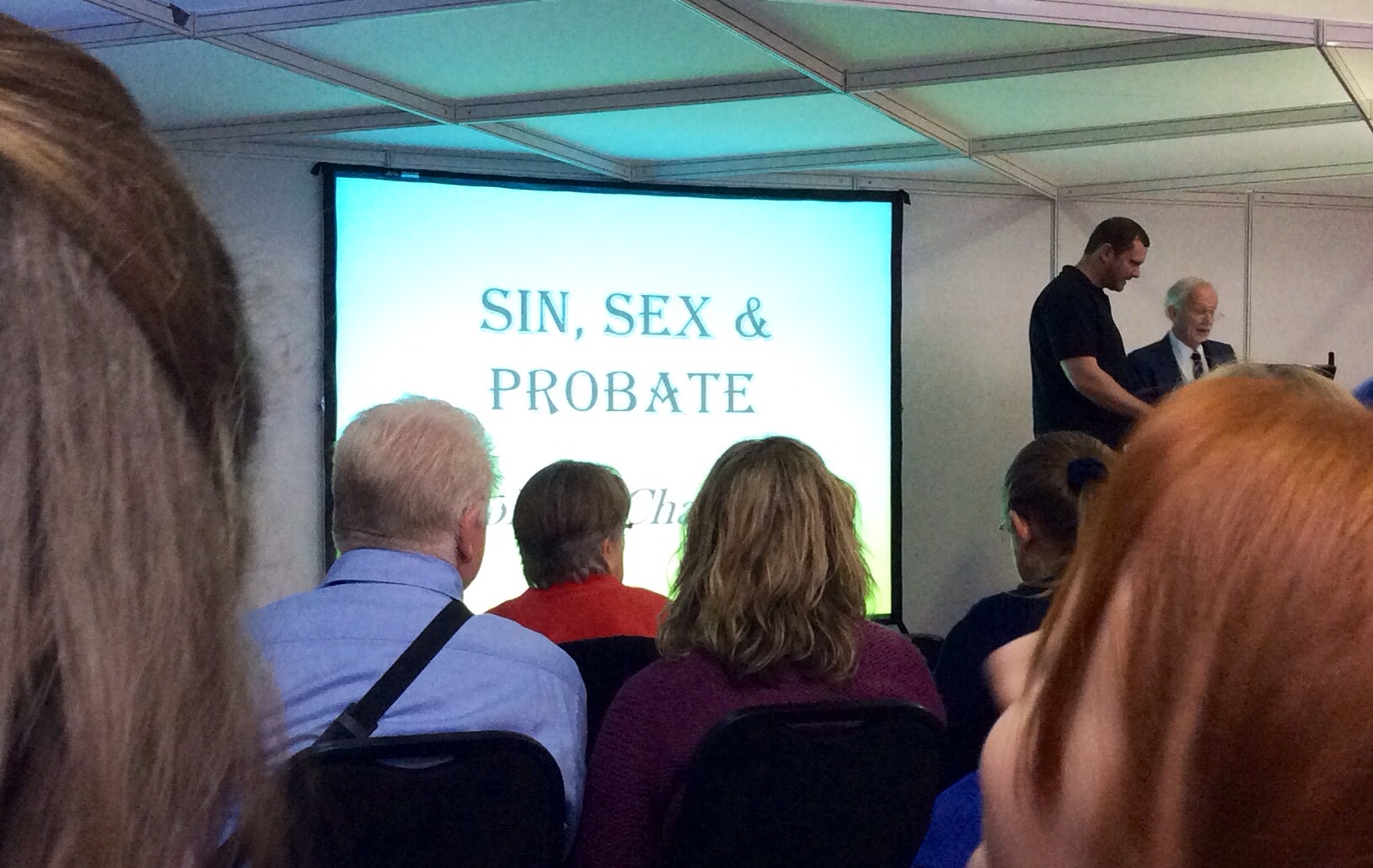
With (a pricey) lunch out of the way, it was time for my second lecture – this time from Dr Colin R Chapman on Sin, Sex & Probate.
Dr Colin R Chapman on Sin, Sex & Probate, at day one of Who Do You Think You Are? Live 2014
Dr Chapman talked through the hierarchical structure of the church, and explained that the records held by each level could be detailed and fascinating – but particularly a Bishop’s records (for the juicy gossip). He pulled some examples out from Norfolk, Essex, Cheshire, and Oxfordshire, to illustrate the range of ‘sins’ that we’re legitimate crimes – including defamation, not returning to church after giving birth to say ‘Thanks’ to God, punching a man whilst in a graveyard, and eating meat in Lent.
He pointed out that the church courts dealt with sins, and the civic courts dealt with crimes.
All in all, a fascinating topic, and I’m considering buying a copy of his book (of the same name), if only to read further examples, and help steer me to somewhere where I might find my own ancestor’s scandal.
I hasten to add, it’s the first time I’ve ever had to ask for a ticket for Sin, Sex & Probate!
I managed to pop along to the FindMyPast stand twice, catching the tail end of David Annal‘s fascinating talk on census returns and how you can use search wild cards to get better results, and examples of poor handwriting and missing relatives.
Also, appearing later, was the turn of Myko Clelland of FindMyPast, who once again under-dressed for the show (see pic below), whilst searching for Cushions in Shoreditch (of the surname kind), to help illustrate the collections, new image viewer, and new tree builder (I’ll be giving this a spin when I get home).
Myko Clelland (FindMyPast.com) talks cushions at Who Do You Think You Are? Live 2014
All in all a good first day. Tomorrow has a tweet-up to attend, more lectures, shopping, and no doubt catching up with more genealogy friends.
Sarah Millican wins 67% of the ‘favourite Who Do You Think You Are? UK series 10 episode’ vote, but where did the rest of the celebrities rank? Plus, rumours for series 11 in 2014.
A few months back, I ran a poll on this blog, where you could vote for your favourite episode from the 10th Series of the UK version of Who Do You Think You Are?, with voting split between the first and second half of the series.
Having collated all of the votes together, for all 10 celebrity episodes, there is a clear winner.
Comedian, Sarah Millican, won the poll with 67% of the votes.
Her voting surged after she retweeted the link to the poll.
In her episode, she aimed to find out about her family’s history in the South Shields area of the UK, and also to see if she could find something her family could be proud of. Well, Sarah, (if you’re reading), you can be proud of your poll glory too.
Her nearest rival to this glory came from actor Nitin Ganatra who scored 11%, and in third came actor and singer Minnie Driver with 7%.
If you’re the kind of person who likes pies and charts, you’re in luck:
Gary Linekar and Nigel Havers languished in joint last place, both with just one vote each. Nick Hewer managed to muster two votes – a score that would surely get him fired.
Who Do You Think You Are? UK Series 11 for 2014?
Whilst I’ve yet to see confirmation that the 11th series of Who Do You Think You Are? is coming this year, it was reported by the Irish Independent in November, that comedian and writer Brendan O’Carroll – who is most famous for playing Agnes Brown in ‘Mrs Brown’s Boys’ – has filmed his episode.
Brendan O’Carrol as Agnes Brown in ‘Mrs Brown’s Boys’. Photograph: Alan Peebles/BBC
This week’s Surname Saturday themed post covers my paternal Barker family, who I’ve traced back to a village in the county of Hertfordshire, England.
Today’s Surname Saturday themed post crosses the border into Hertfordshire, and visits a small village where my Barker ancestors lived.
My progress in researching the family history of my Barker family is somewhat incomplete. Of course, a family tree is never really complete, but what I mean to say is that it is not very well documented.
This will no doubt be down to the fact that researching Hertfordshire is not as convenient for me as Cambridgeshire, and also because I have stumbled across name duplication from different family groups.
It’s been more of a ‘i’ll come back to this puzzle later‘ approach. That’s probably why blogging about it here today is actually a good thing – as I do get messages from distant relatives who have read the blog and find myself getting back on the trail.
Meet the Hay-binders!
From what I do know, the most recent Barker in my ancestry was my Great Great Grandmother, Mary Ann Barker, who was born in 1854, in Barkway, Hertfordshire. She was the third of at least nine children of William Barker and Mary Head, who had married in October 1847. In all, it appears that she had 3 brothers, and 5 sisters.
Joseph Barker (b.c 1849)
Louisa Barker (b.c 1850)
Mary Ann (as mentioned, b. 1854)
Harriet Eliza Barker (b.c 1856)
Henry Barker (b.c 1859)
Elizabeth Barker (b.c 1861)
Esther Barker (b.c 1864)
Thomas Barker (b.c 1866 – d.1913)
Frances Barker (b.c 1869)
William Barker (born around 1823 in Barkway), is noted as a ‘Hay Binder’ at the time of the 1861 census, and his wife Mary is noted similarly as ‘Hay Binder’s Wife’. The rolling countryside around Barkway would no doubt have been great for hay, but by 1880 he had turned his hand to being a carpenter.
William is deceased by the time that Mary (his daughter) marries for the second time in 1896. Mary (née Head), his wife, appears to survive until at least 1911, when it looks like she is living alone as a widow at the Clock House in Barkway.
Barkway Parish Church would have been very familiar to the Barker family.
Thomas Barker
Note that the only death date I have of Mary’s siblings is for Thomas, her younger brother who died in 1913. He was my Great Great Great Uncle.
I only have this information due to a recent connection with distant relative (2nd cousin, twice removed, apparently!) Peter Barker, who is Thomas’ grandson. He kindly sent me the following photo of Thomas – it being the only photograph I have of a Barker relative.
Mary’s little brother, Thomas Barker (1866-1913). Image: Peter Barker.
Sadly, Thomas died in July 1913 at London’s Royal Free Hospital when he was in his late 40s, from blood poisoning, which was as a result of his injuries of being run-over by a cart. He was a carman.
Finding Esther…
William was baptised at the parish church in Barkway on 16th March 1823. He was the second of at least seven children of Joseph Barker and his wife Esther. It’s worth noting now, that I am uncertain of the identity of Esther, as I have two possible candidates, but the dates are out.
Esther #1 may have been ‘Hester Hawks‘ who married Joseph Barker in 1809 – but then there was either a very long pause before marriage and first child (12 years), or there’s 12 year’s worth of children hiding somewhere.
Esther #2 may have been ‘Esther Elizabeth Nottage‘ (‘spinster’) who married Joseph Barker (noted as a ‘bachelor’) after the baptism of William (himself, the second child) in November 1823 at nearby Braughing. Were there two illegitimate sons, and a marriage in a different parish to hide the shame?
I’m stuck.
My only slight glimmer, is that on the same day that William went to church to be baptised in March 1823, he was joined on the day by John and Anne Nottage for their son’s baptism (also a William, albeit Nottage).
My Downton Abbey Moment
By the time of the 1871 census, Mary Ann becomes a kitchen maid for a wealthy land owner John H Phillips – a Justice of the Peace (JP) for Hertfordshire, and Deputy Lieutenant for Cambridgeshire. He is also noted as farming 400 acres, and employing 19 men and 7 boys.
Here, she is one of several staff members, including a Lady’s Maid, a Page, Butler, Nurse and a housemaid.
Research by the kind volunteers at Royston and District Museum, brought up several references to John Phillips and his family’s brewery, but none of Mary herself. As a kitchen maid, it was unlikely that she’d be well documented, but it was worth a look in case a photograph might have been lurking.
However, what is likely, is that this is where Mary Ann learnt her skills in servitude, and hopefully earned herself a good reputation. The heads of the household may have written her a suitable reference that helped to take her down to London by 1880, where she appears as working in the now famous Abbey Road in St John’s Wood.
It was there in London, that she met my Great x 2 Grandfather George Burnell of Somerset, and their lives (and mine) grew into a new branch of the Burnell tree.
I’ve been crunching data again, and following on from my previous infographics, this time it’s the turn of my own surname – Martin. How do the life statistics stack up?
There’s a few things evident from this infographic:
The average life-span of a Martin descendant is lower
Winter weddings are popular with Martins
Winter children are common with Martins
Martin men most commonly die around agricultural calendars (May and September)
Maybe the last three are connected? Is data showing that the agricultural occupations of the male Martin name-bearers was central to their home lives?
As for the age of death for men, fitting in with agricultural calendars – there may be some truth in this, similar to the parallel decline in UK heavy industry and the increase in male life expectancy in the 1980s.
As for me, well, it looks like that statistically i’ve got about 16 years left, will have one child, still have time to marry, and will probably die at one of my birthday parties (May).
I look forward to skewing the figures (the good way!).
Memories of attending Wilburton Primary School, Cambridgeshire, during the Edwardian era, including snowstorms and earthworms.
I started school when I was 5 years old [1904].
My mother [Adelaide (née Bishop)] was very good, she used to show us how to write, count and read as she taught the infants at Little Thetford school. Our school [Wilburton Primary] consisted of two rooms – a big one divided by a wooden and glass partition which was pulled across.
Mrs Alma Marchant with children from Wilburton Primary School. Maude is apparently 5ft from left, on the third row. Image: CCAN.
There were over 100 of us with two teachers, Mr Harry Marchant and his wife Alma, who lived in the school house. The school was built on the back of their house.
Strict or soft? Alma A. Marchant mistress at Wilburton School. Image: CCAN.
The girls and infants had to go in the front way. We had a small playground and the laboratories were in a block across there with the fuel shed. We only had a small porch for hanging our coats and bags in, so they had to hang over one another which wasn’t very well on wet days.
There’s something in the water
We had a basket behind the door with a tin bowl on it where we used to wash in and a roller-towel on the door. We used to have to pump water to wash in but we were not allowed to drink the water as we used to pump earthworms up sometimes and our teachers had to fetch their drinking water from another house.
We used to take food with us for midday and go out begging for water to drink. There were quite a lot of us dinner children, as the came from far away places.
Mother always cooked us some hot dinner when it was cold.
Lost in the snow
We lived a long way from school. I remembered my next sister, Jessie and I got lost in a snow storm. We had to walk down a long path. It was dark and snowing hard and the school master had kept us in until 4pm.
The big children ran home without us, so mother ran to the station and told father (the stationmaster) and he had to run up the path looking for us in between train arrivals.
We were lost and it was snowing hard and we did not know which way to go. We were heading the wrong way – back to Wilburton. Jessie was five and I was six.
I think poor old dad didn’t get and tea that night. He used to have to get his meals when he could and if he had to put overtime in when trains were late he had to lay off the next day to make it up.
During dinner times we played with skipping ropes, hoops, tops, marbles and balls. We sat in school at long desks attached and tightly pushed together and it was very cold for those at the back as the stoves didn’t send much heat back there.
Father sent a letter to the school master the day after we got lost, and gave him a good telling off! It was too dark to do lessons, so why didn’t he keep us in?
After that, Mr Marchant let all the long-distance children go home sooner when it was dark early.
Schoolmaster Mr Harry Marchant, with children at the Wilburton Primary School. Image: CCAN.
Making Do
We were very poor as he only brought home about 15 shillings and 10 pence after he had paid house rent and club money.
Father was a good gardener and he grew us plenty of vegetables. He kept bees so that we got some honey and mother made a lot of jam. We used to do sewing and knitting at night when we had washed up.
Mother was good at that and she used to put us right and we used to teach other dinner children. We used to pull old socks undone to do it and children from farms brought fencing nails as needles.
We used to have some happy times, and we used to play in the road.
Passing exams and saying ‘goodbye’
I passed an exam when I was twelve and had to go and work in the fruit gardens to earn a few more shillings but the poor Dr. Banardos children were sent to Canada and Australia to work when they were twelve.
It did seem a shame and we didn’t see them again, poor little things. The people who had them were very upset over that as some of them had had them from babies.












 History Repeating