Surname Saturday: Boulter

The pop-up family of Boulter are the subject of this week’s Surname Saturday theme. Can you shed any light on this name in Cambridgeshire, England?

An unusual family name that stays in one village – simply popping up in records and then vanishing again.

My Boulter line came to an end when my maternal Great Great Grandmother Elizabeth Boulter married John Freeman Dewey in 1878 at the tiny village of Wentworth in Cambridgeshire.

Elizabeth’s parents were Robert Boulter and Mary Ann Moden who also married at Wentworth. After marrying in 1852, the couple went on to have 10 children with Elizabeth being the oldest. Out of the ten children, seven of them were daughters (one of whom did not survive infancy).

The earliest Boulter ancestors i’ve found so far is William Boulter and his wife Ann Covell – Robert’s parents. They married in 1815 (again, in Wentworth), and had at least four children – 3 sons and a daughter. I don’t yet know where William came from before his marriage to Ann – although she was from the neighbouring village of Witchford, so perhaps William was living in Wentworth in 1815.

John and Edward Boulter
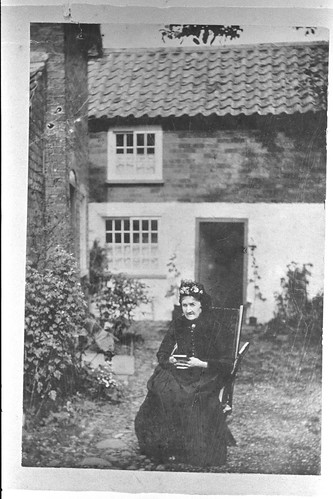
John Boulter (right), my Gt Gt Grandmother’s illegitimate first child, with his son Edward ‘Happy’ Boulter (left) – the only part of the Boulter family that I have photographs for.

The mysteriousness of the family continues, with only one part of the Boulter family (not ancestral) that I have photographs of in my collection (see above) – given to me by a fellow researcher (and distant relative). The photo shows John Boulter (right), the illegitimate first son of my Gt Gt Grandmother Elizabeth Boulter, who was born five years before she married my Gt Gt Grandfather John Freeman Dewey. John Boulter occasionally takes the surname of Dewey in census returns, but this may have been more an attempt to hide the stigma attached to illegitimacy than it might have been to suggest that John was actually his father. In fact, when John got married in 1896, he names his father as ‘John Boulter – deceased’ – did he ever know the truth, or was he using his step-father’s first name?

John Boulter moved to London when he was just 17 where he married Alice Watts and started a family of 11 children (the photo shows him with his third son Edward). Eventually, he joined the Corporation of London as a groom and often rode First Postilion on the Lord Mayor of London’s coach during the annual show.

Distribution of the surname

With Robert and Mary’s family consisting of a larger number of female children than male, it may go some way to explaining how/why the surname has struggled to survive in the area – with the name becoming redundant upon marriage.

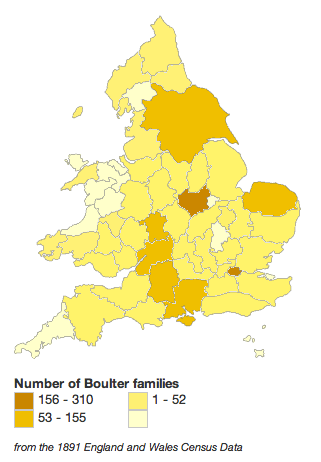
Distribution of Boulter families in England, 1891
Ancestry.com’s mapping of the distribution of Boulter families in England, according to the 1891 census.

Ancestry.com have plotted the 1891 census data for the surname, allowing me to see the distribution of 1,661 Boulter families (note – not individuals). According to this data, Cambridgeshire had just 21 families with the surname. Norfolk is the 4th highest concentration of Boulter families with 102 – with it being a neighbouring county, this data might suggest that the family went there or even came from there. Unsurprisingly London led the way with 310 and Leicestershire came second with 240 families. Wiltshire was third with 121.

Origin of the surname

John Ayto offers a couple of different origins for the surname, probably due to it’s common misspellings. In his book ‘Encyclopedia of Surnames
he suggests that the origin is either from a ‘maker of bolts’ (as in for arrows or crossbow); a name given to someone short and stocky; or to the name of someone who sifts flour (from the Middle English term ‘bolten’ – to sift flour).

Where next for research?

I hope one day to find a photograph of my Gt Gt Grandmother Elizabeth Dewey (née Boulter), particularly as I have a photo of her husband, and I know where her grave is. She is my closest ancestor of whom I don’t have a photograph.

As for finding the surname’s next generation back – I’ll be resuming the search in neighbouring parishes for clues (Witcham and Sutton are top of my list) on William’s parents, and I’ll be checking Wills to see if there are any clues left there.

If you have stumbled across this unusual name in your research, please do drop me a line!

Surname Saturday: Levitt

This week’s Surname Saturday focuses on the Levitt family of Swaffham Bulbeck in Cambridgeshire, England.

This week’s Surname Saturday theme posting looks at the Levitt family, who lived in the village of Swaffham Bulbeck in Cambridgeshire during the 18th and 19th century.

Swaffham Bulbeck, Cambridgeshire
St Mary’s Church, Swaffham Bulbeck

My most recent Levitt ancestor was Emma Levitt, who was born in 1825 as the oldest of at least nine children of John Levitt (a blacksmith) and Elizabeth (née Skeels). She went on to become my Great Great Great Grandmother when she married Charles Newman (also of Swaffham Bulbeck) in 1847, with whom she had six children.

The earliest Levitt name bearer in the Swaffham Bulbeck parish registers appears on 12th November 1750 when my Great x6 Grandfather James Levitt married local girl Frances Roote (she was about 16 at the time).

James and Frances settled down to have nine children over a 22 year period. Their fourth child, and oldest son, born in 1758 was James Levitt – my 5x Great Grandfather. With this James having married Elizabeth Fabb and bringing three sons into the world, the youngest – John Levitt – was born in 1797. By 1824, John was married to Elizabeth Skeel, and his father was dead.

The faux-Hardings on the 1871 census
John and Elizabeth Levitt appeared as ‘Hardings’ on the 1871 census for Swaffham Bulbeck.

Swaffham Bulbeck was still home to the Levitt family, and would remain so during through the 19th Century census returns (including a stint where John and Elizabeth were disguised by their married daughter’s name on the folio – proving a small challenge to find them) whilst John and Elizabeth rear a brood of nine children – all of whom appear to have survived into adult life. The oldest of these is where the Levitt family name ends (at least for me), when their oldest child – Emma Levitt (born in 1825) married my Great Great Great Grandfather Charles Newman.

Emma’s Levitt siblings appear to have married and bore their own families, helping to keep the family alive.

Swaffham Bulbeck

Variants

There seem to be a few variants of the surname’s spelling, but the main ones that I have seen are: Levitt, Levit, Levet, Levett and Livett.

John Ayto‘s book “Encyclopedia Of Surnames” notes that Levett may have come from a few different origins.

(i) ‘person from Livet’, the name of various places in Normandy, of unknown origin; (ii) from the medieval personal name ‘Lefget’ (from Old English ‘Leofgeat’, literally ‘beloved Geat’ (a tribal name)); (iii) from a medieval Norman nickname based on Anglo-Norman leuet ‘wolf cub’.

Standard or News?

Guest blogger Jane Freeman writes about using local history sources in print and online to research her Stretham roots.

Ooooh, this is a bit scary …. my first “guest” blog. Let’s start with the fact that I’m nearly related to Andrew, via a chap called Francis Yarrow, of Little Thetford, who married Anne Langford in Stretham, back in the mists of time. So, Andrew & I are related in a rather tenuous way best described by my maternal grandmother as “their cat ran over our doorstep”.

My maternal grandmother, that is, who came from Stretham, and whose wedding photo started me on my genealogical travellings. Kate Langford was born in 1889 and left the village, as girls her age did, to go into service. Her brothers mostly stayed there and my visits to Stretham as a child were to see “Uncle Bill”, her older brother, by then a widower living with two of his step-daughters. Cis & Ethel – one of them was an excellent cook and to this day I remember her mince pies & sausage rolls at Christmas!

These are the kind of memories which I most like about family history; collecting names and occupations is fine, and satisfying in its own way, but I like to make them into “real” people again and this part of my research is being aided and abetted at the moment by the British Newspaper Archives. A brilliant resource, albeit slightly expensive – its Australian counterpart “Trove” is free. But I digress: my latest find was in the Chelmsford Chronicle, May 1844, under the heading “Awfully destructive fire at Stretham”, which described a widespread fire in the village affecting “not fewer than 25 houses, &c………including habitations of wealthy agriculturists and humble labourers….” (see below for transcription of the full article). Although these articles are very useful in telling one who was around at the time, the writing of them also fascinates me. They didn’t have photographs, of course, to show the destruction so the journalists had only words to use; and how well did they use them.

Stretham - A Feast of Memories by Beatrice Stevens

More up to date, but every bit as informative, is “Stretham: A Feast of Memories” by the late Beatrice Stevens. This book gives a portrait of life in the village in the early 20th century and is an absolute gold-mine of detail. The Cambridgeshire library has a number of copies and I recommend it highly for those who have an interest in the village! In its pages I discovered that Uncle Bill’s step-son emigrated to Canada, returning a few years later to fight in the Great War (wherein he was wounded and lost an eye – in the Ely Standard, that one) and returned once more to Stretham, this time with his wife. Because of these clues I went to the Outgoing Passenger Lists on FindMyPast, and thence to the Canadian Library & Archives for his Attestation Papers. Never mind that I’m not at all related to him – I just had to know what happened to him. He sailed on the “Tunisian” to Halifax, Nova Scotia, leaving Liverpool three days after the 1911 census, and subsequently joined the Canadian Mounted Rifles when the Great War broke out.

So, while I couldn’t live without the census and parish registers, it’s the “off-piste” information which I enjoy most of all; the only problem is that I get so easily side-tracked – I mean, what’s not to like about some of the old adverts or, my particular favourite, seeing articles in the Cambridge papers of the late 19th/early 20th century which are complaining about traffic chaos!

‘Awfully destructive fire at Stretham’

CHELMSFORD CHRONICLE – 10th May 1844

One of the most awful fires which it was ever our province to record took place Wednesday week, at Stretham, near Ely. The destruction of property is enormous; and when we say that not fewer than 25 houses, &c. have been razed to the ground, including habitations of wealthy agriculturists and humble labourers, the reader will imagine for himself the extent of misery which must be the consequence of this lamentable visitation.

The fire originated in small hovel adjoining the blacksmith’s shop of Mr. John Westby. It is supposed that some sparks of hot iron were the immediate cause of the catastrophe, but this does not quite clearly appear. At any rate, about one o’clock in the day the hovel was discovered to be in flames; and although assistance was hand, and the fire seemed at first but trifling, so dry were the materials of which the hovel was composed that it was very soon enveloped in flames, which communicated with Mr. Westbv’s house on one side, and Mr. Wright’s stack-yard the other. No sooner were Mr. Wright’s extensive and well-stored premises seized upon by the devouring element, than the utmost alarm for the safety of the village was entertained. Nor was this alarm unfounded, for the flames spread with such frightful rapidity, on both sides of the street, that in a little more than an hour from the time of their breaking out twenty-five occupations, extending over about fifteen acres of ground were in a blaze. To describe the scene would be impossible. The reader will conceive the terrible fright and disorder which prevailed, and the awful character of the destruction going on. So wonderfully rapid was the spread of the names, and so great the heat emanating from the immense mass of burning materials, that many those who fancied their premises secure when the fire first broke out, and consequently neglected to take care their own furniture, clothes, &c. were unable to secure a particle. Some have lost every chip and every rag, save the garments they happened to have on at the time. There is no engine at Stretham. About two o’clock the Haddenham engine arrived, and to the good use made of it, under the most active and energetic directions of the Rev. S. Banks, incumbent of Haddenham, may be attributed the saving of great part of the village. On one side of the street, the progress of the flames was arrested at a cow-lodge, belonging to Mr. Hazel, and the other side the yard of the public-house, next Messrs. Senet and Graves’s premises. In order that the reader may form an idea the extent of damage done by this destructive conflagration, we will give a list of the premises burnt.

  1. The hovel in which the fire originated.
  2. John Westby, blacksmith.—House, furniture, and clothes destroyed.
  3. Mr. Boultentarf, miller.—House, furniture, out-buildings, hay, &c.
  4. Mr. Wright, farmer.—Mr. Wright’s premises occupy both sides the street; at present we are describing the property on the south, but we include Mr. Wright’s total loss. Two barns, stables, cart-lodges, 300 coombs of wheat, 4 wheat stacks, 3 hay stacks, 2 straw stacks, a large number of pigs and fowls, &c. destroyed. House saved.
  5. Mr. Coy, farmer.—Dwelling-house, new barn, granary, stables, machines, wagons, out-buildings, wheat stack, beanstack, hay stack, straw stack, about 12 pigs, fowls, &c.
  6. Mr. Murfitt.—House, furniture, barn, stables, hay, &c.
  7. Mr. Lester, butcher.—House, furniture, clothes, stables, cart, five £5 notes, and 40s. in silver.
  8. Mr. Jackson.—House, barn, hay stable, & building in the yard.
  9. Mr. S. Wright.—House, bam, stables, hay stack, wheat, peas, and beans.
  10. Mr. Philips, baker.—House, furniture, clothes, stock-in-trade, and in fact every thing.
  11. Alms-houses—two families.
  12. Ditto —four families.
  13. Mr. John Wheeler, shoemaker and brewer.—House, furniture, stock in trade, warehouse, &c.
  14. Mr. Hazel.—Cow-lodge. Here the fire was stopped on this side of the street.
  15. Mr. Wright.—See No. 4.
  16. Mr. R. Wheeler.—House and out-buildings.
  17. Mr. Gibbons, shoemaker.—House, furniture, stock in trade, and every thing.
  18. Mr. Dimmock.—House, buildings, &c.
  19. Mr. Langford, linen-draper.—House, furniture, stocktrade, and every thing.
  20. Mr. Baxter, harness-maker.-The same.
  21. Mr. Savidge, tailor.—The same.
  22. Mr. T. Grainger farmer.—Barn, stables, every outbuilding, haystack, straw stack, 30 coomb of beans, about 40 coomb oats, 14 pigs, a quantity of fowls, &c. Mr. Grainger’s barn was the largest the county: nothing but the walls are left, and so intense was the heat that the brickwork seems in some places to have been almost molten. The house was saved.
  23. Mr. L Langford – House, stable, barn & other buildings.
  24. Mr. Dring, veterinary surgeon – House and furniture.
  25. Messrs. Senet and Graves.—House, barn, and stables.

It will be understood from the foregoing that the desolation is heart-rending. The Church was made the receptacle of the furniture, &c. which could saved: and as to the numerous persons deprived of house and home, they were accommodated as well as circumstances would admit, and every attention paid to them by the clergyman and their neighbours. Two engines from Ely were present: and the Superintendent and some men of the isle Ely constabulary rendered great service in the prevention of depredations. It is of course difficult to speak with any thing like accuracy but it has been estimated at between £15,000 and £20,000, a great portion of the property being, we fear, uninsured.— Cambridge Chronicle.

Surname Saturday: GILBERT

Surname Saturday: GILBERT – The Gilbert family of Huntingdonshire and Cambridgeshire are the focus of this week’s meme day.

This week’s Surname Saturday post is that of my paternal Gilbert family. My connection is through my paternal Great Grandmother, who was born in 1884, in Littleport, Cambridgeshire.

With the help of the research of distant relative Colin Tabeart, the tree has been found to stretch back through time as far as 1694 when the family turns up in Abbotsley, Huntingdonshire (now part of Cambridgeshire). It is here that they are noted in the parish records and taxation records.

It appears that the earliest Gilbert I’ve found (with, as yet, an unproven connection) was in Abbotsley, Huntingdonshire in 1605, when a John Gilbert takes his daughter Maria to be baptised in the parish church of St Margaret on 24th February.

Abbotsley Church
St Margaret’s church at Abbotsley, Cambridgeshire.

By the beginning of the 18th century, the Gilbert families in Abbotsley were booming with each seemingly having at least 9 children, and up to as many as 13 children over a 24 year period – as was the case of James and Anne Gilbert between 1752 and 1776.

In 1767 at Abbotsley, Elizabeth Gilbert (née Hale) – the widow of James Gilbert – is noted as paying a Land Tax of £1, 19 shillings to a Mr Robert Edsope.

In 1828, the son of my Gilbert line – William – leaves Abbotsley and heads about 40 miles North East to Littleport in Cambridgeshire, where he married Elizabeth Brightly. The couple settle down in Burnt Chimney Drove – an area of rich agricultural fenland just to the North West of Littleport, where William becomes a farmer. The couple bear 12 children, although sadly a few of these don’t survive their early years.

Whilst William’s relocation may well have been because of his love for Elizabeth, his parents – Edward and Susan Gilbert have fallen on hard times –  by 1851 they are both noted as ‘paupers’ and are living with their daughter Mary and her husband Thomas Cade. Susan has become blind, but goes on to live another 8 years. Edward only lived until 1852.

Elizabeth Howlett and James Gilbert

Despite this hardship, William and Elizabeth were making progress for themselves and managing to live outside of poverty thanks to farming. Their 9th child (also Edward and Susan’s grandson), James, was my Great Great Grandfather, and he survived his two older brothers. In doing so, and in an act not unusual or unlike primogeniture, he inherited his father’s farm in 1879, which by 1871 had grown to 40 acres and employed one family.

By this time, James had got married to Elizabeth Howlett – and they had already bore two of their eventual family of nine children.

The family still lives and farms in the area today.

Wordless Wednesday (well, almost)

Wordless Wednesday – 1947 floods and the 2012 flooding at Haddenham and Earith, Cambridgeshire. Both causing widespread disruption.

1947

My Great Grandmother receiving tinned goods from The Red Cross during the 1947 floods.

1947 - Red Cross suppliers


2012

The Great Ouse at Earith. The neighbouring village from where my Great Grandparents lived, cut off by flooding in December 2012. There’s a river in there somewhere.

Flooding in Earit, Cambridgeshire in 2012

How To: Have your ancestor’s headstone cleaned and stood back up (Part One)

Article detailing the first two steps in exploring how to get my great great grandparents’ headstone cleaned and re-stood in a UK churchyard.

If whilst doing the graveyard shift of your family history research, you find one of your ancestor’s headstones in a less-than-favourable condition, what can you do about it?

This article might help you if you’re in the UK and thinking of having a gravestone cleaned up, repaired, or re-stood up.

My Great Great Grandparents’ headstone toppled over at some point in 2011 or early 2012. It had always seemed sturdy, so this came as a surprise. I wonder whether it might have been helped on its way down? I’ll never know.

John and Elizabeth Dewey gravestone laying down in 2012
John and Elizabeth’s gravestone in 2012 – may have fallen over as long ago as 2011.

When the headstone fell backwards, it landed partly on the kerb stones of the grave behind it, but fortunately it appears that neither grave sustained any damage.

During the 00s, the church had a tidy up of their churchyard, and this included removing the kerb stones from the grave in order to help them mow the grass (don’t think they asked!). This would have probably have contributed to the gravestone’s instability, as it was never designed to stand on its own. Also, the grave stands in Cambridgeshire, and therefore with the heavy clay soil, it is prone to movement.

John Freeman Dewey and Eliabeth (née Boulter) grave in 1990s
The grave of John and Elizabeth, complete with some kerbstones, in about 1996.

Step One: The Church

My first step was to email the church to find out how to go about having it re-stood and possibly cleaned. I received a friendly and helpful email back from the Canon to say that the church is not involved in that process but that I should contact a stonemason directly as they would then do the necessaries.

Understandably the Cannon asked that, if I did go through with some work and the stone needed to be removed (perhaps for cleaning), that it would be best to keep her and/or the churchwarden in the know, so that its removal doesn’t suddenly trigger a search for a missing headstone.

So, next step is the stonemason for an idea on costs and feasibility of cleaning it.

It’s worth bearing in mind that some lichen in the UK are protected by law, so I’m hoping that this will not be an issue here – and that I can bring this headstone back up to how it would have looked in 1943 after John Dewey’s burial.

My reasoning for contacting the church first was down to a couple of conversations i’ve heard over the years about being charged by the church for setting a stone in place. No fee has been mentioned – perhaps an indication that the Cannon would be pleased to see a tidier graveyard.

Step Two: Contacting the Stonemasons

After Googling for stonemasons in the appropriate county, I emailed 3 of them to ask for rough ideas of prices for both the re-standing and cleaning parts, and included a link to the photo of the grave laying down.

Essentially I have a few questions about the whole process:

  • Cost for re-standing
  • Cost for cleaning
  • Insurance – what happens if the stone breaks whilst in their care?
  • Marker – does a grave get a marker to a) mark the position of the grave and b) alert any visitors to the grave as to where/why the stone isn’t there?

Admittedly I haven’t asked the last two questions yet, but as I don’t have a massive budget, I want to know that I have the first two options covered first.

… to be continued….

William Bailey ‘Died by the visitation of God’

William Bailey died whilst cutting oats in a field in Wicken in 1861. The inquest’s verdict was ‘died by visitation of God’.

William Bailey - killed 'by God'

Newspaper report from page 5 of the Cambridge Chronicle, dated 31st August 1861, details the sudden death of labourer William Bailey of Wicken. After an inquest took place, the cause of death was noted as ‘Died by the visitation of God’.

Needless to say, the culprit was subsequently not brought to justice.

Why keeping up with the neighbours is important in genealogy

If you’re not examining your ancestor’s neighbours, then you could be missing some key information.

These days, quite a lot of people have no idea who their neighbours are – their names, what they do, where they work etc, and the only interaction may be a quick ‘hello’, a nod, or occasionally collecting parcels from each other.

It’s just a sad sign of the times that as our lives become busier, and as families become more geographically spread, that we just don’t have the time or inclination to socialise with the people who live just a few feet away.

It’s not always been like this though – looking to the censuses of at least the early 1900s, you may discover that your ancestor’s neighbours play a much more significant role in your family.

‘Neighbours. Everybody needs good neighbours’

When the 1861 census took place, the enumerator for Swaffham Bulbeck in Cambridgeshire, England, visited Village Street and noted down the names and details of everyone there including four families who were all living nextdoor to eachother – each with different surnames.

1861 census return for Village Street, Swaffham Bulbeck, Cambridgeshire.
The 1861 census of Village Street in Swaffham Bulbeck, shows a number of families.

The enumerator may well have known the Newman, Skeels, Fordham and Levitt families seen in the example above, but the census does not shed any light onto the significance of the proximity of these 18 people.

The 18 people on this census folio are actually four generations of the same family, and this folio is a snapshot of how they had stayed together as the families grew. By trawling back to the 1851 census, you are able to find the core family again, in a much smaller family group.

The seventy-seven year old widow, Elizabeth Skeels, née Richardson, is the great grandmother and matriarch of the family. She appears here in 1861 as living just feet away from her daughter’s (Elizabeth Levitt, née Skeels) family, and is surrounded by the families of her daughter’s oldest children (Emma Newman, née Levitt and Harriet Fordham, née Levitt) whilst the younger children are still at home.

At first glance, I would have spotted Skeels, or if i had been in Newman or Levitt ‘research mode’ I’d have seen them and not necessarily spotted or realised the importance of the families around them.

So, keeping an eye on what’s happening nextdoor on the census returns can help you in your research.

Four families in a row is probably my best when it comes to related neighbours – can you beat that? Or have your ancestors had a famous/infamous neighbour? Let me know in the comments below.

Wordless Wednesday

Wordless Wednesday – Ernest Herbert Barber (1902-1983) in his garden circa. 1954.

Ernest Barber in his garden

Surname Saturday: TINGEY

Surname Saturday – TINGEY or TINGAY. A look at the Tingey surname in Cambridgeshire.

An unusual surname with seemingly disconnected family groups turns up in both my maternal and paternal families.

Mary Tingey (1821-187?)
Mary Tingey

The Tingey name turns up twice in my family tree. Once as ancestral in my paternal tree, and the other as a husband of a maternal great aunt.

My earliest record of a bona-fide Tingey ancestor is Ann Tingey, who appears at the parish church in Witcham, Cambridgeshire in 1769 where she went to baptise her illegitimate son Thomas.

By 1771 she had returned, to marry James Toll with whom she had at least two children.

Thomas remained in Witcham, where he married Mary Barber in 1794 and together they had three children – Robert, Elizabeth and Sarah. It appears that the family moved just a few miles away to Oxlode in 1841 – a tiny hamlet close to the village of Little Downham, Cambridgeshire – which is where they ended up by the time of the 1851 census.

Robert went on to marry Fanny Harrison and together they had a family of 12 children, with their oldest (Mary Tingey) being my ancestor, born in 1820.

Amongst family photographs is a photograph of Mary in later life. By the time that this photo was taken, she would have either have been Mary Martin, widow, or Mrs Mary Watling(ton). She was married a total of three times.

Another photograph is somewhat of a mystery – a carte de visite with the words ‘Aunt Tingey’ written on the back. It remains unclear as to whether this was an elderly maiden aunt, or a  wife of a Tingey uncle.

Aunt Tingey
The mystery ‘Aunt Tingey’

Other family groups

Whilst my own branch was busy living their lives and growing in the Little Downham area of Cambridgeshire, just four miles away in Ely appears to be another family group which I’ve never found a connection to.

Another group of Tingeys appear in Henlow, Bedfordshire. For many years I have been in correspondence with another researcher – but as yet there appears to be no link between the family groups. According to the researcher, there are many gravestones for Tingey name-bearers standing in the parish churchyard.

This unusual surname does have a few variants through the years – ranging from: Tingey, Tingay, Tingye, Tangye, Tyngy Tyngie.

Origins of the name

According to John Ayto’s ‘Encyclopedia of Surnames’, Tingey/Tingay are derivative of Tangye. He says that:

“Tangye from the Breton personal name Tanguy, a contracted form of Tanneguy, literally ‘fire-dog’.”

According to The House Of Names.com:

“First found in Cambridgeshire where the name first appeared in the early 13th century.”