BBC One’s probate research programme, Heir Hunters returns for a seventh series.
Probate research programme, Heir Hunters, has returned for a seventh series.
The Heir Hunters programme, which follows probate research companies as they seek the benefactors of unclaimed estates, is currently showing during BBC One’s daytime weekday schedules and also on iPlayer (UK only).
As a fan of the show, I’m pleased to see it return, although know some friends who aren’t fans of the show – seeing the probate researchers as ‘money grabbers’.
In my opinion, if the estate is left unclaimed, and distant relatives have no idea of their relative’s death (or even existence in some cases), the commission that the probate teams earn is perfectly acceptable. In addition, with millions of GBP going unclaimed each year – it would simply go to the government if a probate researcher didn’t seek these out.
In addition, several previous episodes have acted as closure or a sad but welcome reunion for family stories and memories.
The first episode covers the cases of Prudence May Bone‘s railway family history, and a mysterious gentleman William Maxwell Naismith Wilcock, whose friends had no idea whether all his unusual life stories were true, and suspected him of being a spy.
The Bona Vacantia Unclaimed Estate Lists all the unclaimed estates since 1997 and can be viewed on their website. Is there an inheritance waiting for you?
This week’s Surname Saturday focuses on the Levitt family of Swaffham Bulbeck in Cambridgeshire, England.
This week’s Surname Saturday theme posting looks at the Levitt family, who lived in the village of Swaffham Bulbeck in Cambridgeshire during the 18th and 19th century.
St Mary’s Church, Swaffham Bulbeck
My most recent Levitt ancestor was Emma Levitt, who was born in 1825 as the oldest of at least nine children of John Levitt (a blacksmith) and Elizabeth (née Skeels). She went on to become my Great Great Great Grandmother when she married Charles Newman (also of Swaffham Bulbeck) in 1847, with whom she had six children.
The earliest Levitt name bearer in the Swaffham Bulbeck parish registers appears on 12th November 1750 when my Great x6 Grandfather James Levitt married local girl Frances Roote (she was about 16 at the time).
James and Frances settled down to have nine children over a 22 year period. Their fourth child, and oldest son, born in 1758 was James Levitt – my 5x Great Grandfather. With this James having married Elizabeth Fabb and bringing three sons into the world, the youngest – John Levitt – was born in 1797. By 1824, John was married to Elizabeth Skeel, and his father was dead.
John and Elizabeth Levitt appeared as ‘Hardings’ on the 1871 census for Swaffham Bulbeck.
Swaffham Bulbeck was still home to the Levitt family, and would remain so during through the 19th Century census returns (including a stint where John and Elizabeth were disguised by their married daughter’s name on the folio – proving a small challenge to find them) whilst John and Elizabeth rear a brood of nine children – all of whom appear to have survived into adult life. The oldest of these is where the Levitt family name ends (at least for me), when their oldest child – Emma Levitt (born in 1825) married my Great Great Great Grandfather Charles Newman.
Emma’s Levitt siblings appear to have married and bore their own families, helping to keep the family alive.
There seem to be a few variants of the surname’s spelling, but the main ones that I have seen are: Levitt, Levit, Levet, Levett and Livett.
John Ayto‘s book “Encyclopedia Of Surnames” notes that Levett may have come from a few different origins.
(i) ‘person from Livet’, the name of various places in Normandy, of unknown origin; (ii) from the medieval personal name ‘Lefget’ (from Old English ‘Leofgeat’, literally ‘beloved Geat’ (a tribal name)); (iii) from a medieval Norman nickname based on Anglo-Norman leuet ‘wolf cub’.
Day Two of 2013’s Who Do You Think You Are? Live event.
So, I’m just back home from my third Who Do You Think You Are? Live show at London’s Olympia.
The show, now in its second day, seems to be about the same size as in previous years. Thankfully the heating was on, as I’d already experienced the gentle flurry of snow adding to the shivvering I had done on the drab Earls Court station platform.
View across Olympia lower court.
At one end of the hall were all the local Family History Society stands – brought together by the Society of Genealogists, whilst the rest of the hall is filled with the behemoths of genealogy – the magazines, the suppliers, and the online datashops – Ancestry, FindMyPast, FamilySearch, and GenesReunited etc.
Upstairs, once again was the legend that is Eric Knowles, along with military historians – some in period costume. This whole area was packed with people clutching medals and photos, seeking information on relatives or identification of uniforms.
Following on from last year’s Titanic themedFindMyPast theatre, this year it was the turn of the Crime and Punishment theme (coinciding with their huge launch of fresh C&P records online). Their presenters were informative and entertaining, particularly period policeman Myko Clelland‘s search for Wombles.
FindMyPast’s Myko goes hunting for wombles.
The WDYTYALive Tweetup!
I had really wanted to attend what i think was the first ‘tweet-up’, and had been looking forward to meeting up with fellow genealogy twitter users, but awkwardly I was double-booked with the Richard III talk, so I had to bail, although did manage to meet a few twitter friends.
Still, as guilty as that snubbing made me feel, i thought I better share Rosemary Morgan‘s photo of all those that did show up, as a kind of ‘sorry i couldn’t make it’.
I arrived before 10am, so had plenty of time until my first booked session – the Celebrity Interview with Samantha Womack (or Janus if you remember her in Game On or Eurovision). Interestingly, interviewer Tessa Dunlop led Sam to reveal that she had not watched the broadcast episode as she felt that it was a personal journey and wanted to keep it that way for herself… plus she said she hates seeing and hearing herself.
That aside, we saw a few broadcast clips from key moments, and also a clip that wasn’t in the programme (something seemingly Sam had wanted kept in the show), which revealed much more about her ancestor Jesse Rider being in ‘The Greatest Show on Earth’ in the USA before she ever married or had children.
The Two Kings
Dr Turi King shed light onto the Richard III dig and its future.
Dr Turi King‘s (University of Leicester) presentation was fascinating, and detailed the archaeological dig from the outset right up to finding and identifying King Richard III via DNA testing and genealogical research. She also gave an insight into what is still going on with the data and the all important skeleton. Dr King told us that there was still a lot of work to do and a lot of information to write up, and also a modern Y chromosome to follow up on. She emphasised that funding is a major issue in this project and in general in archaeology (a subject which Tony Robinson and Helen Geake also emphasised the other week at the University of Cambridge), and whilst this dig has been back-filled, there were still plenty of things to explore further – including a stone coffin which was left untouched.
The talk buried a few rumours (see what i did there?) circulated by the press – including free DNA tests via Who Do You Think You Are?, and also the rumour that Richard III was buried beneath the letter ‘R’ painted on a carpark. He was not.
Searching for Surnames with SoG
My third and final workshop was one with the great Else Churchill from the Society of Genealogists (affectionately known as SoG). She showed off the Society’s forthcoming much improved website, and also gave an insight into the work and vast collection that the Society performs and maintains. Sounds like the Society has a huge legacy of great and valuable historical sources but they are tied up in a range of formats making them a challenge to see. Still, it sounded like plans were afoot to change this, and the new site would at least make searching those items that are already indexed/catalogued much easier.
All in all, this was probably my most enjoyable WDYTYALive. After my first one being somewhat uninteresting, and my second one (last year) seeing me attend workshops for the first time and getting more value from it, this one built on that but with the added meeting of twitter friends old and new.
I look forward to WDYTYALive 2014 (i’m pretty sure I saw a stand selling next year’s tickets).
Tickets for Who Do You Think You Are? Live 2013 have arrived!
This year I decided to ‘treat myself’ with VIP Tickets for Saturday 23rd – not ever so sure what ‘VIP’ means, but I thought i’d give it a go. Maybe I’ll be able to tweet from the red carpet area?
I have also booked myself on three sessions, including the Celebrity Theatre with Samantha Womack (Series 9 of WDYTYA, Game On, EastEnders, Eurovision Song Contest entry).
I’ve also joined in on a session with the fantastic Else Churchill from the Society of Genealogists, and a session with Dr. Turi King – which fortunately, IS about finding Richard III in a car park in Leicester. Not sure what would have happened if they’d realised it wasn’t him after I’d bought my ticket!
Huntingdonshire Family History Society has confirmed that there will be no ‘Big Family History Fair’ in 2013.
Last April, I visited the fair, which packed both car park and the St Ives venue with visitors for a day’s worth of genealogy and local history shopping, networking, and expert talks.
The glimmer of hope from the contact at the Society about a repeat of hosting it again, is that they ‘may do again in the future’ – perhaps in 2014?
Meanwhile, the Society continue to run their regular programme of events – which cover a broad range of local history topics.
Surname Saturday: GILBERT – The Gilbert family of Huntingdonshire and Cambridgeshire are the focus of this week’s meme day.
This week’s Surname Saturday post is that of my paternal Gilbert family. My connection is through my paternal Great Grandmother, who was born in 1884, in Littleport, Cambridgeshire.
With the help of the research of distant relative Colin Tabeart, the tree has been found to stretch back through time as far as 1694 when the family turns up in Abbotsley, Huntingdonshire (now part of Cambridgeshire). It is here that they are noted in the parish records and taxation records.
It appears that the earliest Gilbert I’ve found (with, as yet, an unproven connection) was in Abbotsley, Huntingdonshire in 1605, when a John Gilbert takes his daughter Maria to be baptised in the parish church of St Margaret on 24th February.
St Margaret’s church at Abbotsley, Cambridgeshire.
By the beginning of the 18th century, the Gilbert families in Abbotsley were booming with each seemingly having at least 9 children, and up to as many as 13 children over a 24 year period – as was the case of James and Anne Gilbert between 1752 and 1776.
In 1767 at Abbotsley, Elizabeth Gilbert (née Hale) – the widow of James Gilbert – is noted as paying a Land Tax of £1, 19 shillings to a Mr Robert Edsope.
In 1828, the son of my Gilbert line – William – leaves Abbotsley and heads about 40 miles North East to Littleport in Cambridgeshire, where he married Elizabeth Brightly. The couple settle down in Burnt Chimney Drove – an area of rich agricultural fenland just to the North West of Littleport, where William becomes a farmer. The couple bear 12 children, although sadly a few of these don’t survive their early years.
Whilst William’s relocation may well have been because of his love for Elizabeth, his parents – Edward and Susan Gilbert have fallen on hard times – by 1851 they are both noted as ‘paupers’ and are living with their daughter Mary and her husband Thomas Cade. Susan has become blind, but goes on to live another 8 years. Edward only lived until 1852.
Elizabeth Howlett and James Gilbert
Despite this hardship, William and Elizabeth were making progress for themselves and managing to live outside of poverty thanks to farming. Their 9th child (also Edward and Susan’s grandson), James, was my Great Great Grandfather, and he survived his two older brothers. In doing so, and in an act not unusual or unlike primogeniture, he inherited his father’s farm in 1879, which by 1871 had grown to 40 acres and employed one family.
By this time, James had got married to Elizabeth Howlett – and they had already bore two of their eventual family of nine children.
The family still lives and farms in the area today.
Wordless Wednesday – 1947 floods and the 2012 flooding at Haddenham and Earith, Cambridgeshire. Both causing widespread disruption.
1947
My Great Grandmother receiving tinned goods from The Red Cross during the 1947 floods.
2012
The Great Ouse at Earith. The neighbouring village from where my Great Grandparents lived, cut off by flooding in December 2012. There’s a river in there somewhere.
My top 5 genealogy things I hope to achieve in 2013 – a mixture of visits, writing and demolishing those research brick walls.
I don’t really go for New Year’s Resolutions, as I like to challenge myself on a daily basis, but I thought that I would put down 5 areas of my family tree research where I hope to make progress in 2013.
1. The Missing Bowers
If you use RootsChat.com, you may have spotted me trying to unravel the Bowers family of Burwell, Cambridgeshire. There’s quite a lot of them there during the 19th century, and amongst them i am sure, *should be* my Great Great Great Great Grandfather, Henry Bowers – yet there’s no sign of him in an appropriate part of the baptism registers, and unhelpfully he was born in about 1812 (so, well before that helpful 1st July 1837 date) and there’s no parents noted on his 1832 marriage entry in nearby Wicken. Henry’s children’s Burwell connections are frequent, yet he himself has yet to appear.
I feel that I’m beginning to make progress though, by researching all the Bowers in Burwell by cross-referencing the registers to census returns. Annoyingly, my favourite census – the 1851 for Burwell – is missing, and so this leaves a hole in the data.
I am determined to crack this one. Somehow.
2. My Time-traveling Great Great Great Great Great Grandmother
Elizabeth Yarrow‘s birth, death and burial dates and place of death is open to discussion as none of the key sources corroborate. A death in London, a burial in Stretham, a date of burial in Stretham differing from the date of burial (randomly) noted in the register for neighbouring hamlet Little Thetford, date of death and age different between burial registers and gravestone.
It’s all a mess… and with her 1837 death year, there’s also no suitable certificate to help iron it all out (the one i did excitedly find was for a small child). My 5x Great Grandmother’s life and death might be impossible to unravel unless I get my hands on some newspapers and some railway records.
3. Writing that book
So, for quite a while now I’ve been toying with writing up research into a book, but then the genealogist’s work is never ever finished – so at what point do I start and end the book? What do i include and omit? Having several friends who are published authors themselves helps, but I hope to be able to work out how, and start, to turn my years of research into something that can be shared in print and in eBook.
If you’re a published genealogy author – drop me a message – i’d love to hear about your experiences.
4. Visiting places familiar to my ancestors
I’m quite good at this, mainly because few strayed from Cambridgeshire. Top of my list is to find the building (or site) of my Great Grandmother’s birthplace – The Stables, Abercorn Place, Kilburn. I’ve meandered the streets via Google Streetview, and I’ve been in the neighbouring streets (including the famous Abbey Road) where the family lived and worked… but this place remains unvisited.
5. Killing off my wicked Great x4 Grandmother
My Great x4 Grandmother, Mary Clarkeended up in court and eventually prison for neglecting, abusing and playing the role of wicked step-mother to her husband’s children during the mid-1800s. She’d already bore my Great x3 Grandmother and a brother outside of marriage and before becoming the wife of William Bailey of Botesdale, Suffolk. This was to be to their advantage, as they went on to escape the miserable family life that followed. No wonder my Great x3 Grandmother Caroline Clarke changed her name and hid her parentage. Meanwhile, after a couple of stints in the workhouse, and one in prison, Mary vanishes after 1881… but I’ve yet to kill her off.
Mary, i’m coming to get you!
What genealogy brick walls are you hoping to demolish in 2013? Is there something special you hope to achieve in the coming year? Let me know in the comments below.
What motivates children to take an interest in genealogy?
I remember being about 11 or 12 and sitting in the front rooms of both sets of maternal Great Grandparents and being completely bored by tails of the war years. Whilst one Gt Grandfather saw action in Egypt and other places, whilst the other was with the Home Guard, yet to my child ears, they were so utterly boring.
As a child, I didn’t want to know about ‘The War’. It meant nothing to me, and I couldn’t comprehend the date, why people would want to fight each other, and certainly not the scale of what actually took place. My mother was the same – she too had spent many hours listening to the very same stories as a child, and had not been interested either.
Now, as an adult, with those Great Grandparents all deceased, I’m left with a gap. An unrecorded gap in oral history, in personal history, and with only a few pay-to-view scanned documents sitting in sites like Ancestry or FindMyPast.
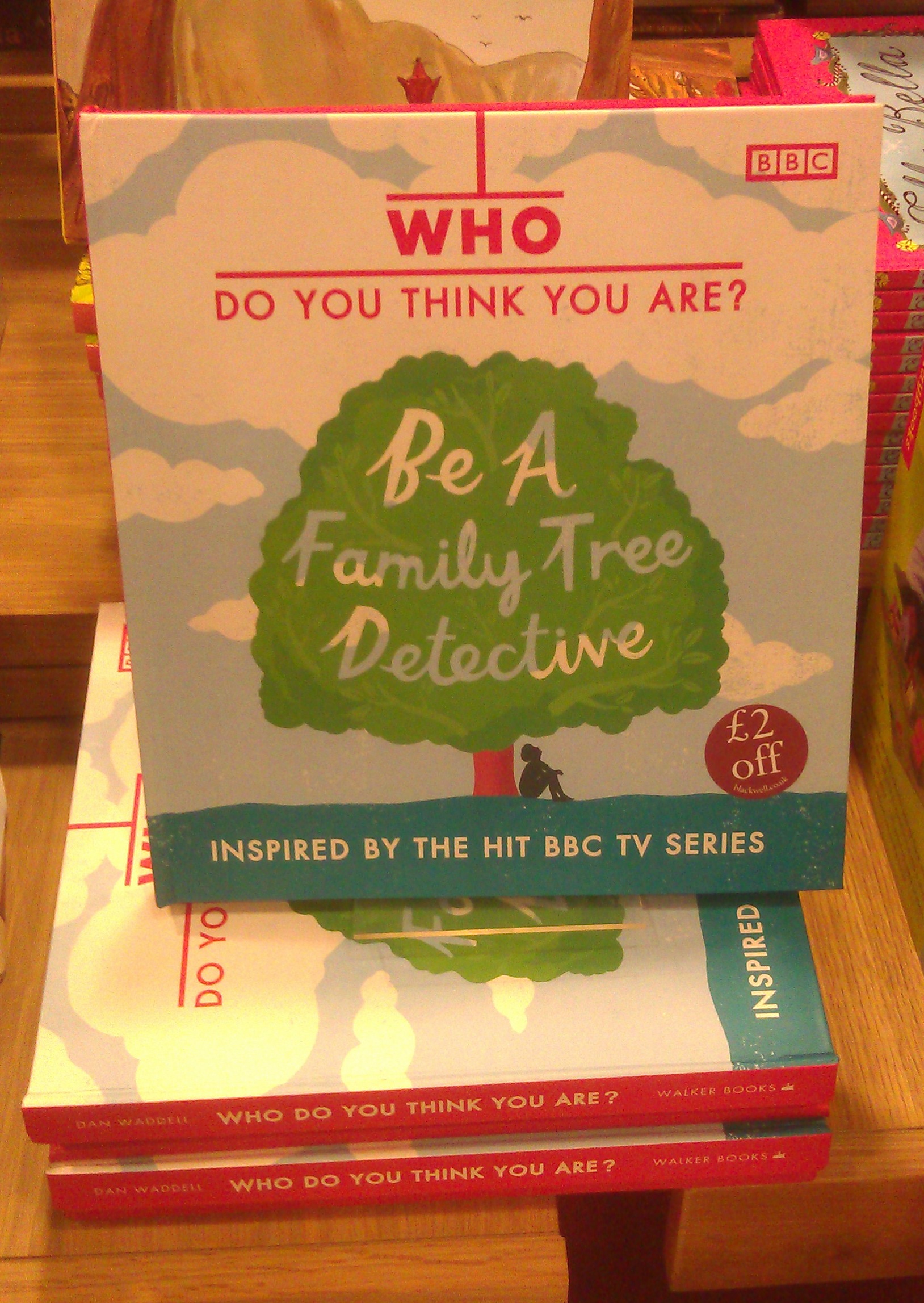
I was in Cambridge earlier today, picking up a few last minute Christmas presents when I spotted the following book from the Who Do You Think You Are? brand. I generally don’t buy genealogy books, as I rely on online information, but this one was different – it was aimed at children.
Be A Family Tree Detective
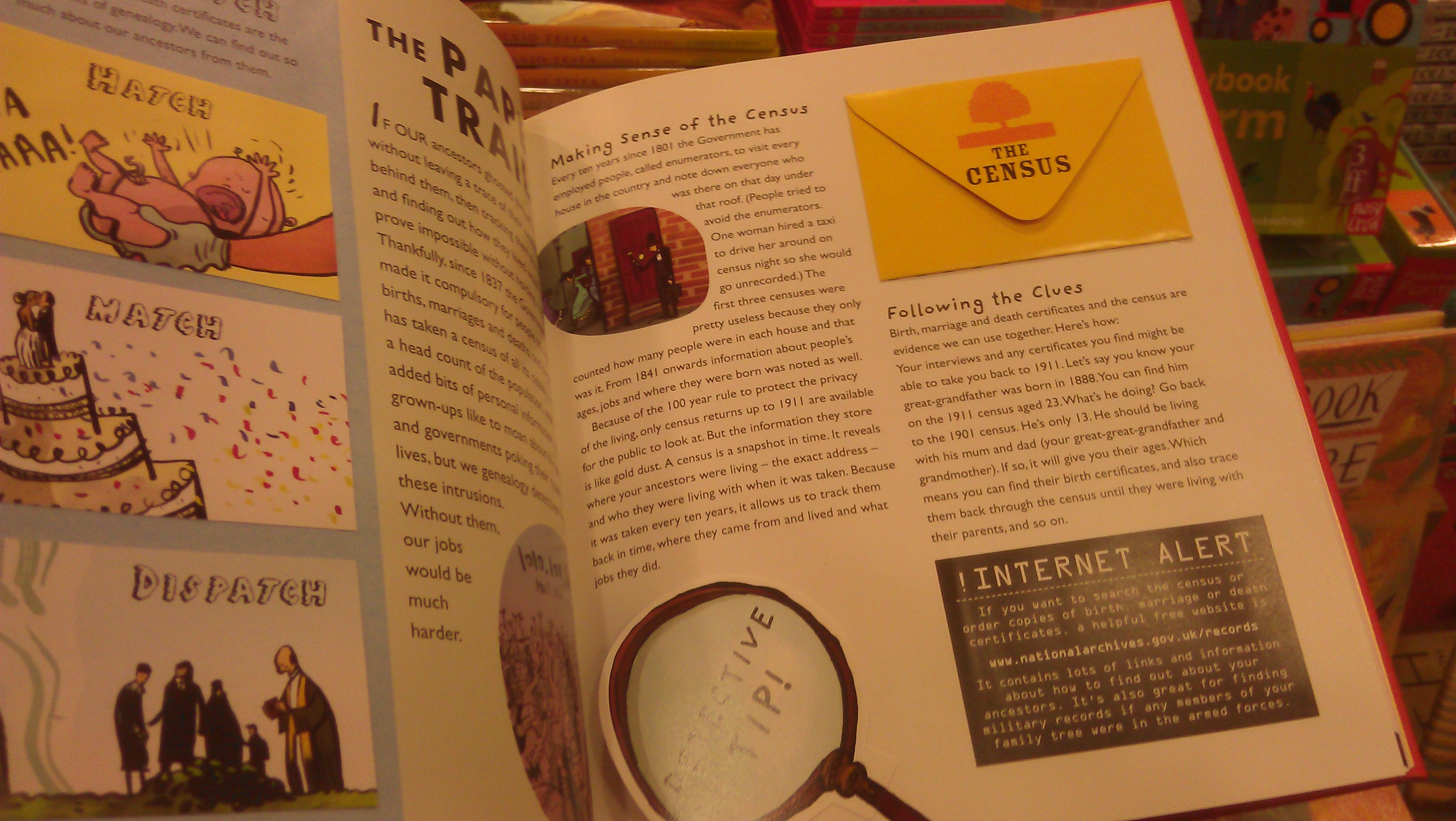
I picked it up and flicked through, to find that it was full of colourful pictures, flaps to reveal information, and more along the lines of a pop-up book (without the pop-up bit).
Inside the book – open the envelope to look at Census, lift the magnifying glass to reveal a tip.
I wondered what it was that inspired me to start (although admittedly i was 16/17yrs old) – knowing that it wasn’t anything like this. Had it have been, i would most likely have been hooked and written down the stories (or at least listened and perhaps remembered some of them) at a much younger age.
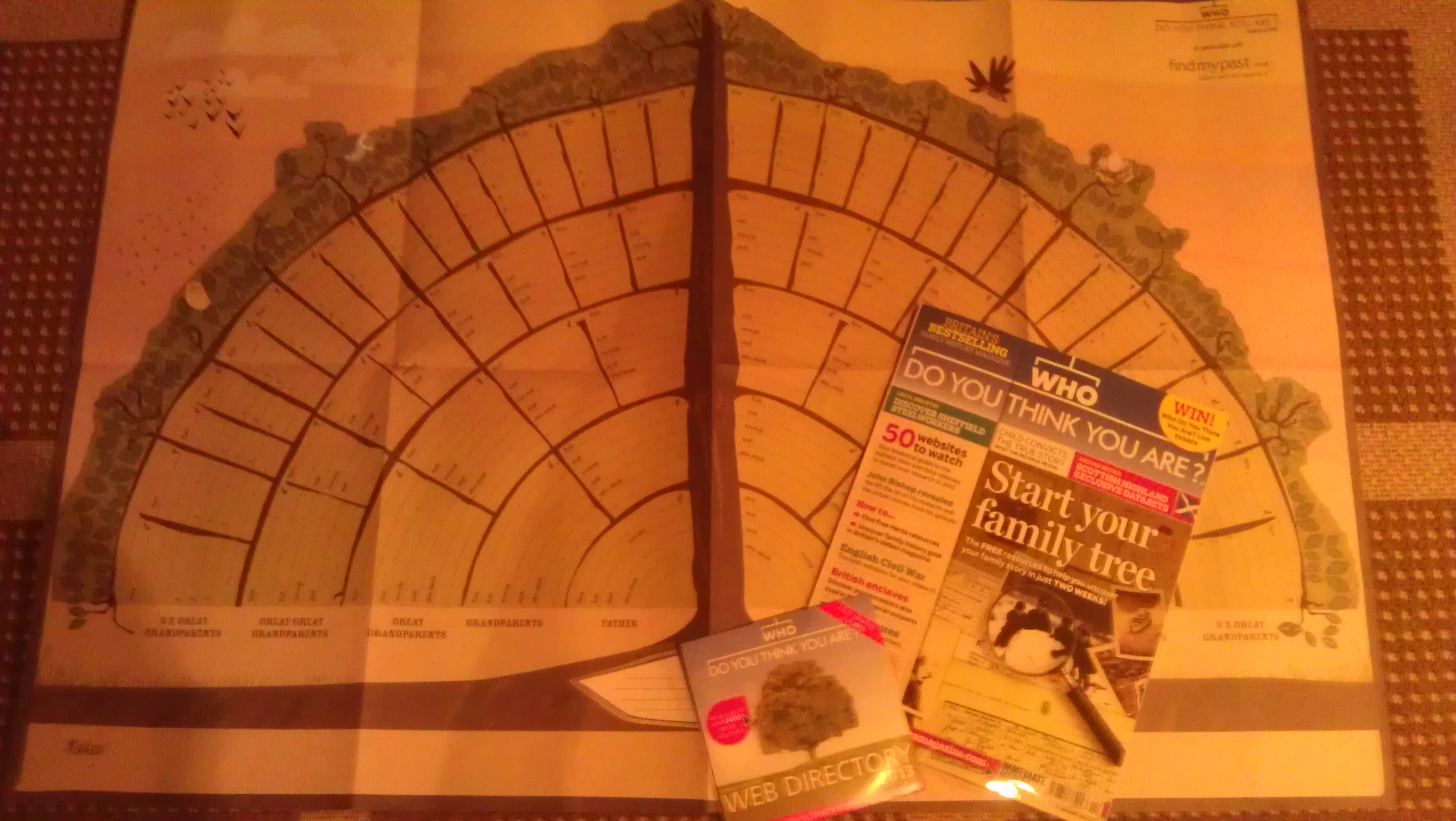
I also got home to find that Who Do You Think You Are? magazine had also landed on my doormat – the January edition – and inside was a great tree chart from FindMyPast – encouraging people to fill in their ancestors. What a great way to help inspire kids to think about the past lives of their family?
The free FindMyPast tree chart with the January 2013 edition of Who Do You Think You Are? magazine.



 History Repeating